How to forecast cash flow by tracking balances, income and expenses

A cash flow forecast gives you a forward view of when money is expected to enter and leave your business. For short-term planning, cash flow forecasting for a small business can cover 4 to 13 weeks, with each period’s closing balance carried forward as the next period’s opening balance.
Sales and expenses tell only part of the story. Timing matters too. A profitable month can still bring a cash squeeze if customer payments arrive after bills are due. This guide explains how to build and maintain a cash flow forecast for a small business by tracking balances, expected income and expenses, spotting potential shortfalls, and choosing tools that fit your bookkeeping routine.
You’ll also learn how to account for seasonal changes, payment delays, and Canadian tax obligations when estimating cash needs. A forecast gives you a clearer view of what may lie ahead, so you can make informed decisions before a tight balance becomes urgent.
Key Takeaways
- Choose a forecast period that fits your cash cycle, then update it as payment timing and estimates change.
- Track cash when it is expected to reach or leave your bank account, not simply when a sale or bill is recorded.
- Test how late customer payments and large purchases could affect your projected balance before committing to spending.
- Include Canadian tax obligations, annual bills and seasonal shifts when estimating upcoming expenses.
- Use a spreadsheet or accounting software to revise projections and spot possible shortfalls early.
What is a Cash Flow Forecast?
A cash flow forecast estimates when money will enter and leave your business, then projects the balance ahead. For cash flow forecasting for a small business, plan a rolling 12 months, review it every 2 to 3 months, and update sooner when circumstances change.
A short-term forecast can cover 4 to 13 weeks; make sure your forecast spans at least your cash cycle, the time between making a sale and receiving payment.
-
Plan for late payments and large purchases
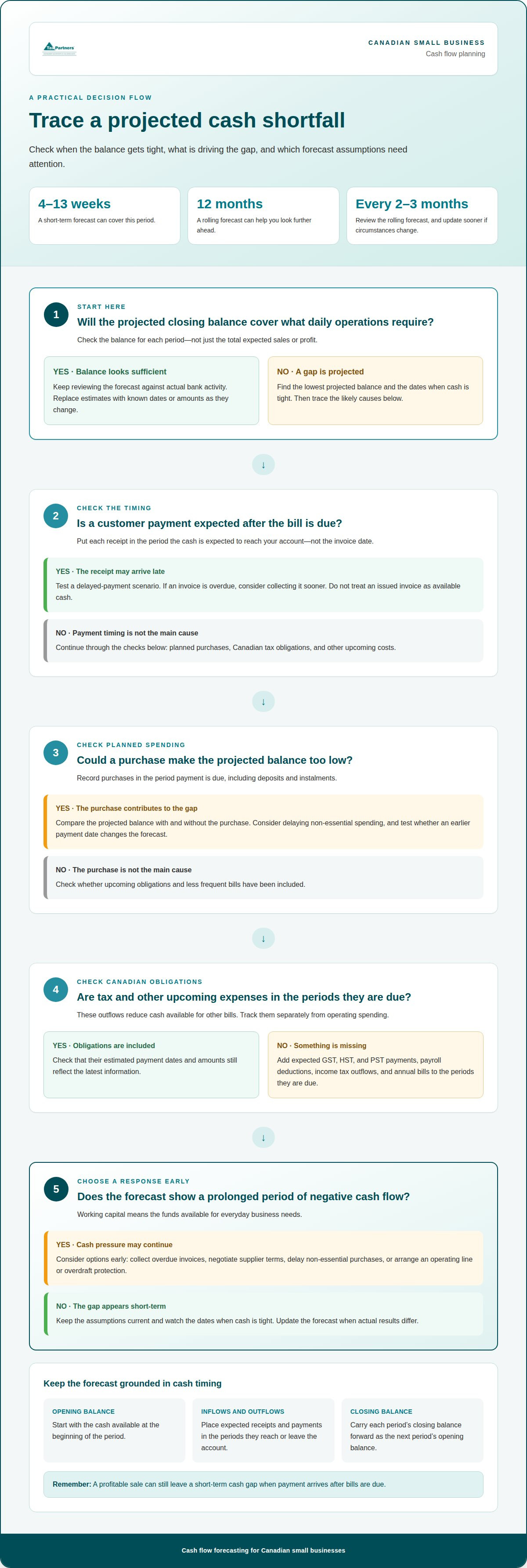
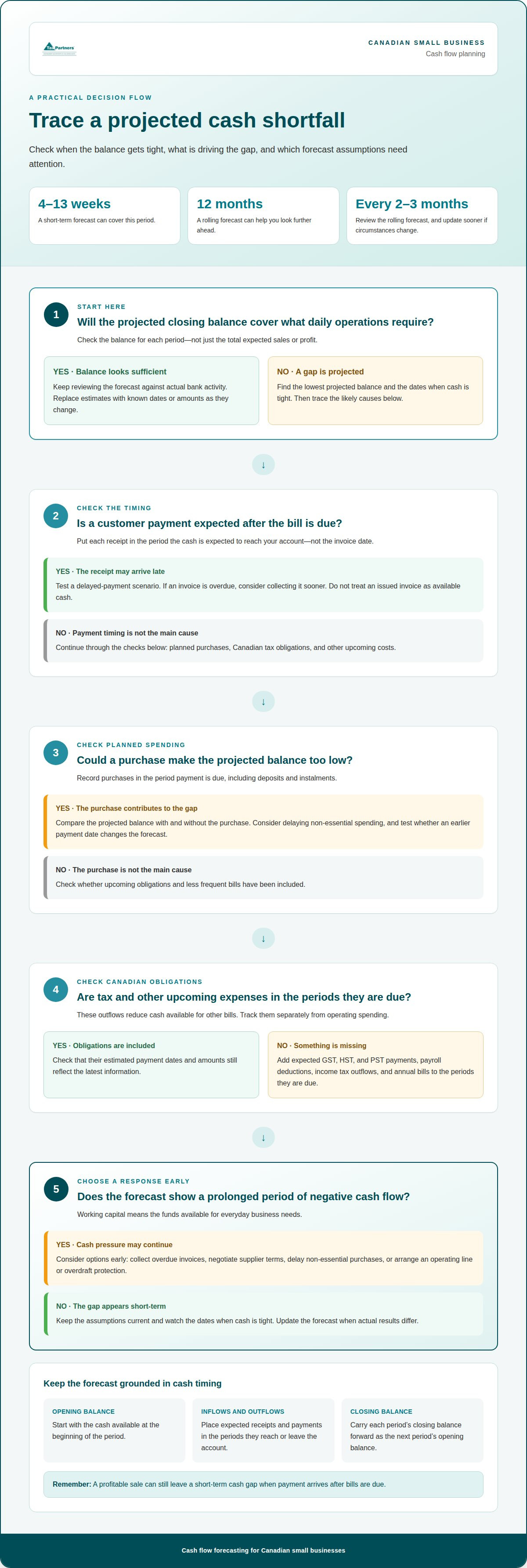
List each expected customer payment by its likely arrival date, not its invoice date. If customers pay in 30, 60, or 90 days, place each receipt in the period when the cash is expected to reach your account.
Enter planned purchases in the period payment is due, including deposits and instalments. Compare the projected balance with and without the purchase, and test a delayed-payment scenario in your spreadsheet. Don’t treat an issued invoice as available cash.
-
Compare best-case and worst-case scenarios
Create separate best-case and worst-case versions of the forecast. In the best case, use realistic payment dates and sales assumptions. In the worst case, delay a customer receipt and include a large purchase earlier than planned.
Compare the projected closing balances in each version. This shows how much room remains if cash inflows arrive late, and whether a purchase could push the balance below what daily operations require. Revise your assumptions when orders, payment patterns, or supplier costs change.
-
Anticipate cash needs and forecasting risks
Identify the lowest projected balance and the dates when cash is tight. A prolonged period of negative cash flow can strain working capital, the funds available for everyday needs. Consider options early, such as collecting overdue invoices, negotiating supplier terms, delaying non-essential purchases, or arranging an operating line or overdraft protection.
For Canadian forecasts, include expected goods and services tax (GST), harmonized sales tax (HST), and provincial sales tax (PST) payments, payroll deductions, and income tax outflows in the periods they’re due. These obligations reduce cash available for other bills, so track them separately from operating spending.
Common mistakes include recording sales before payment arrives, overlooking annual bills, and relying on outdated estimates. A new business can use projected sales, supplier costs, overhead, and payment terms even without historical records. Forecasts become less reliable further into the future, so update them when actual results differ. Cash flow isn’t the same as profit: a profitable sale may still leave a short-term cash gap.
Cash flow forecasting tools and accounting software
Choose a forecasting method that fits your records and the decisions you need to make. A spreadsheet can work well for a straightforward forecast, while accounting software can help organize transactions and provide information for regular updates.
- Start with a spreadsheet you can maintain. Set up columns for each week or month, then rows for opening balance, cash inflows, cash outflows, and closing balance. In Microsoft Excel, formulas can recalculate the forecast when you update an income or spending estimate. Add a notes column to explain assumptions, such as a customer payment expected after the invoice date.
Keep the layout easy to review. Separate recurring costs from one-time purchases, and label each estimate with its expected payment date. An organized spreadsheet helps you see which assumptions changed instead of relying on a total that hides the details.
- Use accounting software as a source of current records. Review the available reports and transaction data, then bring relevant figures into your forecast. Check how the software handles bank activity, invoices, payroll, and supplier bills before relying on it. An accounting record may show an invoice, but your forecast still needs the date cash is expected to arrive.
Review integrations or data transfers before using them. Confirm that imported transactions cover the accounts and periods you need, and watch for duplicates or missing entries. For example, compare a bank transaction list with recorded customer receipts before adjusting projected cash inflows.
- Build a repeatable update routine. At each review, compare the forecast with actual bank activity and accounting records. Replace estimates with known dates or amounts, explain significant differences, and carry updated assumptions into later periods. This helps you predict cash needs using current information instead of an outdated snapshot.
Assign responsibility for each input. The person tracking customer payments can update expected receipts, while the person overseeing payroll can flag upcoming outflows. A coordinated spreadsheet or shared accounting workflow helps prevent conflicting versions.
- Work with an accountant when assumptions need review. Ask a qualified accountant to review how your records, payment timing, and expense categories feed into the forecast. Their perspective can help identify omitted items or unclear assumptions, especially when business activity, payroll, or reporting needs change.
Bring the current spreadsheet or accounting reports, a list of assumptions, and questions about uncertain entries. If maintaining the records and forecast is taking time away from running the business, discuss accounting support as a practical next step.
Identifying cash shortfalls and upcoming expenses
Use the forecast to identify when available cash may fall below what your business needs to operate. Then connect each projected gap to specific receipts, bills, and decisions you can act on.
- Mark the lowest projected balance and its date. Review each forecast period and flag when cash is tightest. Compare that balance with payments due for suppliers, rent, payroll, and other operating needs.
Check the expected timing behind each entry. A client’s late payment can create a shortage before a profitable sale turns into cash, while a large supplier bill may be due before revenue arrives. Record the likely payment date and update it when new information changes the estimate.
- List expenses that don’t appear in routine monthly totals. Add annual bills, seasonal costs, planned equipment purchases, and tax obligations to the periods when payment is expected. For a Canadian business, include GST, HST, and PST obligations in projected cash outflows.
Separate essential costs from spending you could defer. For example, if a planned equipment purchase coincides with a slower sales period, compare the forecast with and without the purchase. This reveals whether its timing, rather than its total cost, creates pressure on available cash.
- Choose a response before the shortfall arrives. If the forecast shows a gap, follow up on overdue invoices and contact customers about outstanding payments. You can also discuss supplier terms, postpone non-essential purchases, adjust hiring dates, or arrange financing to address the timing mismatch.
Match each action to the cause. Following up on a late client payment may help if receivables are delayed; changing a purchase date may help if a one-time expense is responsible. Record the action in the forecast, then compare the revised projection with the original.
- Compare forecast results with actual activity. At each review, check projected revenue and expenses against bank activity and accounting records. Note which assumptions were inaccurate, such as a customer paying later than expected or a seasonal sales period generating less cash.
Use those differences to refine future estimates. If sales repeatedly arrive later than planned, shift expected receipts to more realistic dates. If an expense recurs, include it in the relevant periods instead of treating it as unexpected.
A cash flow forecast can help a business respond to an anticipated shortfall by following up on overdue invoices, negotiating supplier terms, delaying non-essential purchases, arranging financing, or adjusting hiring dates.
When preparing a cash flow forecast, businesses should account for GST, HST, and PST obligations in the periods they’re due.
Tracking opening balances, inflows, outflows, and closing balances
Build each forecast period from the cash available at its start, then track expected receipts and payments. A small business can create a forecast step by step using bank records, sales estimates, bills, and payment dates.
-
Gather forecast information and documents
Gather current bank balances, customer invoices, sales estimates, supplier bills, payroll records, and tax payment details. Add annual bills and planned purchases so the forecast reflects more than recurring monthly expenses.
Use past records to inform estimates, but don’t assume future timing will match past results. For each sale or bill, record when cash is expected to arrive or leave the account. This gives your forecast a practical basis for tracking inflows and outflows.
-
Record opening cash balances
Enter the cash available at the start of the first forecast period, using your current bank balance as the starting figure. Keep operating accounts separate from funds that aren’t available for routine business payments.
At the end of each period, carry the closing balance forward as the next period’s opening balance. For a month-by-month forecast, this creates a running view of cash instead of separate, disconnected monthly estimates.
-
Forecast sales, expenses, taxes, and seasonal cash flow
Enter sales as inflows in the period when customers are expected to pay, not simply when you make the sale. Add expected operating costs, payroll, supplier payments, and Canadian GST, HST, or PST obligations as outflows in their expected payment periods.
Use seasonal patterns to refine estimates. For example, a gift shop may expect higher sales in November and December, followed by slower months. Include annual bills and compare seasonal revenue with expenses that continue during quieter periods.
-
Calculate net cash flow and closing balances
Subtract expected outflows from inflows to calculate net cash flow for each period. For example, a forecast with a C$3,000 opening balance, C$15,000 in sales inflows, and C$13,000 in total outflows produces C$2,000 net cash flow and a C$5,000 closing balance.
That C$13,000 in outflows could include C$1,000 for marketing, C$8,000 for raw materials, and C$4,000 for wages. Compare each forecast closing balance with the actual bank balance, then investigate differences in payment timing or estimates. Track the lowest projected balance and forecast-versus-actual differences to assess accuracy and spot changing cash needs.
Cash flow management and forecasting basics
Use forecast insights to guide operating choices, not just to monitor projected balances. The direct method estimates receipts and payments; the indirect method starts with projected earnings and adjusts for non-cash items and changes in working capital.
- Choose the method that supports your decision. A direct forecast helps you examine expected cash receipts and payments by timing. An indirect approach can help connect projected earnings with changes in working capital. For a Canadian small business deciding whether to take on a contract, the direct method can make upcoming customer and supplier cash movements easier to assess.
- Set a sales target grounded in costs and profit. Calculate the revenue needed to cover expected costs and reach your desired profit, then assess whether the target is feasible. Consider expected demand, available capacity, and the costs of delivering the work. A target that depends on unprofitable projects may increase activity without strengthening your business’s cash position.
- Prioritize work by its expected margin. Compare projects based on their revenue and the costs required to complete them. If two jobs compete for the same staff or materials, prioritize the work expected to produce the stronger margin, provided it can be delivered profitably. This helps direct limited resources toward work that better supports operating needs.
- Assess supplier terms before accepting a discount. If a supplier offers a Canadian business terms written as 2/10 net 30, the buyer can take a 2% discount by paying within 10 days; otherwise, the full invoice is due within 30 days. Compare the early payment date with other obligations before choosing the discount. It can reduce the invoice amount, but uses cash sooner.
- Turn forecast findings into assigned actions. If a project has a weak margin, review its scope or resource needs before accepting it. If supplier terms affect available working capital, discuss whether the payment schedule fits expected receipts. Assign a person to track each decision and its effect on the forecast. For help connecting cash planning with broader business decisions, discuss your cash flow planning.
Keep the forecast distinct from records and plans that serve other purposes. A cash flow forecast projects future cash movements, while a cash flow statement reports historical movements. A forecast tracks when money is expected to come in and go out, while a budget outlines planned earnings and spending over a set period. This distinction makes the forecast useful for timing decisions, rather than treating it as a record of past performance or a summary of intended spending. Record sales income in the forecast when the money is expected to reach the business’s bank account, not simply when a sale is made. That timing gives you a clearer view of cash available for upcoming obligations.
For each forecast period, calculate cash flow by subtracting net outgoings from net income. A business has negative cash flow when more money leaves its account than comes in, so review the timing and size of expected movements when a period shows a shortfall. If fluctuations are seasonal or unplanned, an operating line or overdraft protection can help manage them. Use these options to address cash timing needs while continuing to monitor expected receipts and payments and adjust operating choices as the forecast changes. A forecast based on when cash is actually expected to arrive can help you identify pressure early and make more deliberate decisions about commitments and payments.
Tax Partners: Canadian Accounting & Tax Services
Tax Partners can help when cash flow planning depends on organized bookkeeping, payroll records, and a clear view of Canadian tax obligations. Its Bookkeeping and Payroll Services can support the records behind your forecast, while Canadian Accounting & Tax Services can help you interpret the figures and plan for upcoming business needs.
Consider getting support when actual results repeatedly differ from projections, payroll or tax outflows are difficult to coordinate, or you need to connect cash decisions with broader financial planning. For a conversation about your business’s accounting needs, contact Tax Partners.
Make your forecast part of everyday decisions
Treat your forecast as a decision framework, not a document to file away. When a proposed hire, purchase, or change in customer terms could affect available cash, record the assumption and decide what evidence would prompt you to review it. That turns an estimate into a practical management tool.
Assign someone to keep projections aligned with actual transactions, and share meaningful changes with people who approve spending or manage collections. This routine can help your team respond thoughtfully as circumstances shift. A forecast is more useful when it guides decisions about timing, not just whether an expense appears affordable.
Cash flow forecasting for a small business works best when the process reflects how your company operates and the decisions you face. Tax Partners offers Canadian Accounting & Tax Services, US & Cross-Border Accounting & Tax Services, and Bookkeeping and Payroll Services. Contact Tax Partners to discuss your business’s accounting needs, and take your next planning step with greater clarity.
Frequently Asked Questions
Can a business be profitable and still run out of cash?
Yes. A business can earn a profit on paper while cash is committed elsewhere, such as inventory purchased ahead of a busy season. For example, a retailer may pay for stock before holiday sales generate receipts.
Review cash tied up in inventory and deposits alongside reported profit. This can help explain why a profitable period may still leave less money available for immediate decisions.
Who is a cash flow forecast for?
It’s useful for owners and managers responsible for approving spending or planning operations. A contractor preparing to take on a large project, for instance, can use a forecast to consider whether the work schedule and payment milestones fit the company’s commitments.
It can also help business partners discuss timing before making a shared decision. A forecast is most useful when the people who control spending and collections can act on its findings.
What are the best cash flow forecasting templates and software for Canadian small businesses?
The best choice is a template or program that supports the decisions your team needs to make. Look for clear assumptions, editable scenarios, and a way to compare projected results with actual outcomes.
Before adopting a tool, test it with a realistic business decision, such as changing a project start date. Choose an option your team can keep current and review together, rather than one with features you won’t use.

Article by
Mahad Mohamed
Mahad Mohamed is an accountant and the CEO of Tax Partners, with over 26+ years of Canadian and international tax and accounting experience. His expertise includes corporate reorganization, cross-border tax structuring (Canada & US), tax disputes, CRA audits, and tax planning for small owner-managed private corporations. Most recently, Mahad is a pioneer in Canadian crypto taxation and founded Block3 Finance.
Previously, Mahad worked for the Canada Revenue Agency (CRA), Big4 accounting firms, and served as a Rulings Officer for the Federal Tax Authority of the UAE before acquiring Tax Partners in 2014.
Tax Partners has 44 full-time accountants and over 18,400+ clients.
Disclaimer
This article provides general information only and is current as of its publication date. It has not been updated and may be out of date. It does not constitute legal advice and should not be relied upon as such. Every tax situation is unique and may differ from the examples discussed in this article. If you have specific questions, you should seek the advice of our accountants for your unique circumstances. Book a FREE Initial Consultation Today!
Frequently Asked Questions
Can a business be profitable and still run out of cash?
Yes. A business can earn a profit on paper while cash is committed elsewhere, such as inventory purchased ahead of a busy season. For example, a retailer may pay for stock before holiday sales generate receipts. Review cash tied up in inventory and deposits alongside reported profit. This can help explain why a profitable period may still leave less money available for immediate decisions.
Who is a cash flow forecast for?
It’s useful for owners and managers responsible for approving spending or planning operations. A contractor preparing to take on a large project, for instance, can use a forecast to consider whether the work schedule and payment milestones fit the company’s commitments. It can also help business partners discuss timing before making a shared decision. A forecast is most useful when the people who control spending and collections can act on its findings.
What are the best cash flow forecasting templates and software for Canadian small businesses?
The best choice is a template or program that supports the decisions your team needs to make. Look for clear assumptions, editable scenarios, and a way to compare projected results with actual outcomes. Before adopting a tool, test it with a realistic business decision, such as changing a project start date. Choose an option your team can keep current and review together, rather than one with features you won’t use.