401(k) or RRSP in Canada: How Contributions and Taxes Compare

If you’re asking, “can I contribute to a 401k while living in Canada?” the answer is yes, if you work for a US employer that sponsors a plan and you meet its eligibility terms. Your nationality alone doesn’t determine access. The employer’s plan does.
Comparing a 401(k) with an RRSP means looking beyond eligibility. The question “can I contribute to a 401k while living in Canada?” is only the starting point: contribution rules and Canadian tax treatment also shape how each account fits your retirement plan. This guide explains how the limits compare and how Canadian tax residency can affect 401(k) earnings and withdrawals, so you can assess the cross-border considerations before making decisions.
Key Takeaways
- Learn what determines whether you can join a 401(k) while living in Canada, and how your employer’s plan affects eligibility.
- Compare how 401(k) contributions and RRSP contribution room work before deciding how to allocate retirement savings.
- Understand how Canadian tax residency can affect investment growth and withdrawals from a US retirement account.
- See which reporting and withdrawal considerations can shape your cross-border retirement plan.
- Use the decision guide to identify when tailored Canadian and cross-border tax advice may help.
Tax treatment of 401(k) earnings and withdrawals in Canada
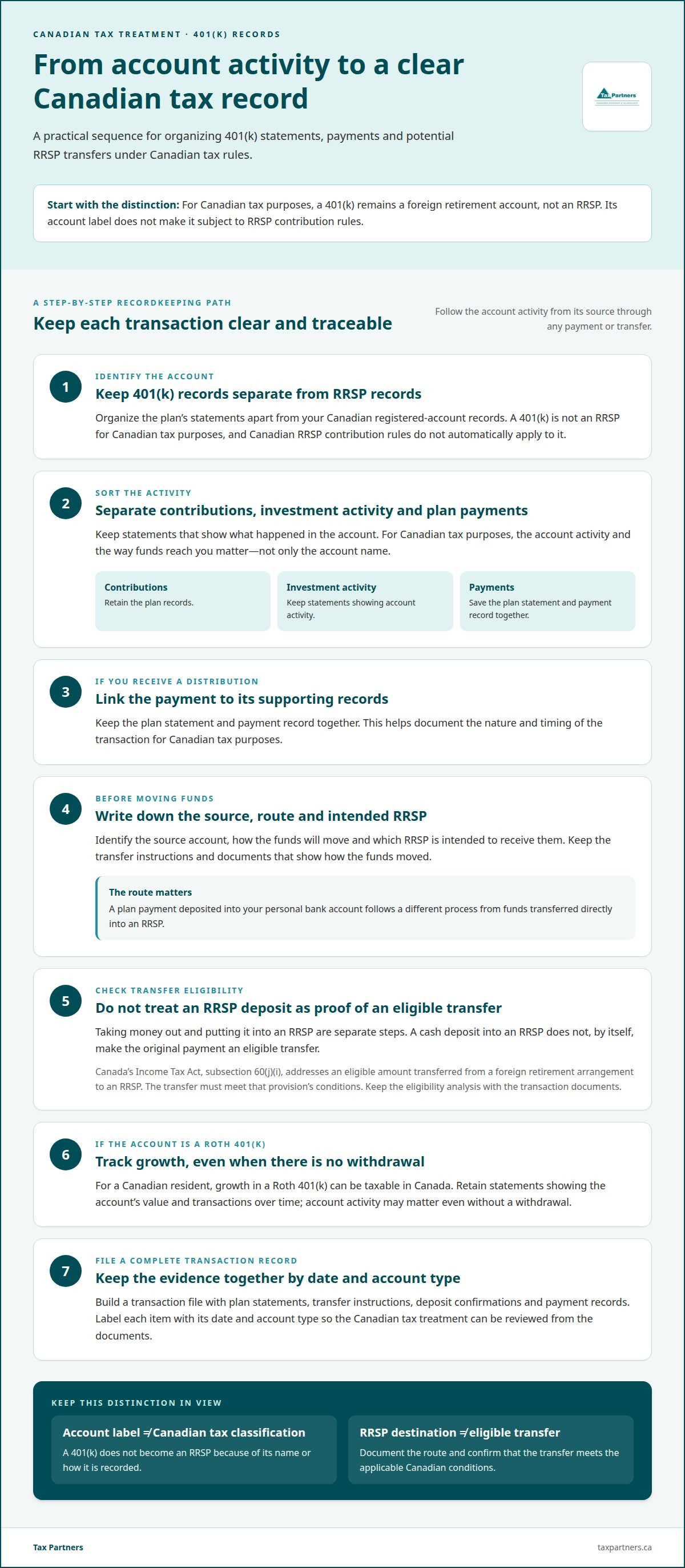
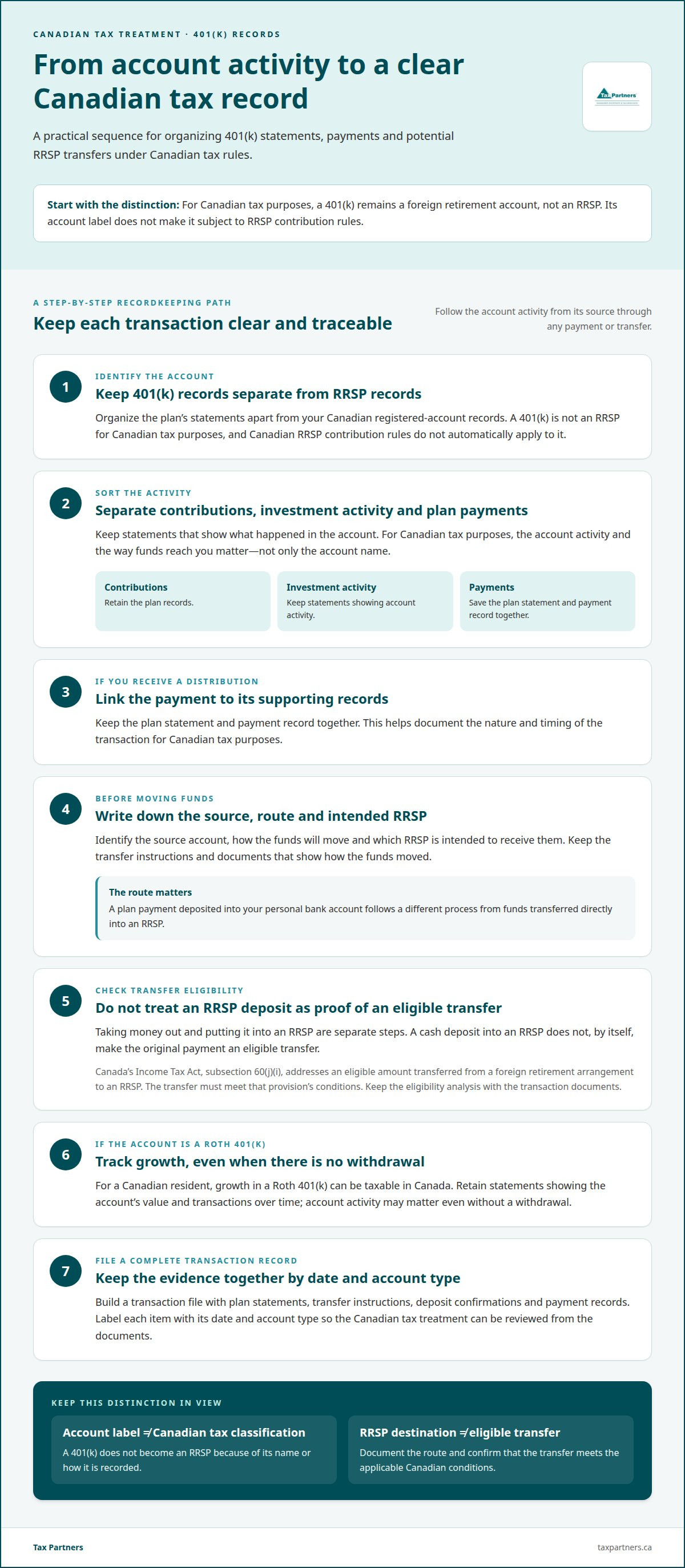
For Canadian tax purposes, a 401(k) remains a foreign retirement account, not an RRSP. Its account label does not make it subject to RRSP contribution rules or give contributions the same treatment as Canadian contributions. Separate the plan’s account records from your Canadian registered-account records when organizing retirement documents.
Canadian tax treatment depends on the account activity and how funds reach you. Keep statements that distinguish contributions, investment activity, and plan payments. If you receive a distribution, retain the plan statement and payment record together. This helps document the transaction’s nature and timing for Canadian tax purposes.
Taking money out and putting it into an RRSP are separate steps. A cash deposit into an RRSP does not, by itself, make the original payment an eligible transfer. Under Canada’s Income Tax Act, subsection 60(j)(i) addresses an eligible amount transferred from a foreign retirement arrangement to an RRSP. The transfer must meet that provision’s conditions.
Before moving funds, identify the source account, transfer route, and intended receiving RRSP. Keep documents showing how the funds moved and how the transaction was classified. For example, a plan payment deposited into your personal bank account follows a different process from funds transferred directly into an RRSP. The records help establish which transaction took place.
Roth 401(k) growth also requires Canadian consideration. For a Canadian resident, growth in a Roth 401(k) can be taxable in Canada, so account activity may matter even without a withdrawal. Retain statements that show the account’s value and transactions over time. This makes it easier to review how the Canadian tax treatment applies to the account.
Keep a transaction file with plan statements, transfer instructions, deposit confirmations, and payment records. Label each item with its date and account type. If you are considering a transfer, keep the eligibility analysis with the transaction documents. This helps distinguish an eligible transfer from a withdrawal followed by an RRSP contribution.
For Canadian tax treatment and reporting, organize the records before preparing your return or changing the account. The key is to identify what the transaction represents under Canadian rules, rather than relying on the account’s name or the destination of the funds.
Canadian tax residency and 401(k) taxation
Your Canadian tax residency status determines how your income and financial records are considered for Canadian tax purposes. According to the Canada Revenue Agency, spending 183 or more days in Canada generally makes a person a deemed Canadian resident. Keep a calendar of your time in Canada and the dates your living arrangements change.
For a 401(k) holder, the residency timeline helps organize account activity for Canadian reporting. Note when you became a Canadian tax resident, then file account statements by tax year. This gives you a record to use when reviewing contributions, investment activity, and payments received while resident in Canada.
Keep separate records of the account balance and any money paid out. An account activity statement can help distinguish a change in value from a distribution you received. Record the payment date and gross amount, then retain the related statement and deposit confirmation with your Canadian tax documents.
For example, if you move to Canada during a tax year, note the move date and organize subsequent account documents accordingly. The timeline does not replace account statements. Together, the dates and statements clarify which activity took place while you were a Canadian resident.
Use a consistent filing system for each Canadian tax year. Store residency records, plan statements, payment confirmations, and tax documents together. If the account has different types of transactions, label each record clearly. This makes it easier to explain what happened when preparing a Canadian return or reviewing a past year.
Your residency status can also affect future retirement-savings decisions. Before changing an account, record what you intend to do and the Canadian tax year involved. Keep the resulting paperwork with the original statements. This documents your decision and its timing, rather than leaving you to rely on memory later.
A move to Canada, a return, or a change in living arrangements is a useful time to review your records. Compare your residency timeline with account statements and payments received, then organize any outstanding Canadian tax documents. This helps keep your Canadian reporting clear as your circumstances change.
If a change in your Canadian residency affects how you organize or report retirement-account activity, discuss your Canadian tax residency and reporting questions.
Cross-border financial and tax advice
For Canadian tax planning, consider a foreign retirement account alongside your Canadian income, savings, and future cash needs. Start by gathering account statements, transaction histories, and records of payments received. Organizing these by account and tax year helps identify the information needed for a Canadian review.
Next, build a clear profile of the account. Record its type, ownership, current balance, investment mix, and any restrictions described in its documents. Note whether it holds traditional or Roth-labelled funds, since Canadian tax treatment can differ. This is a more useful starting point than looking only at the account’s total value.
Consider how the account fits your expected retirement income. List other income sources, planned withdrawals, and the timing of major expenses. For example, if you expect income from several sources, map when each may become available and consider how that sequence affects Canadian cash-flow planning. Avoid basing your plan solely on recent investment performance.
Canadian advice should consider how account decisions affect your broader finances. A proposed withdrawal, transfer, or investment change can affect available funds and future income. Before acting, record the purpose of each proposed change and compare it with your long-term goals. Keep the supporting account documents with your decision notes.
A practical review can cover these areas:
- Account ownership, type, and investment holdings.
- Transaction records and payments received during each Canadian tax year.
- Planned retirement income and expected cash needs.
- How a proposed account change fits your wider Canadian financial plan.
Use the review to identify questions that need Canadian tax analysis, rather than assuming the account’s label determines its treatment. For example, a Roth designation alone does not settle how the account’s growth is treated for Canadian tax purposes. Keep the account documents and transaction history together so the analysis reflects actual activity.
When financial planning and Canadian tax reporting intersect, consider the account as part of your wider retirement strategy. The goal is to understand how each decision affects your Canadian financial position, rather than treating the retirement account as an isolated investment. Organized records of holdings, transactions, and intended actions make the discussion more focused and useful.
What risks or reporting requirements apply to 401(k) accounts for Canadian residents?
Canadian tax residency brings reporting responsibilities that continue beyond Canadian accounts. Once you become a Canadian tax resident, Canada requires you to report worldwide income, including income from 401(k) withdrawals. A distribution can therefore affect your Canadian tax return even if the plan remains in the United States.
Keep clear records for each account and transaction. Save plan statements, distribution confirmations, and documents showing any tax withheld. For every withdrawal, note its date, gross amount, account type, and amount received. These records help distinguish a payment from investment activity and support accurate Canadian reporting.
Timing matters too. A withdrawal received during a particular Canadian tax year belongs in the records for that year. For example, if a 401(k) payment arrives after you become a Canadian tax resident, document the payment date and residency timeline together. That context helps connect the account transaction with the correct Canadian tax return.
Required minimum distributions create a separate timing risk under US rules. Failing to take a required minimum distribution on time can result in a 50% penalty tax. Treat the plan’s distribution schedule as a distinct obligation, and keep evidence of each required payment and its completion date.
Do not assume that a Canadian reporting position removes a US plan requirement, or that completing a US distribution settles your Canadian reporting. The two countries’ rules address different obligations. A useful review separates the account’s distribution schedule, any US tax withheld, and the amount to report in Canada.
Use a simple annual file to keep these records together:
- Store year-end 401(k) statements and transaction confirmations.
- Record each withdrawal’s gross amount, payment date, and tax withheld.
- Keep the plan’s required distribution notices with proof of completed payments.
- Match account activity to the Canadian tax year and your residency timeline.
This process can also help you spot inconsistencies before filing. For example, a plan statement may show a gross distribution while your bank record shows only the net deposit. Keeping both documents makes the difference clear and provides a better audit trail for Canadian tax reporting.
Review your file whenever you change residency, receive a distribution, or approach a required payment date under US rules. Consistent records of account type, payment timing, and tax withheld help you manage Canadian reporting while keeping the plan’s separate US obligations in view.
401(K) participation while living in Canada
Yes, a Canadian resident can participate in a 401(k) if they work for a US employer that sponsors the plan. Eligibility depends on the employer’s offering, not the employee’s nationality. So, can I contribute to a 401(k) while living in Canada? The key starting point is whether your employer’s plan allows you to join.
If you live and work only in Canada, you can’t open a 401(k) without working for a US employer that sponsors one. Living near the border or being a US citizen alone doesn’t establish access. The employer and its plan determine whether an eligible worker can enrol and make contributions.
Start with the plan documents or enrolment materials. Find out who can participate, how contributions are made, whether the employer offers a match, and what happens if your employment changes. These details shape the practical value of joining. The plan’s contribution conditions may differ from the rules governing your Canadian savings.
Compare the 401(k) with your Canadian RRSP using separate contribution calculations. According to the Canada Revenue Agency, the Canadian RRSP contribution limit is 18% of the previous year’s earned income, up to the annual maximum. The Canadian maximum is C$33,810 for 2026. Your available room may also include unused contribution room carried forward from earlier years.
That comparison matters because a 401(k) contribution doesn’t create RRSP contribution room. A newcomer who has little Canadian earned income history may have limited RRSP room, even if their US employer offers a 401(k). Conversely, a Canadian worker with available RRSP room should compare both options alongside any employer match and the account’s tax treatment in Canada.
Before enrolling, record the decision factors and keep the relevant documents together:
- Confirm your US employer sponsors a 401(k) and review its participation conditions.
- Record the employer match and how your contribution is calculated under the plan.
- Check your Canadian RRSP room separately from your 401(k) contributions.
- Keep plan statements and contribution records for Canadian tax reporting.
For example, a Canadian resident working remotely for a US employer may have access if that employer sponsors a plan and permits participation. A neighbour working only for a Canadian employer doesn’t gain 401(k) access solely by living close to the border. The difference is the employer-sponsored plan, not where either person lives.
Use the plan’s eligibility terms, employer match, Canadian RRSP room, and Canadian tax treatment to guide your choice. If you’re weighing a US workplace plan against Canadian retirement savings, discuss your 401(k) and RRSP contribution planning.
Tax Partners: Canadian Accounting & Tax Services
Tax Partners can help you assess how a US 401(k) fits with Canadian tax obligations and retirement planning. Its US & Cross-Border Accounting & Tax Services address situations involving accounts, income, and filings across the border.
For questions about Canadian reporting and RRSP considerations, turn to Canadian Accounting & Tax Services. If you are aligning retirement savings with broader financial goals, Wealth Management & Financial Planning can support that planning. Bookkeeping and Payroll Services can help organize relevant financial records.
Bring your account statements, contribution history, and any withdrawal records to frame the discussion. Contact Tax Partners to discuss your cross-border tax and retirement planning.
Make your next retirement decision with clarity
Your next step is to turn the information about your accounts into a practical plan. Before changing contributions or moving funds, gather your plan documents, account statements, and Canadian tax records. These are a useful starting point for weighing each decision against your future income needs.
If you’re still asking whether you can contribute to a 401(k) while living in Canada, focus first on your employer’s plan terms and your own cross-border circumstances. A decision that suits one person may not fit another’s residency history, account structure, or retirement timeline.
Tax Partners offers Canadian Accounting & Tax Services, US & Cross-Border Accounting & Tax Services, and Bookkeeping and Payroll Services. For help connecting your records and retirement decisions, contact Tax Partners to discuss cross-border advice.
An organized plan can make your next decision easier. Take it one step at a time, keeping your records and long-term goals in view.
Frequently Asked Questions
What is a 401(k) in Canada?
A 401(k) is a US employer-sponsored retirement plan, not a Canadian registered account. A Canadian resident may hold one through an eligible US employer, but the account remains subject to its plan’s terms. For example, a Canadian employee working for a US company may have access if that company sponsors a plan. Canadian tax treatment is a separate consideration from the account’s US plan rules.
Can I keep my 401(k) if I leave the U.S.?
Yes, you may be able to keep your 401(k) after leaving the United States. Depending on the plan, an administrator may require you to move the account into an IRA or another employer’s 401(k). A Roth 401(k) does not automatically have to move to a different account when you return to Canada. Review plan terms before changing jobs or relocating, and keep statements showing the account’s status.
How is Canadian tax residency determined, and how does it affect your 401(k)?
According to the Canada Revenue Agency, spending 183 or more days in Canada generally makes a person a deemed Canadian resident. Canadian residents report worldwide income, including 401(k) withdrawals. A practical step is to keep a travel-day record and note when your Canadian residency begins. Pair that timeline with plan statements so you can distinguish account activity before and during Canadian residency.
What should I consider before contributing to a 401(k)?
Consider your employer’s plan terms, any available match, your Canadian retirement savings, and the account’s tax treatment in Canada. For example, a match may affect how much you choose to contribute, while limited RRSP room may shape your Canadian savings options. Compare the choices together rather than assuming a 401(k) contribution creates RRSP room or receives identical tax treatment.
What is a 401(k) plan?
A 401(k) plan is a workplace retirement arrangement sponsored by a US employer. The plan sets participation and contribution terms, and may include an employer match. Employee contributions and employer contributions are recorded in the plan account. For someone living in Canada, the plan’s US rules govern participation, while Canadian residency can affect how account income and withdrawals are reported in Canada.
Can a U.S. employer let an employee living in Canada contribute to a 401(k)?
Yes, a US employer can allow an employee living in Canada to participate if it sponsors a 401(k) and the employee meets the plan’s eligibility terms. The employee’s nationality alone does not determine eligibility. For example, a Canadian resident working for a US employer may be eligible if that employer’s plan covers them. The plan’s enrolment rules and payroll arrangements determine the practical steps.
Can a Canadian resident contribute to a U.S. 401(k) without U.S. earned income?
Living in Canada does not, by itself, provide access to a US 401(k). Participation generally depends on working for a US employer that sponsors a plan and meeting its eligibility conditions. A person working only for a Canadian employer cannot open a 401(k) solely because they want one. The key distinction is employer-sponsored plan access, not Canadian residency or nationality alone.
How do employee and employer 401(k) contributions work for someone living in Canada?
Employee contributions are made through the employer’s plan, following its contribution process. The employer may also contribute a match if the plan offers one. Plan documents explain how contributions are calculated and recorded. For Canadian tax purposes, retain pay records and plan statements that distinguish employee contributions, employer contributions, and later withdrawals. These records help you track account activity without treating it as RRSP contribution room.

Article by
Mahad Mohamed
Mahad Mohamed is an accountant and the CEO of Tax Partners, with over 26+ years of Canadian and international tax and accounting experience. His expertise includes corporate reorganization, cross-border tax structuring (Canada & US), tax disputes, CRA audits, and tax planning for small owner-managed private corporations. Most recently, Mahad is a pioneer in Canadian crypto taxation and founded Block3 Finance.
Previously, Mahad worked for the Canada Revenue Agency (CRA), Big4 accounting firms, and served as a Rulings Officer for the Federal Tax Authority of the UAE before acquiring Tax Partners in 2014.
Tax Partners has 44 full-time accountants and over 18,400+ clients.
Disclaimer
This article provides general information only and is current as of its publication date. It has not been updated and may be out of date. It does not constitute legal advice and should not be relied upon as such. Every tax situation is unique and may differ from the examples discussed in this article. If you have specific questions, you should seek the advice of our accountants for your unique circumstances. Book a FREE Initial Consultation Today!
Frequently Asked Questions
What is a 401(k) in Canada?
A 401(k) is a US employer-sponsored retirement plan, not a Canadian registered account. A Canadian resident may hold one through an eligible US employer, but the account remains subject to its plan’s terms. For example, a Canadian employee working for a US company may have access if that company sponsors a plan. Canadian tax treatment is a separate consideration from the account’s US plan rules.
Can I keep my 401(k) if I leave the U.S.?
Yes, you may be able to keep your 401(k) after leaving the United States. Depending on the plan, an administrator may require you to move the account into an IRA or another employer’s 401(k). A Roth 401(k) does not automatically have to move to a different account when you return to Canada. Review plan terms before changing jobs or relocating, and keep statements showing the account’s status.
How is Canadian tax residency determined, and how does it affect your 401(k)?
According to the Canada Revenue Agency, spending 183 or more days in Canada generally makes a person a deemed Canadian resident. Canadian residents report worldwide income, including 401(k) withdrawals. A practical step is to keep a travel-day record and note when your Canadian residency begins. Pair that timeline with plan statements so you can distinguish account activity before and during Canadian residency.
What should I consider before contributing to a 401(k)?
Consider your employer’s plan terms, any available match, your Canadian retirement savings, and the account’s tax treatment in Canada. For example, a match may affect how much you choose to contribute, while limited RRSP room may shape your Canadian savings options. Compare the choices together rather than assuming a 401(k) contribution creates RRSP room or receives identical tax treatment.
What is a 401(k) plan?
A 401(k) plan is a workplace retirement arrangement sponsored by a US employer. The plan sets participation and contribution terms, and may include an employer match. Employee contributions and employer contributions are recorded in the plan account. For someone living in Canada, the plan’s US rules govern participation, while Canadian residency can affect how account income and withdrawals are reported in Canada.
Can a U.S. employer let an employee living in Canada contribute to a 401(k)?
Yes, a US employer can allow an employee living in Canada to participate if it sponsors a 401(k) and the employee meets the plan’s eligibility terms. The employee’s nationality alone does not determine eligibility. For example, a Canadian resident working for a US employer may be eligible if that employer’s plan covers them. The plan’s enrolment rules and payroll arrangements determine the practical steps.
Can a Canadian resident contribute to a U.S. 401(k) without U.S. earned income?
Living in Canada does not, by itself, provide access to a US 401(k). Participation generally depends on working for a US employer that sponsors a plan and meeting its eligibility conditions. A person working only for a Canadian employer cannot open a 401(k) solely because they want one. The key distinction is employer-sponsored plan access, not Canadian residency or nationality alone.
How do employee and employer 401(k) contributions work for someone living in Canada?
Employee contributions are made through the employer’s plan, following its contribution process. The employer may also contribute a match if the plan offers one. Plan documents explain how contributions are calculated and recorded. For Canadian tax purposes, retain pay records and plan statements that distinguish employee contributions, employer contributions, and later withdrawals. These records help you track account activity without treating it as RRSP contribution room.