Canadian tax on US stock options and how the benefit is calculated

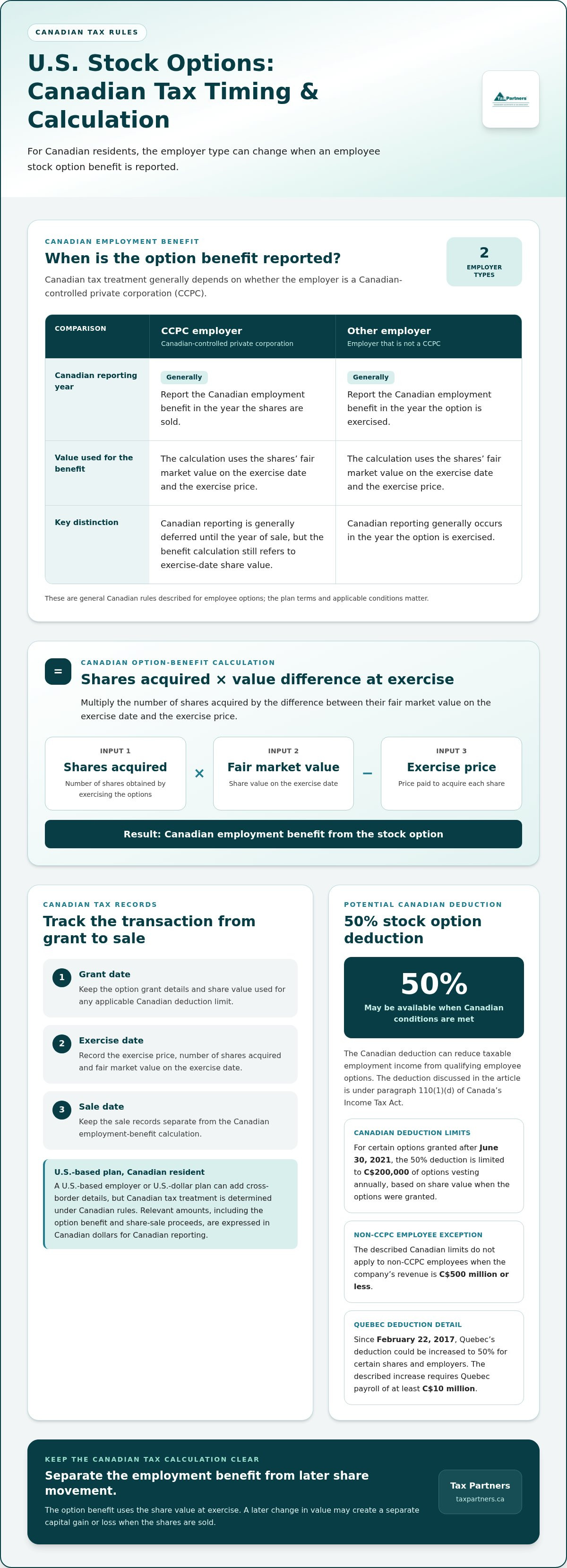
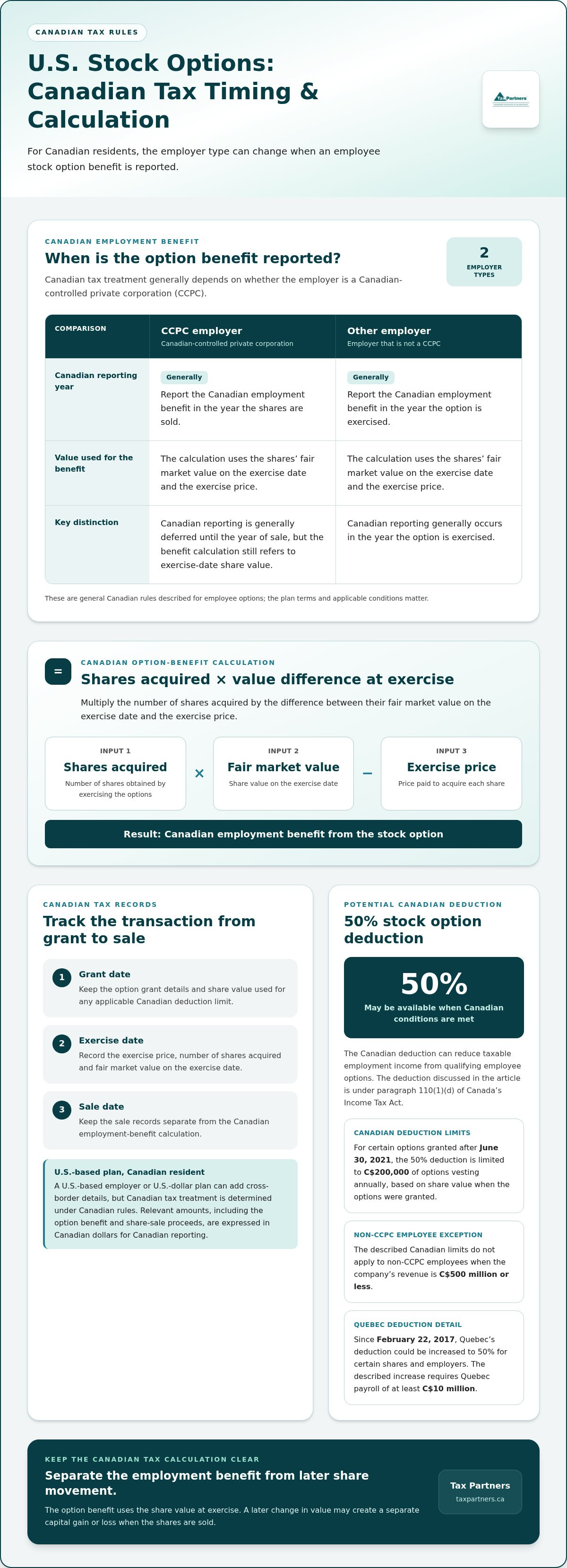
For Canadian residents, Canadian tax on US stock options generally starts with an employment benefit when the options are exercised, although employees of Canadian-controlled private corporations generally report that benefit in the year they sell the shares. To calculate it, multiply the number of shares acquired by the difference between their fair market value on the exercise date and the exercise price. A 50% stock option deduction may be available when the applicable Canadian conditions are met.
A U.S.-based employer or an option plan denominated in U.S. dollars can add cross-border details, but Canadian tax treatment is still determined under Canadian rules. The grant, exercise and sale dates all matter, as do the currency details used in the calculation.
This article explains when Canadian employees report an option benefit, how U.S. stock options are treated for Canadian residents, and how to work through a clear calculation example. You’ll also learn what can affect the available deduction and why tracking the option’s key dates and values helps clarify the tax result.
Key Takeaways
- Determine whether your employer is a Canadian-controlled private corporation, as this can affect when you report the option benefit.
- Keep the grant, exercise and sale details together; each date can help establish the Canadian tax treatment.
- Calculate the employment benefit using the shares’ fair market value at exercise and the price you paid for them.
- Review whether you qualify for the stock option deduction and whether limits apply to your options.
- For U.S.-based stock options, consider how Canadian currency rules and reporting requirements affect your Canadian tax return.
How are stock options taxed in Canada?
Canadian tax treatment depends on the employer’s status and the option terms. Any deduction also depends on meeting the applicable conditions. Registered-account rules and employee-option rules are separate.
The stock option deduction
The Canadian stock option deduction reduces taxable employment income from qualifying employee options when its conditions are met. The deduction discussed here is under paragraph 110(1)(d) of Canada’s Income Tax Act.
For an employee of a Canadian-controlled private corporation (CCPC), the stock-option employment benefit is generally reported in the year the shares are sold. For an employee of another company, the benefit is generally taxed in the year the option is exercised. This difference determines when the employment benefit enters the Canadian tax calculation.
Canada’s deduction limits apply to options granted after June 30, 2021. For certain options, the 50% employee stock option deduction is limited to C$200,000 of options vesting annually, based on share value when the option was granted. Vesting means the options become available to exercise under the plan.
The described limits don’t apply to non-CCPC employees when their company’s revenue is C$500 million or less. Quebec has a separate deduction detail: since February 22, 2017, its deduction could be increased to 50% for certain shares and employers. The increased Quebec deduction described here requires Quebec payroll of at least C$10 million.
Options held in registered accounts
An employee stock option is a right under an employer plan to acquire shares. It is distinct from shares held in a TFSA or RRSP. The employment-option rules apply to compensation connected with the option, while the account relates to the assets held within it.
If you’re a Canadian resident considering options in a TFSA or RRSP, first identify what the account holds: an employer’s option right or shares acquired after exercising the option. Don’t assume the account label changes the nature or timing of an employment benefit. The option agreement and account records can help you distinguish the two.
The Canadian tax treatment described for employee options concerns the employment benefit arising from the option. It does not establish whether a particular employer option can be held in a TFSA or RRSP, or determine the tax treatment of shares held there. Keep plan documents separate from registered-account statements when organizing your Canadian tax records.
Canadian stock-based compensation
Canadian employees may receive compensation tied to their employer’s shares through stock options, restricted share units or employee share purchase plans. These arrangements differ: an option gives the employee the right to buy shares, while a restricted share unit represents a promise of shares or their value under the plan. The plan documents set out what the employee receives and when.
For Canadian tax purposes, identify the type of compensation before considering its treatment. Stock options can create an employment benefit when exercised, while other share-based awards follow their own plan terms and transaction details. A grant, vesting date, exercise and sale are separate events, so recording each date helps establish what happened and when.
For an employee stock option, the employment benefit is based on the difference between the shares’ fair market value at exercise and the price paid. The number of shares acquired also affects the calculation. Even if an employee keeps the shares after exercising the options, the employment benefit must be distinguished from any later change in share value.
That later change may result in a capital gain or loss when the shares are sold. For shares held in a non-registered account, half of capital gains are taxable in Canada. The gain or loss is separate from the employment benefit, so don’t use the sale price in place of the shares’ value on the exercise date.
When reviewing a Canadian compensation plan, organize the records around these key details:
- Award type: Identify whether the plan grants options, units or shares.
- Key dates: Record the grant, vesting, exercise and sale dates that apply to the award.
- Share values: Keep the plan’s stated exercise price and relevant share values for each transaction.
- Settlement details: Note whether the award results in shares, cash or another form of compensation.
These details help separate employment income from investment gains and show which records support each amount. For example, an option statement may show the exercise price, while a trade confirmation records the later sale. Keeping both documents together makes it easier to trace the award from exercise through sale.
Canadian tax treatment can depend on the award’s structure, the employer and the transaction sequence. For a plan involving several award types or share transactions, discuss the Canadian tax treatment with a tax professional before preparing your return.
Cross-border taxation of U.S. stock options for Canadian residents
A U.S. employer’s option plan still needs to be assessed under Canadian tax rules when the employee is a Canadian resident. Currency, employment income and later share sales all affect the Canadian reporting picture. To understand Canadian tax on US stock options, consider each transaction under the rules that apply in Canada.
For Canadian reporting, express relevant amounts in Canadian dollars, including the option benefit and share-sale proceeds. Keep the original U.S.-dollar figures and record the conversion basis and transaction date used for each amount. This creates a clear record of how foreign-currency values were converted for the Canadian return.
Currency movements also have a specific Canadian tax rule for option agreements. According to the Department of Justice Canada, under subsection 7(1.5)(a), the amount payable to acquire a security under an employee option agreement is determined without reference to changes in the foreign currency’s value relative to Canadian currency after the agreement was made.
Reporting options on a Canadian T1 return
A Canadian T1 return is the individual income tax return used to report relevant employment income and investment transactions. For a U.S. stock option, separate the employment benefit from any later gain or loss on shares.
Keep the employer’s option statement, exercise confirmation, share transaction records and currency calculations with your Canadian tax documents. The T1 return is the central filing document; supporting records explain how each reported amount was calculated.
Canadian taxpayers should retain those records and file by the applicable Canadian T1 deadline. The documents help connect the employer’s reported compensation with the employee’s exercise and sale activity, even when those events fall in different tax years.
Calculating gains or losses on shares
A capital gain or loss compares the Canadian-dollar proceeds from selling shares with their Canadian-dollar cost. This calculation matters because the option benefit and the later change in share value are separate tax amounts.
For shares acquired through a U.S. option, keep the exercise-date value and the amount paid to acquire the shares. Then record the sale proceeds and the details of their conversion to Canadian dollars. Comparing the sale amount with the share cost shows whether the later transaction resulted in a gain or loss.
For example, if a Canadian resident exercises an option and later sells the U.S. shares acquired, the exercise and sale are separate events. The option records support the employment-benefit calculation; the sale records support the capital gain or loss calculation. Canadian tax on US stock options therefore involves tracking both events accurately.
For Canadian tax purposes, foreign-currency records should make each step traceable. Keep the grant agreement, exercise confirmation, brokerage statements and sale confirmation together, with dates and amounts in both currencies. This record trail helps distinguish the option’s contractual purchase amount from later changes in share value or currency.
Example calculation of an employee stock option benefit
For Canadian tax purposes, calculate the employment benefit using the shares acquired, their fair market value at exercise and the exercise price. This example shows how the benefit and a possible deduction affect the taxable amount.
Assume an employee exercises an option two years after it was granted. The employee buys 100 shares at C$30 per share, when each share is worth C$50. The C$30 exercise price is what the employee pays for each share under the option.
First, find the difference between the exercise price and the share value on the exercise date. The resulting C$2,000 is the employment income inclusion in this example.
- Shares acquired: 100
- Fair market value at exercise: C$50 per share
- Exercise price: C$30 per share
- Employment income inclusion: C$2,000
The C$2,000 difference is the option benefit, not the full value of the shares.
In Canada, the stock option employment benefit is generally eligible for a 50% deduction when the applicable conditions are met. In this example, a 50% deduction on the C$2,000 inclusion equals C$1,000. The deduction reduces the amount of employment income subject to tax in this calculation; it does not change the original benefit.
At a 35% marginal tax rate, tax on the C$2,000 employment income inclusion is C$700 without the deduction. With the 50% deduction, tax on the remaining C$1,000 is C$350. These figures illustrate the arithmetic for this example, rather than a universal tax result.
Keep the option grant and exercise records together to support each input. The grant date establishes the plan’s starting point, while the exercise statement records the shares acquired, exercise price and transaction date. Use the shares’ fair market value on the exercise date, not a later sale price.
For a U.S.-denominated plan, amounts on the Canadian return must also be expressed in Canadian dollars. This example uses Canadian-dollar figures throughout, isolating the benefit calculation. For an actual cross-border calculation, keep the original plan figures separate from the Canadian-dollar amounts used for reporting.
Finally, separate the employment benefit from any later gain or loss when the shares are sold. The C$2,000 inclusion arises from exercising the options in this example. A subsequent sale is a different transaction, with its own proceeds and share cost to consider.
How do I report US stock options on a Canadian T1 tax return and which forms are required?
For Canadian tax purposes, report U.S. stock-option amounts in Canadian dollars on your Canadian T1 income tax return. Separate the employment benefit from any capital gain or loss on shares sold, because they arise from different transactions.
Start by matching each option event to the relevant tax year. Record the grant, vesting, exercise and sale dates, then identify which events occurred in that year. The option agreement and employer statements help establish the award terms and employment compensation; brokerage records show the share transactions.
The T1 is the Canadian individual income tax return. The records supporting your calculation are not substitutes for the return, and a U.S. employer’s statement doesn’t replace Canadian reporting. The applicable Canadian schedules depend on the income and transactions being reported, so use the current CRA filing package to identify them.
Organize the figures before transferring them to the return:
- Employment benefit: Keep the exercise confirmation, number of shares, exercise price and fair market value used for the benefit calculation.
- Currency conversion: Record the original foreign-currency amount, its Canadian-dollar equivalent, transaction date and conversion basis.
- Share sale: Keep the brokerage confirmation showing sale proceeds, date and any transaction details relevant to the calculation.
- Deduction support: Retain documents that establish the option terms and information relevant to the Canadian stock option deduction.
Next, reconcile your employer’s compensation records with your option statements. If the reported amount differs from your calculation, compare the exercise date, share value and number of shares. A mismatch in any one of these inputs can change the employment benefit reported for that year.
For shares sold after exercise, calculate the Canadian-dollar proceeds and share cost separately from the employment benefit. Use the sale confirmation and exercise records to trace each amount. This helps prevent the full sale proceeds from being mistaken for taxable employment income.
Keep the agreement, employer statements, exercise confirmations, brokerage records and currency-conversion calculations with your Canadian tax files. Together, these records provide a clear trail from the option grant to the return figures, including transactions that span multiple tax years.
If U.S. plan statements and Canadian reporting records don’t align, get help preparing your Canadian stock-option reporting before filing your T1 return.
Tax Partners: Canadian Accounting & Tax Services
Tax Partners helps individuals with Canadian tax reporting for U.S. stock options through its Canadian Accounting & Tax Services and US & Cross-Border Accounting & Tax Services. This support can be useful when an option exercise, a share sale and foreign-currency records all affect the same Canadian return.
Gather your option agreement, employer statements, exercise confirmations and brokerage records. Tax Partners can help organize the information, assess the Canadian reporting treatment and distinguish employment income from a later share gain or loss. Bookkeeping and Payroll Services can also support accurate compensation records when employer payroll details are relevant.
For help with your option-related tax reporting, contact Tax Partners.
Make your next equity decision with clarity
Equity compensation can change as your role, employer or financial priorities evolve. Treat each new grant or plan amendment as a prompt to update your personal records, keeping important details accessible when you prepare future returns or consider selling shares.
Planning for Canadian tax on US stock options also means connecting tax records with broader financial decisions. Consider how holding or selling employer shares fits your investment mix, cash-flow needs and longer-term plans. Consistent records of plan documents and transactions can make those conversations more productive.
Tax Partners offers Canadian Accounting & Tax Services, US & Cross-Border Accounting & Tax Services, and Bookkeeping and Payroll Services. If you’d like guidance applying Canadian tax rules to your option situation, contact Tax Partners about your options.
With clear records and informed support, you can approach your next equity decision with greater confidence.
Frequently Asked Questions
How do employee stock options work?
An employee stock option gives you the right to buy employer shares at a set exercise price, subject to the plan’s terms. The plan explains when you can exercise and whether conditions such as vesting apply.
Before deciding, review the exercise window, expiry date and any restrictions on transferring shares. These details affect when you can act and what happens if you leave your employer.
How are US stock options taxed in Canada for Canadian residents?
Canadian residents assess stock options from U.S. employers under Canadian tax rules. The employer’s location or the currency used in plan documents doesn’t, by itself, determine the Canadian tax result.
Keep Canadian-dollar calculations traceable to the original plan and transaction records. When preparing Canadian tax information, identify compensation from exercising options separately from any later share transaction.
How are employee stock options from a US employer taxed in Canada?
A Canadian resident’s options from a U.S. employer are considered under Canadian rules. The plan terms, employer status and transaction dates help determine the Canadian tax treatment.
Use the option agreement alongside employer statements and brokerage records. If the documents show different figures, compare the share count, exercise price and transaction dates before reporting the amounts in Canada.
What is the Canadian stock option deduction and when does it apply?
The Canadian stock option deduction can reduce taxable employment income from qualifying options when the conditions are met. Eligibility depends on the award and employer details, so the deduction isn’t automatic.
For options granted after June 30, 2021, limits apply to certain deductions. Retain the grant documents and information about the employer, since those details help determine whether a limit affects your Canadian calculation.
How are US incentive stock options and nonqualified stock options treated for Canadian tax purposes?
Those labels describe U.S. tax categories and don’t, on their own, determine Canadian treatment. For Canadian reporting, examine the actual plan terms and how the award gives the employee the right to acquire shares.
Keep the award agreement and exercise confirmation together. They help connect the plan’s description to the Canadian analysis, rather than relying only on labels in U.S. employer paperwork.
When is stock option income reported in Canada: grant, exercise, or sale?
For Canadian purposes, the reporting year generally depends on whether the employer is a Canadian-controlled private corporation. An employee of a CCPC generally reports the benefit in the year the shares are sold; an employee of another company generally reports it in the exercise year.
The grant date still matters for identifying the option terms and considering deduction rules. Keep it distinct from the exercise and sale dates in your records.
Can Canadian residents claim foreign tax credits for US taxes paid on stock option income?
A Canadian resident may be able to claim a Canadian foreign tax credit for qualifying foreign income tax paid on income also reported in Canada. Eligibility and the credit amount depend on the Canadian rules and the tax paid.
Keep records showing the income involved, the foreign tax assessed and the payment made. These documents help link the tax paid abroad to the amount included in your Canadian filing.
How does the Canada-US tax treaty address cross-border employee stock options?
For a Canadian resident, the treaty can provide a framework for determining which country may tax employment income connected with an option. Its application depends on the circumstances, including the employment and option arrangement.
The treaty coordinates tax treatment but does not replace calculating Canadian income under Canadian rules. Keep employment and option records showing the relevant work period and award terms for the Canadian analysis.

Article by
Mahad Mohamed
Mahad Mohamed is an accountant and the CEO of Tax Partners, with over 26+ years of Canadian and international tax and accounting experience. His expertise includes corporate reorganization, cross-border tax structuring (Canada & US), tax disputes, CRA audits, and tax planning for small owner-managed private corporations. Most recently, Mahad is a pioneer in Canadian crypto taxation and founded Block3 Finance.
Previously, Mahad worked for the Canada Revenue Agency (CRA), Big4 accounting firms, and served as a Rulings Officer for the Federal Tax Authority of the UAE before acquiring Tax Partners in 2014.
Tax Partners has 44 full-time accountants and over 18,400+ clients.
Disclaimer
This article provides general information only and is current as of its publication date. It has not been updated and may be out of date. It does not constitute legal advice and should not be relied upon as such. Every tax situation is unique and may differ from the examples discussed in this article. If you have specific questions, you should seek the advice of our accountants for your unique circumstances. Book a FREE Initial Consultation Today!
Frequently Asked Questions
How do employee stock options work?
An employee stock option gives you the right to buy employer shares at a set exercise price, subject to the plan’s terms. The plan explains when you can exercise and whether conditions such as vesting apply. Before deciding, review the exercise window, expiry date and any restrictions on transferring shares. These details affect when you can act and what happens if you leave your employer.
How are US stock options taxed in Canada for Canadian residents?
Canadian residents assess stock options from U.S. employers under Canadian tax rules. The employer’s location or the currency used in plan documents doesn’t, by itself, determine the Canadian tax result. Keep Canadian-dollar calculations traceable to the original plan and transaction records. When preparing Canadian tax information, identify compensation from exercising options separately from any later share transaction.
How are employee stock options from a US employer taxed in Canada?
A Canadian resident’s options from a U.S. employer are considered under Canadian rules. The plan terms, employer status and transaction dates help determine the Canadian tax treatment. Use the option agreement alongside employer statements and brokerage records. If the documents show different figures, compare the share count, exercise price and transaction dates before reporting the amounts in Canada.
What is the Canadian stock option deduction and when does it apply?
The Canadian stock option deduction can reduce taxable employment income from qualifying options when the conditions are met. Eligibility depends on the award and employer details, so the deduction isn’t automatic. For options granted after June 30, 2021, limits apply to certain deductions. Retain the grant documents and information about the employer, since those details help determine whether a limit affects your Canadian calculation.
How are US incentive stock options and nonqualified stock options treated for Canadian tax purposes?
Those labels describe U.S. tax categories and don’t, on their own, determine Canadian treatment. For Canadian reporting, examine the actual plan terms and how the award gives the employee the right to acquire shares. Keep the award agreement and exercise confirmation together. They help connect the plan’s description to the Canadian analysis, rather than relying only on labels in U.S. employer paperwork.
When is stock option income reported in Canada: grant, exercise, or sale?
For Canadian purposes, the reporting year generally depends on whether the employer is a Canadian-controlled private corporation. An employee of a CCPC generally reports the benefit in the year the shares are sold; an employee of another company generally reports it in the exercise year. The grant date still matters for identifying the option terms and considering deduction rules. Keep it distinct from the exercise and sale dates in your records.
Can Canadian residents claim foreign tax credits for US taxes paid on stock option income?
A Canadian resident may be able to claim a Canadian foreign tax credit for qualifying foreign income tax paid on income also reported in Canada. Eligibility and the credit amount depend on the Canadian rules and the tax paid. Keep records showing the income involved, the foreign tax assessed and the payment made. These documents help link the tax paid abroad to the amount included in your Canadian filing.
How does the Canada-US tax treaty address cross-border employee stock options?
For a Canadian resident, the treaty can provide a framework for determining which country may tax employment income connected with an option. Its application depends on the circumstances, including the employment and option arrangement. The treaty coordinates tax treatment but does not replace calculating Canadian income under Canadian rules. Keep employment and option records showing the relevant work period and award terms for the Canadian analysis.