Charitable donation tax credits: how to claim and carry forward

Eligible charitable donations can generally be claimed up to 75% of net income in a year, according to the Canada Revenue Agency.
It’s reasonable to think a donation receipt is all you need to claim the credit. But you’ll also need to know which gifts qualify, how federal and provincial or territorial credits are calculated, and how combining donations or carrying them forward may affect your return.
This guide explains how to claim the credit on a Canadian tax return, which records to keep, and how the rules apply to different gifts. You’ll also learn how the annual claim limit and carry-forward period can shape your decisions about charitable giving and taxes.
Key Takeaways
- Confirm a gift qualifies and keep its donation receipt so you can support your claim on a Canadian tax return.
- Section 118.1 of Canada's Income Tax Act governs charitable donation tax credits for gifts, according to Department of Justice Canada.
- Donating appreciated securities in kind can affect how the accrued capital gain is treated for regular tax purposes.
- Learn how federal and provincial or territorial credits work together before deciding when to claim your donations.
1. Can charitable donations reduce taxes after death?
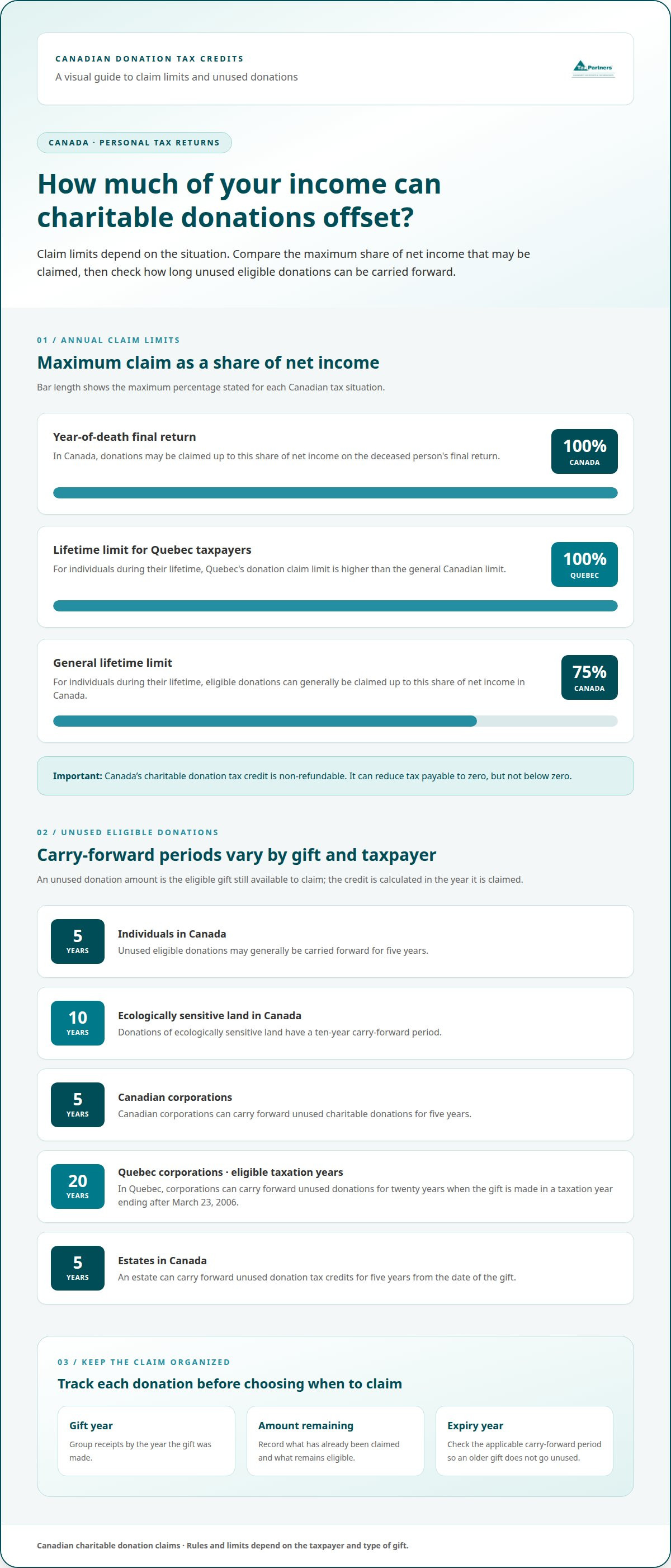
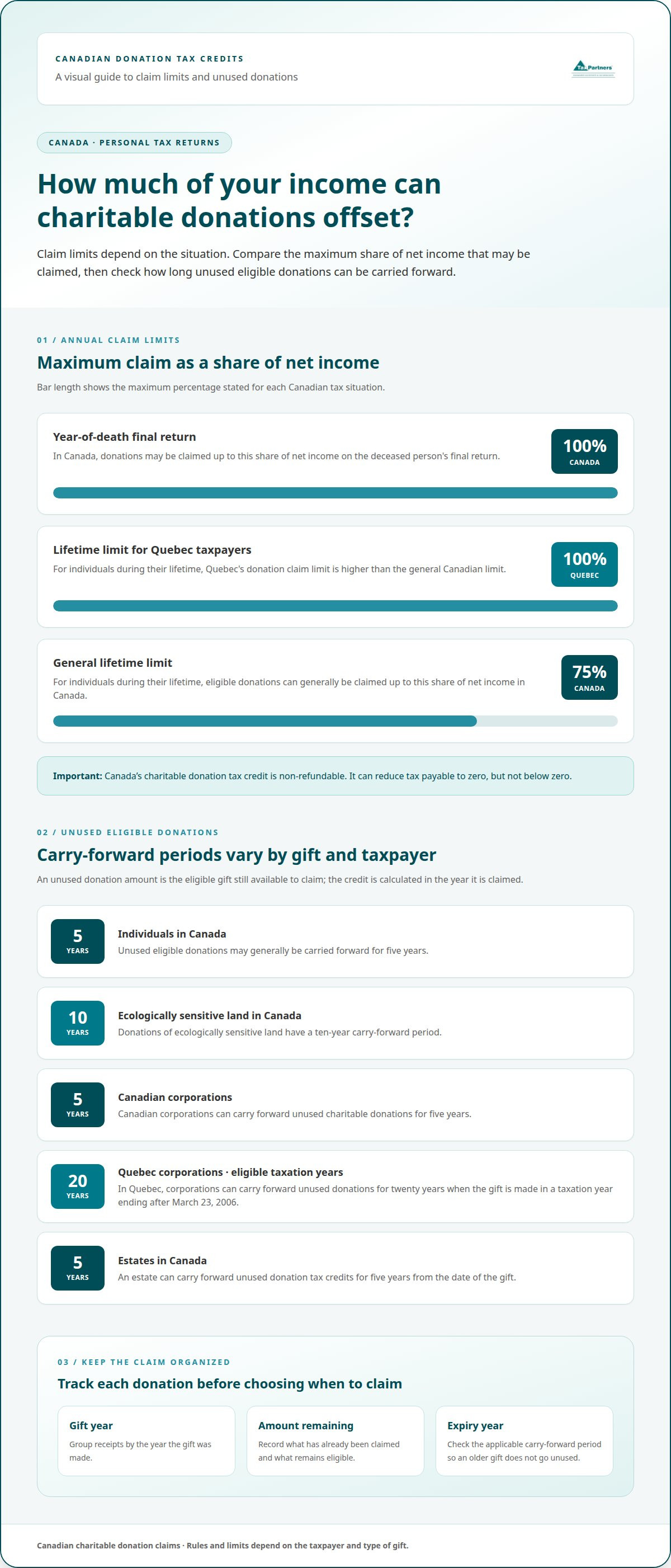
Yes. In Canada, charitable donations may be claimed up to 100% of net income on the year-of-death final tax return. Donations of a deceased person may also be claimed on the previous tax return or on any of the three years of a Graduated Rate Estate return.
For cryptocurrency, private shares, or other non-cash gifts, don’t assume the rules for publicly listed securities apply. The gift must qualify for the relevant charitable tax treatment, and its value and tax consequences must be assessed based on the specific property.
Donate appreciated securities in kind
An in-kind donation transfers the securities directly to a charity instead of selling them first and donating cash. In Canada, an eligible gift of appreciated marketable securities is generally valued at fair market value on the donation date. The donor does not report a capital gain for regular tax purposes, and the capital gains inclusion rate is 0% for this gift.
A direct transfer may be useful when securities have increased in value. Selling first may trigger a capital gain; donating publicly listed securities in kind avoids reporting that gain for regular tax purposes while supporting the charity. Confirm the transfer is completed as a gift, and retain the charity’s receipt and transaction records.
Keep timing in view. A securities transfer can take up to 10 business days after the broker initiates it, so starting near year-end may leave little time for completion. For Canada’s tax-year deadline, the date the donation is made matters.
Consider depreciated securities
A security worth less than its purchase cost may create a capital loss when disposed of. If a donation or transfer results in an allowable net capital loss, Canada’s rules permit unused net capital losses to be carried back up to 3 years or forward indefinitely against taxable capital gains. A loss generally does not reduce income from every source, so its value depends on capital gains available in the relevant years.
Compare donating the security directly with selling it and donating the proceeds. The options affect both the donation claim and any capital loss, and the result can depend on the security’s value and your other gains. Keep acquisition records and transfer documents to support the tax calculation.
Plan for the estate and tax limits
For a deceased donor, compare the final return, the prior year’s return, and eligible Graduated Rate Estate returns before allocating the donation claim. An estate can also carry forward unused donation tax credits for five years from the date of the gift. The available claim and timing can affect how much tax relief the estate uses.
Alternative minimum tax may also affect the tax treatment of donated appreciated securities, so donors should consider it when planning. Individuals planning substantial gifts, including gifts through an estate, should factor this into their tax calculations. Canadian tax services can help assess how donation timing, securities, income, and provincial tax fit together.
2. Can you carry charitable donations forward?
Yes. This can help when your donations in one year exceed the amount you plan to claim, or when your income changes.
Keep the tax receipt and record the gift’s date, recipient, and value. When claiming later, track the unused donation amount separately from the tax credit: the carried-forward amount is the eligible gift, and the credit is calculated for the year you claim it.
Plan donations around the tax-year deadline
For a Canadian donation to count in a tax year, plan to complete the gift by December 31 of that year. CanadaHelps advises donors to plan charitable giving before that deadline. A transfer of appreciated property may need extra time because the date the charity receives the gift can affect the claim year.
The 2024 tax year had a specific exception: the Government of Canada extended the eligible donation deadline to February 28, 2025. That extension applied to the 2024 tax year, not automatically to later years. For other years, use the applicable year-end deadline when scheduling a gift.
Match the claim to your income
During their lifetime, Canadian taxpayers can generally claim donations up to 75% of net income. Quebec’s limit is 100%. If eligible donations exceed the amount claimed, the unused balance may be carried forward under the applicable rules.
For example, if your eligible donations exceed the annual claim limit, you can retain the unused amount for a later return, subject to the five-year carry-forward period. Review the balance each year and claim donations that remain within their permitted period. This helps prevent an older eligible gift from going unused.
Different gifts can have different periods. Donations of ecologically sensitive land in Canada have a 10-year carry-forward period. Canadian corporations can carry forward unused charitable donations for five years; in Quebec, corporations can carry forward unused donations for 20 years when the gift is made in a taxation year ending after March 23, 2006.
Coordinate credits and carry-forwards
Canada’s charitable donation tax credit is non-refundable, so it can reduce tax payable only to zero. Other tax credits also reduce the balance owing, so consider which credits are available for the year before deciding how much of an eligible donation to claim.
A first-time donor super credit does not change the donation carry-forward period. The carry-forward applies to eligible unused donations, while credits affect the tax payable for the year you claim them.
To organize a carry-forward schedule, group receipts by gift year, note the amount already claimed, and track the remaining balance and expiry year. A review of your donation carry-forward plan can help coordinate eligible claims with income and other credits.
3. How do I claim a charitable tax credit?
Spouses or common-law partners in Canada can combine donation receipts and have one partner claim the total. Compare the federal and provincial or territorial credit each person could receive, then choose the claimant whose return makes better use of the credit.
Enter donations on the Canadian return
For the 2025 Canadian tax year, individuals report federal donations and gifts on line 34900 and provincial or territorial donations and gifts on line 58969. Schedule 9 is titled Donations and Gifts and supports the calculation. Follow the tax-return software prompts or complete the relevant schedule using eligible receipts.
Keep each receipt with your tax records. The Canada Revenue Agency doesn’t require you to submit a paper copy with your tax return, but it may ask for supporting records later. Check that the receipt identifies the recipient and gift, then retain it with documents showing the payment or transfer.
Understand federal rates
Eligible amounts above C$200 generally receive a federal credit at 29%, or 33% for taxpayers in the highest federal tax bracket.
The credit is non-refundable, meaning it reduces income tax payable but doesn’t create a refund beyond that tax liability. For example, if you have little tax payable after other credits, part of your donation credit may not provide an immediate benefit. The amount claimed and other credits on your return affect the result.
Account for provincial or territorial credits
Provincial and territorial credits are calculated alongside the federal credit, but rates differ by location. Canadian provincial charitable donation credit rates range from 4% to 25.75%, while combined federal and provincial credits range from 19% to 54.75%, depending on the province.
The same eligible gift can produce a different total credit depending on where you live. Review the province or territory shown on your return and calculate its contribution separately from the federal amount. Don’t assume a federal estimate includes provincial tax relief.
Coordinate a couple’s claim
When deciding which spouse claims the donations, compare both returns using the combined receipts. Consider each person’s income tax payable, other credits, and applicable provincial or territorial rates. The better choice is the one that makes fuller use of the available credit.
Donated mutual fund securities may also require transaction records alongside the donation receipt. Reviewing receipts, tax-return entries, and federal and provincial calculations step by step helps keep the claim consistent. Save the final schedule with both partners’ records when one return reports their combined gifts.
4. Eligibility of qualified donees and donation receipts
To qualify for the Canadian tax incentives described here, a donation must be made to a registered charity. The Canada Revenue Agency maintains an online database where you can check an organization’s registration before giving.
Not every payment to a charitable cause qualifies. A gift to an organization that isn’t a registered charity doesn’t meet this eligibility rule, and a payment that buys goods or entertainment may qualify only in part.
To claim a Canadian charitable donation tax credit, keep the official donation receipt and records supporting the gift, such as payment or transfer details. The Canada Revenue Agency doesn’t require you to submit a paper copy with your tax return, but retain it with your tax records.
Check what the receipt represents
A receipt should reflect the gift actually made, not simply the amount paid at an event.
Keep event details alongside that receipt. The C$75 benefit affects the eligible gift amount, so retaining the ticket or event information helps explain why the receipt is lower than the payment.
For non-cash gifts, keep records showing what property was transferred and how its value was established. The receipt and transaction documents should connect the eligible amount claimed with the actual gift.
Separate the gift from a benefit
If you receive something in return, distinguish its value from the charitable portion of your payment.
The same principle applies to donation schemes and flow-through share arrangements. These transactions can involve complex valuations and tax treatment, so don’t claim an amount solely because promotional material calls it a charitable gift or promises a tax advantage.
Review the organization’s registration, the property transferred, any benefit received, and the supporting tax receipt together. If the records don’t support the eligible gift amount, the claimed credit may not match the qualifying donation.
Keep a clear record trail
Before filing, match each receipt to its payment or transfer record and confirm the charity’s registered status in the CRA database. For a fundraising event, keep information explaining any benefit received; for a property gift, retain documents showing the asset and its valuation.
This approach helps you distinguish an eligible gift from a payment that partly purchased goods or services. It supports a claim based on the actual donation, rather than the full amount paid or an unsupported receipt figure.
5. How Canadian charitable donation tax credits are calculated
Canada calculates charitable donation tax credits in federal and provincial or territorial parts. Each part applies its own rates to eligible gifts, so the total depends on the donation amount, tax year, and donor’s province or territory.
According to Department of Justice Canada, Section 118.1 of Canada’s Income Tax Act governs charitable donation tax credits for gifts. It provides the framework for determining which gifts qualify and how individuals calculate credits on Canadian tax returns.
According to Canada Revenue Agency, donors can claim charitable donations up to 75% of net income in one year. This limit caps the eligible donations claimed for that year. It doesn’t mean the credit equals 75% of the gift.
A sound approach to charitable donation tax credit strategies in Canada starts by separating the gift amount from the credit. Eligible amounts above C$200 generally receive a federal credit at 29%, or 33% for taxpayers in the highest federal tax bracket.
Provincial or territorial rates are applied separately and vary by location. As a result, the same eligible gift can produce different combined credits across Canada.
A 2026 Ontario example illustrates the calculation. For a C$1,000 donation, the federal credit is C$260 and Ontario’s credit is C$99.38, for a combined credit of C$359.38.
Calculate the federal and provincial amounts separately, then combine them to estimate the total tax reduction.
Also consider whether the credit is refundable. Canada’s charitable donation tax credit is non-refundable, so it can reduce tax payable but cannot create a refund beyond the tax owed.
Alternative Minimum Tax is a separate calculation that can increase tax payable when certain deductions and credits reduce regular tax too far. For Canadian Alternative Minimum Tax purposes, only 80% of the regular charitable donation tax credit is allowable as an AMT donation credit for 2024 and forward.
To estimate a claim, total eligible receipts, apply the federal rates, then add the applicable provincial or territorial amount. Compare the result with your tax payable and account for the Alternative Minimum Tax calculation where relevant.
If you want help applying these calculations to your return, discuss your charitable donation tax calculation with a tax professional.
Tax Partners: Canadian Accounting & Tax Services
Tax Partners can help you apply Canadian charitable donation tax rules when your return involves carried-forward gifts, donated securities, or estate donations. Its Canadian Accounting & Tax Services can support a review of eligible receipts, claim timing, and how donation credits fit with your broader tax return.
Consider this support if you’re weighing whether to claim donations now or carry them forward, or if gifts and income need to be coordinated across tax years. A clear record of receipts, donation dates, and previous claims helps inform the review.
For guidance on your charitable donation tax return, contact Tax Partners.
Make your next charitable gift with a plan
Your next step is to connect your giving goals with the records and tax decisions that support them. A thoughtful plan can help you organize donation documentation, consider how a gift fits your broader financial picture, and prepare for tax filing with greater clarity. The right charitable donation tax credit strategies in Canada should reflect your circumstances, not just the size of a gift.
Tax Partners offers Canadian Accounting & Tax Services, alongside US & Cross-Border Accounting & Tax Services and Bookkeeping and Payroll Services. If you have questions about how charitable giving fits with your Canadian tax return or broader financial records, the team can help you consider the next steps.
Contact Tax Partners to discuss your tax needs, and move forward with a clear plan for your giving.
Frequently Asked Questions
How do I claim a charitable tax credit?
Report eligible gifts on your Canadian income tax return using Schedule 9, Donations and Gifts. For the 2025 tax year, individuals claim federal donations on line 34900 and provincial or territorial donations on line 58969. Keep receipts and supporting transaction records with your tax documents. The Canada Revenue Agency doesn’t require a paper receipt with your return, but you should retain it if asked to support your claim.
Who can I donate to?
For the Canadian tax incentives described here, donate to a registered charity. The Canada Revenue Agency maintains an online database where you can check an organization’s registration status. Before claiming a gift, compare the charity’s registered name with the name on your receipt. A payment to an organization that isn’t a registered charity doesn’t meet this eligibility rule, even if it supports a charitable cause.
What counts as a charitable donation in Canada?
A gift may qualify when it is made to a registered charity and you receive no more than an eligible benefit in return. Cash and eligible property can be donated, but the qualifying amount depends on the gift and any advantage received. For donated property, keep documents showing what was transferred and its value. A payment for goods or services isn’t automatically an eligible donation simply because a charity receives it.
Can I receive something in return for my charitable donation?
Yes, but the value of what you receive can reduce the eligible donation amount. For a Canadian fundraising dinner, for example, the meal and entertainment value is excluded from the amount that may be receipted, if CRA requirements are met. Keep event tickets or other records showing the benefit received, then compare those details with the charity’s receipt before claiming the gift.
Can charitable donations reduce taxes after death?
Yes. In Canada, donations may be claimed on the deceased donor’s final return, carried back to the previous tax return, or claimed on an eligible Graduated Rate Estate return. The final return can generally claim donations up to 100% of net income in the year of death. The executor should keep donation receipts and estate records together to support the claim and its allocation.
Can you carry charitable donations forward?
Yes. Keep a year-by-year schedule showing the original gift, amount already claimed, remaining balance, and applicable claim period. This makes it easier to use older gifts before newer ones and reconcile the balance with receipts when preparing a later return.
How can families maximize the tax benefits of charitable giving?
Families can compare the result of claiming eligible receipts on one spouse’s return rather than dividing them. Consider each person’s tax payable and other credits, since a non-refundable donation credit can only reduce tax payable. Keep the combined receipts and the chosen claimant’s calculation with both partners’ records.
How much can I claim on my tax return?
According to the Canada Revenue Agency, donors can claim charitable donations up to 75% of net income in one year. That is the eligible donation amount you may claim, not the amount of the tax credit. The credit is calculated separately using federal and provincial or territorial rates, and it can reduce tax payable only to zero because it is non-refundable.

Article by
Mahad Mohamed
Mahad Mohamed is an accountant and the CEO of Tax Partners, with over 26+ years of Canadian and international tax and accounting experience. His expertise includes corporate reorganization, cross-border tax structuring (Canada & US), tax disputes, CRA audits, and tax planning for small owner-managed private corporations. Most recently, Mahad is a pioneer in Canadian crypto taxation and founded Block3 Finance.
Previously, Mahad worked for the Canada Revenue Agency (CRA), Big4 accounting firms, and served as a Rulings Officer for the Federal Tax Authority of the UAE before acquiring Tax Partners in 2014.
Tax Partners has 44 full-time accountants and over 18,400+ clients.
Disclaimer
This article provides general information only and is current as of its publication date. It has not been updated and may be out of date. It does not constitute legal advice and should not be relied upon as such. Every tax situation is unique and may differ from the examples discussed in this article. If you have specific questions, you should seek the advice of our accountants for your unique circumstances. Book a FREE Initial Consultation Today!
Frequently Asked Questions
How do I claim a charitable tax credit?
Report eligible gifts on your Canadian income tax return using Schedule 9, Donations and Gifts. For the 2025 tax year, individuals claim federal donations on line 34900 and provincial or territorial donations on line 58969. Keep receipts and supporting transaction records with your tax documents. The Canada Revenue Agency doesn’t require a paper receipt with your return, but you should retain it if asked to support your claim.
Who can I donate to?
For the Canadian tax incentives described here, donate to a registered charity. The Canada Revenue Agency maintains an online database where you can check an organization’s registration status. Before claiming a gift, compare the charity’s registered name with the name on your receipt. A payment to an organization that isn’t a registered charity doesn’t meet this eligibility rule, even if it supports a charitable cause.
What counts as a charitable donation in Canada?
A gift may qualify when it is made to a registered charity and you receive no more than an eligible benefit in return. Cash and eligible property can be donated, but the qualifying amount depends on the gift and any advantage received. For donated property, keep documents showing what was transferred and its value. A payment for goods or services isn’t automatically an eligible donation simply because a charity receives it.
Can I receive something in return for my charitable donation?
Yes, but the value of what you receive can reduce the eligible donation amount. For a Canadian fundraising dinner, for example, the meal and entertainment value is excluded from the amount that may be receipted, if CRA requirements are met. Keep event tickets or other records showing the benefit received, then compare those details with the charity’s receipt before claiming the gift.
Can charitable donations reduce taxes after death?
Yes. In Canada, donations may be claimed on the deceased donor’s final return, carried back to the previous tax return, or claimed on an eligible Graduated Rate Estate return. The final return can generally claim donations up to 100% of net income in the year of death. The executor should keep donation receipts and estate records together to support the claim and its allocation.
Can you carry charitable donations forward?
Yes. Keep a year-by-year schedule showing the original gift, amount already claimed, remaining balance, and applicable claim period. This makes it easier to use older gifts before newer ones and reconcile the balance with receipts when preparing a later return.
How can families maximize the tax benefits of charitable giving?
Families can compare the result of claiming eligible receipts on one spouse’s return rather than dividing them. Consider each person’s tax payable and other credits, since a non-refundable donation credit can only reduce tax payable. Keep the combined receipts and the chosen claimant’s calculation with both partners’ records.
How much can I claim on my tax return?
According to the Canada Revenue Agency, donors can claim charitable donations up to 75% of net income in one year. That is the eligible donation amount you may claim, not the amount of the tax credit. The credit is calculated separately using federal and provincial or territorial rates, and it can reduce tax payable only to zero because it is non-refundable.