Common T2 Filing Mistakes for Ontario Corporations

Most Ontario business owners don't realize that the Canada Revenue Agency (CRA) often flags corporate returns not for what they've reported, but for how they've categorized it. Identifying common T2 filing mistakes Ontario corporations encounter when filing their T2, or corporate income tax return, requires more than just basic record-keeping. It demands a precise understanding of the General Index of Financial Information (GIFI), which is the standardized system used to report financial statement items to the CRA under Canadian tax rules.
You've likely felt that familiar knot of anxiety when facing the complexity of Ontario provincial tax schedules or the 2026 small business rate reduction. It's perfectly normal to feel overwhelmed by these regulatory shifts, especially when the threat of penalties and daily compounded interest looms over your business. We believe that tax compliance should feel like a guided journey rather than a source of constant stress for hard-working entrepreneurs.
We'll help you identify and avoid these frequent errors to protect your revenue from unnecessary CRA audits and late-filing penalties. This guide provides a strategic compliance framework that clarifies your obligations and simplifies the path to an accurate filing. You'll gain the foresight needed to move from a state of uncertainty toward total control over your corporate tax health and long-term stability.
Key Takeaways
- Learn how the Canada Revenue Agency (CRA) administers the harmonized T2—the primary Corporate Income Tax Return—for Ontario filers to ensure both federal and provincial requirements are met.
- Avoid the common T2 filing mistakes Ontario corporations encounter by correctly utilizing the General Index of Financial Information (GIFI) to report your financial data.
- Protect your business from interest charges by understanding the critical difference between the CRA filing deadline and the tax payment deadline.
- Ensure accurate depreciation claims by properly applying Capital Cost Allowance (CCA), which is the tax-deductible portion of an asset's cost, and the half-year rule for new acquisitions.
- Maximize your return by identifying eligible provincial incentives, such as the Ontario Innovation Tax Credit, through a proactive tax planning framework.
Navigating the Complexity of T2 Corporate Tax Compliance
The T2 Corporate Income Tax Return serves as the definitive financial narrative for your business. Every incorporated entity in Ontario must submit this document annually to the Canada Revenue Agency (CRA) to report its global income. Managing these requirements is often where we see common T2 filing mistakes Ontario entrepreneurs make, particularly when they underestimate the interplay between federal and provincial regulations. Your corporate income tax filing isn't just a regulatory hurdle; it's a vital record that validates your business's financial health to stakeholders and lenders.
Accuracy remains the cornerstone of a successful filing strategy. The Income Tax Act governs these submissions, requiring a level of precision that goes beyond simple bookkeeping. When you prioritize exactness, you protect your corporate standing and ensure your business remains eligible for essential financing and government contracts. We view ourselves as your proactive guardian, helping you transform this complex requirement into a streamlined part of your annual operations.
Understanding CRA Filing Requirements for Ontario Filers
Under CRA rules, every corporation must file a T2 return even if there's no profit to report or tax to pay for the fiscal year. This requirement includes inactive businesses that haven't officially dissolved. Taxable income represents the profit remaining after you've subtracted all allowable business expenses and capital deductions from your gross revenue. It's a specific calculation that often differs from the "net income" shown on your standard accounting software.
Ontario businesses utilize a harmonized return system. This means the CRA administers provincial tax alongside federal tax on a single document, simplifying the process for most filers. You don't need to submit a separate return to the Ontario Ministry of Finance, but you must still accurately calculate Ontario-specific surtaxes and credits. This unified approach requires a deep understanding of how provincial rules layer onto federal mandates to avoid common T2 filing mistakes Ontario corporations frequently encounter.
The True Cost of Non-Compliance and Filing Errors
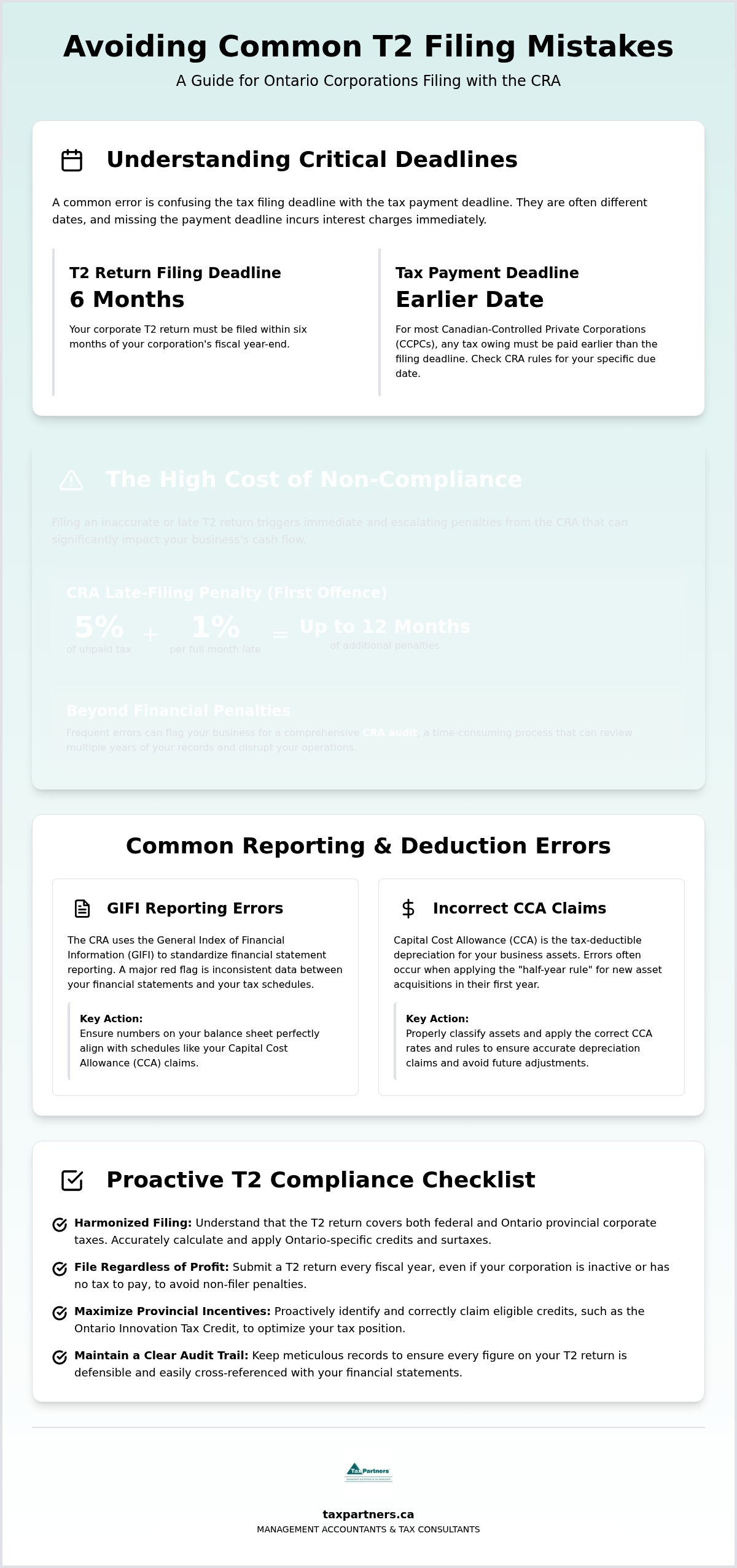
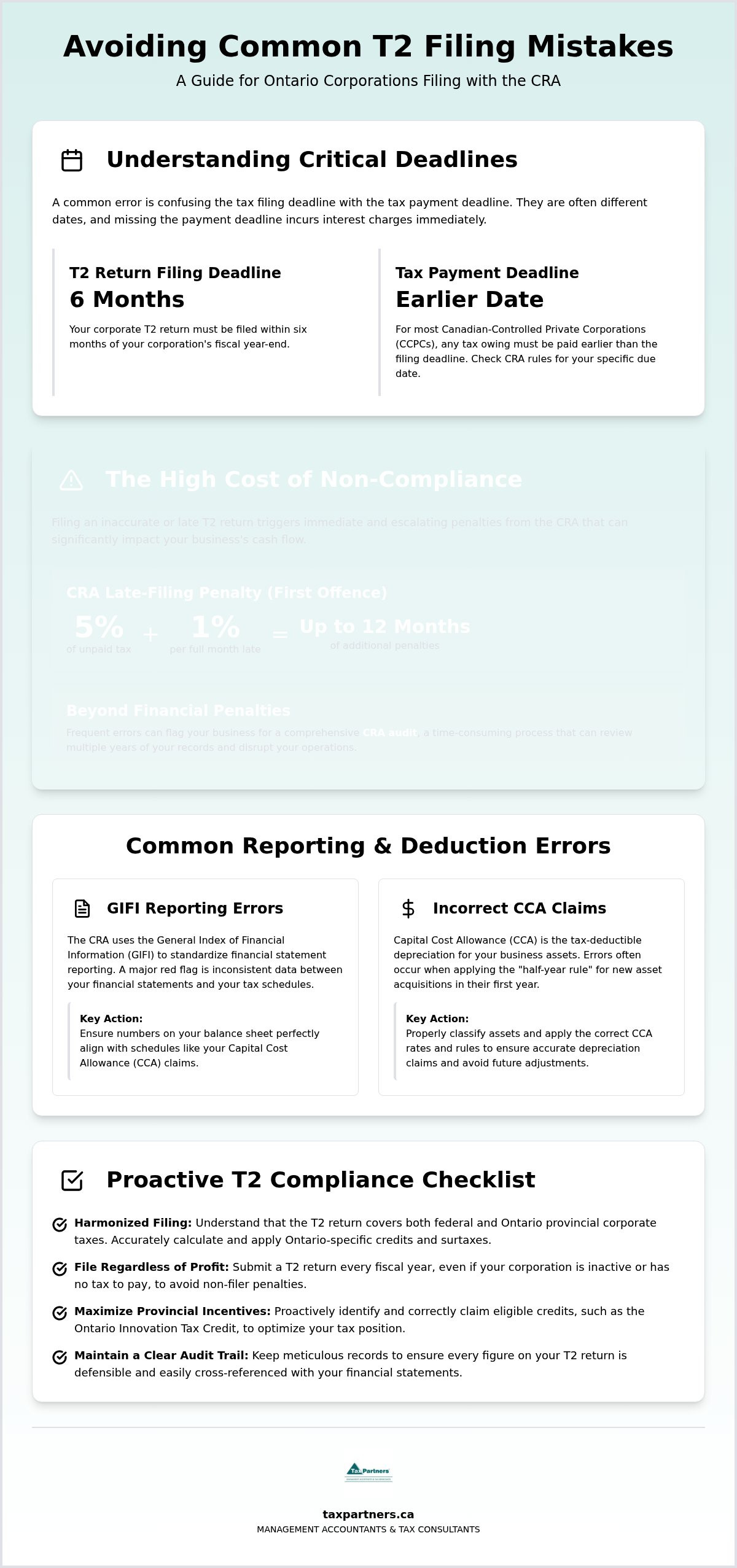
Filing an inaccurate return or missing your deadline triggers immediate consequences that can jeopardize your cash flow. For a first offence, the CRA applies a late-filing penalty of 5% of your unpaid tax, plus an additional 1% for each full month the return is late, up to a maximum of 12 months. These costs escalate quickly and are entirely avoidable with a methodical approach to your year-end obligations.
Beyond the immediate financial hit, frequent errors often signal a lack of internal controls, which may trigger a comprehensive CRA audit. These intrusive reviews can last for months and consume valuable administrative resources. Maintaining a clean filing history protects your reputation and ensures you stay in a position of strength when seeking future investment. We've seen how a single misstep can lead the CRA to re-examine multiple years of records, making a proactive compliance framework your best defence.
Administrative Pitfalls: Deadlines and GIFI Reporting Errors
Administrative oversights are often the most expensive common T2 filing mistakes Ontario businesses make. These errors usually stem from a lack of organization rather than a misunderstanding of the law itself. Maintaining a clear audit trail ensures that every figure on your return is defensible under CRA scrutiny.
Inconsistent data between your financial statements and tax schedules is a major red flag. When the numbers on your balance sheet don't align with your capital cost allowance schedules, the CRA's digital filters often trigger a manual review. Precision in these cross-references is essential for maintaining a low audit profile.
Managing Critical T2 Filing and Payment Deadlines
Many entrepreneurs confuse the deadline to submit their return with the deadline to pay their taxes. For most Canadian corporations, the T2 return must be filed within six months of the fiscal year-end. However, the deadline to pay any tax owing is significantly earlier for many businesses.
Most Canadian-Controlled Private Corporations (CCPCs) must pay their corporate income tax within three months of their year-end. For other corporations, this payment window closes after just two months. If you miss this payment date, the CRA charges interest at the prescribed rate plus four percentage points, compounded daily.
Since these dates vary based on your specific corporate structure and fiscal year, you should confirm your exact deadlines directly with the CRA. Staying ahead of these dates preserves your cash flow and avoids unnecessary interest charges. If you're feeling unsure about your specific timeline, our team can help you map out a compliance calendar.
Common Errors in GIFI Code Selection
The General Index of Financial Information (GIFI) is a standardized list of codes used to report financial statement items to the CRA. Every line item on your balance sheet and income statement must be assigned a specific GIFI code. This creates a uniform digital record that the CRA's automated systems can analyze instantly.
Miscoding a capital asset as a current expense is one of the common T2 filing mistakes Ontario filers struggle with most. If your GIFI entries don't align with your internal bookkeeping or previous years' filings, it may prompt a request for more information. Consistency across all schedules is vital for a smooth assessment process.
Ensuring your financial statements match your tax schedules exactly prevents discrepancies that lead to manual reviews. We suggest a methodical review of your chart of accounts to ensure every category maps correctly to the corresponding GIFI code. Precision here reduces the likelihood of intrusive questions from tax authorities.
Strategic Missteps in Expense Claims and Deductions
Strategic errors often involve misinterpreting how the Income Tax Act allows for the recovery of business costs over time. These common T2 filing mistakes Ontario filers make frequently involve aggressive or poorly documented expense claims that draw unwanted CRA attention. We believe that a robust tax strategy should maximize your deductions while maintaining a fortress-like audit trail.
Accuracy in your claims ensures that you don't leave money on the table or inadvertently trigger a desk audit. Every deduction you claim must be supported by a clear business purpose and verifiable documentation. When you treat your record-keeping as a strategic asset, you move from a reactive posture to one of total control over your corporate tax health.
Miscalculating Capital Cost Allowance Classes
Capital Cost Allowance (CCA) is the tax-deductible portion of a capital asset's cost, spread over several years under Canadian tax rules. Placing an asset in the wrong class, such as mistaking a specialized piece of equipment for a standard passenger vehicle, can lead to significant assessment errors. Each class has a specific rate, and using the incorrect one will result in an inaccurate tax liability calculation.
You must also apply the 'half-year rule' for most assets during the year they are acquired. This rule generally limits your CCA claim to 50% of the normal rate for the first year of ownership, regardless of when in the fiscal year the purchase occurred. Failing to apply this adjustment is a frequent oversight that leads to the CRA reassessing your return and charging interest on the difference.
Complexity increases when you sell assets, potentially triggering a 'recapture' or a 'terminal loss.' Recapture occurs when you sell an asset for more than its remaining tax value, adding that amount back to your income. Conversely, a terminal loss happens when you sell the final asset in a class for less than its remaining value, allowing for a further deduction. Our corporate income tax specialists ensure these calculations are precise to prevent future adjustments.
Common Oversight in Meals and Entertainment Deductions
Under CRA rules, corporations can generally only deduct 50% of the cost of meals and entertainment expenses. Some businesses mistakenly claim the full 100%, which is a frequent trigger for automated adjustments during a review. This limitation applies even if the expense was entirely legitimate and necessary for business development or client relations.
There are specific exceptions where a 100% deduction might be applicable. These include staff parties available to all employees or meals provided for a charitable fund-raiser. Misapplying these exceptions can be just as costly as failing to use them at all, so precise categorization is vital.
Maintaining a clear audit trail is non-negotiable for these types of expenses. You must keep detailed receipts that note who was present and the specific business purpose discussed during the meal. Without this context, the CRA may disallow the deduction entirely, even if you have a credit card statement showing the transaction occurred.
Avoiding Errors in Ontario-Specific Tax Credits
Ontario corporations benefit from a variety of provincial incentives that are claimed directly on the harmonized T2 return. While the Canada Revenue Agency (CRA) administers these credits, the eligibility criteria are strictly defined by provincial legislation. We often see common T2 filing mistakes Ontario filers make when they assume federal eligibility automatically translates to provincial approval.
The Ontario Innovation Tax Credit (OITC) is a frequent source of calculation errors. This refundable credit—which is a tax credit that can be paid out even if no tax is owed—supports small to medium-sized corporations performing scientific research and experimental development (SR&ED) in the province. Accuracy in tracking qualifying expenditures is essential, as the CRA frequently audits these claims to ensure they meet specific Ontario requirements.
Claiming credits for which your corporation is not eligible can lead to significant reassessments and interest charges. It's vital to treat these incentives as a strategic opportunity rather than a guaranteed deduction. If you're unsure which provincial incentives apply to your industry, speak with our tax specialists to verify your eligibility before you file.
Navigating Ontario Provincial Tax Incentives
Ontario offers several niche credits designed to bolster specific sectors within the province. These include the Ontario Book Publishing Tax Credit (OBPTC), which supports the literary industry, and the Ontario Business-Research Institute Tax Credit (OBRITC) for collaborative research. Each of these requires specific provincial supporting documentation that must be available for CRA review.
- Ontario Book Publishing Tax Credit: A refundable credit for eligible Ontario-based book publishing corporations that produce qualifying literary works.
- Ontario Business-Research Institute Tax Credit: A refundable credit for corporations that perform R&D under a contract with an eligible Ontario research institute.
You should never claim these credits based on verbal agreements or informal partnerships. The CRA expects formal contracts and detailed expense breakdowns to substantiate every dollar claimed. Maintaining these records is a hallmark of a sophisticated corporate tax strategy that ensures long-term compliance.
Errors in Claiming the Small Business Deduction
The Small Business Deduction (SBD) is a lower tax rate available to Canadian-controlled private corporations (CCPCs) on their first portion of active business income. For Ontario filers, this deduction significantly reduces the provincial tax rate compared to the general corporate rate. However, miscalculating the SBD limit is one of the common T2 filing mistakes Ontario businesses encounter during growth phases.
The 'associated corporations' rule is a critical factor that many owners overlook. If your business is associated with other corporations through common ownership, you must share a single SBD limit among the group under CRA rules. Failing to properly allocate this limit can lead to the CRA denying the deduction for one or more entities in the group.
Passive income also plays a major role in your ability to claim the SBD. If your corporation earns significant "adjusted aggregate investment income" (AAII), which includes interest, dividends, and capital gains, your SBD limit may be reduced. We recommend a proactive review of your investment portfolio to ensure it doesn't inadvertently increase your corporate tax liability.
Strengthening Your Corporate Tax Strategy for 2026
Moving beyond a year-end reaction to a state of total control requires a shift in perspective. Many business owners view tax season as a hurdle to clear, yet the most resilient corporations treat it as an ongoing strategic dialogue. By refining your internal processes, you naturally avoid the common T2 filing mistakes Ontario entrepreneurs often face when rushing to meet CRA deadlines.
Professional tax preparation acts as a form of risk mitigation that pays dividends in stability. It moves your business away from simple data entry toward a bespoke compliance framework. This proactive approach ensures that your corporation is not just reacting to requirements but is actively looking ahead to secure a better financial outcome. We believe that professional oversight is an investment in your company's long-term health and creditworthiness.
The Risks of DIY Corporate Tax Software for SMEs
Off-the-shelf software often provides a false sense of security for complex corporate structures. While these programs are frequently updated, they rarely capture the strategic nuances of legislative shifts, such as the prorated calculations required for the 2026 Ontario small business rate reduction. A software-only solution lacks the foresight of a seasoned mentor who can interpret how these changes impact your specific industry under Canadian rules.
Relying solely on automation leaves you without a proactive guardian during a CRA audit. Software cannot defend its own logic or explain the business rationale behind a specific deduction to a tax auditor. You can explore the deeper differences between automated tools and expert guidance in our guide on Professional Tax Preparation vs. DIY Software for SMEs.
Implementing Robust Bookkeeping and Payroll Controls
The accuracy of your T2 return is only as reliable as the data supporting it. Establishing strict internal controls for your daily transactions prevents the messy year-end reconciliations that lead to filing errors. When your payroll and bookkeeping are harmonized, the transition to corporate tax filing becomes a guided, stress-free journey rather than a source of anxiety.
Integrated professional bookkeeping services provide the steady hand at the helm that many growing businesses need. These systems ensure that every expense is categorized correctly from the moment it occurs, rather than being guessed at months later. This level of precision is the most effective way to eliminate common T2 filing mistakes Ontario corporations encounter under CRA scrutiny.
Consider these essential steps to strengthen your 2026 strategy:
- Schedule quarterly reviews to monitor tax liabilities and cash flow.
- Automate payroll to ensure accurate T4 and T2 reconciliation under CRA rules.
- Consult with a CPA before making major capital purchases to confirm CCA classes.
- Maintain digital backups of all receipts for a minimum of six years.
Investing in professional oversight provides the clarity needed to make confident decisions throughout the year. It allows you to focus on growth while we handle the complexities of regulatory compliance. With a seasoned expert at your side, you gain the peace of mind that comes from knowing your corporate tax health is secure.
Securing Your Corporate Financial Future
Mastering your corporate tax obligations requires a move from simple data entry to a proactive guardianship of your business health. By refining your approach to GIFI coding and deadline management, you effectively eliminate the common T2 filing mistakes Ontario entrepreneurs often face. Precision in calculating Capital Cost Allowance and maximizing provincial credits ensures your corporation remains both compliant and competitive under CRA rules.
Tax Partners brings over 40 years of corporate tax expertise and specialized CRA audit mediation support to your side. We're proud to be trusted by thousands of Ontario business owners who value stability and long-term partnership. Our team acts as a steady hand at the helm, helping you realize a more strategic and stress-free tax season through every stage of your corporate journey.
Don't let regulatory complexity slow your momentum or jeopardize your hard-earned revenue. Secure your corporate compliance with Tax Partners and gain the clarity you need to focus on your next phase of growth. We're here to help you turn compliance into a position of strength and lasting peace of mind.
Frequently Asked Questions
What is the deadline for filing a T2 return in Ontario for 2026?
Under CRA rules, your T2 corporate income tax return for 2026 must be filed within six months of your fiscal year-end. However, you must pay any taxes owing within three months if you're a Canadian-Controlled Private Corporation (CCPC) or two months for other entities. Missing these specific payment dates is one of the most common T2 filing mistakes Ontario business owners make. You should confirm your exact year-end dates directly with the CRA to avoid interest charges.
Can I file my Ontario corporate tax return separately from my federal return?
No, you cannot file your Ontario provincial corporate tax return separately from your federal return under current CRA rules. Ontario uses a harmonized return system where the CRA administers provincial tax on behalf of the province through the T2 return. This unified process simplifies your administrative burden but requires you to complete specific Ontario schedules. These schedules ensure you receive provincial-specific credits while maintaining a single point of contact for your filings.
What happens if I make a mistake on a previously filed T2 return?
If you discover an error on a previously submitted return, you shouldn't file a completely new T2 for that year. Instead, you must request an adjustment by filing a T2-ADJ, which is the official form for amending a corporate return under CRA rules. You can also use the "Change a return" feature within the CRA's My Business Account portal. Addressing these errors promptly helps mitigate potential interest and demonstrates a proactive approach to your corporate compliance.
What are GIFI codes and why are they important for my T2 filing?
The General Index of Financial Information (GIFI) is a standardized list of codes used to report your financial statement data to the CRA. Every line item on your balance sheet and income statement must correspond to a specific GIFI code on your T2. Using these codes allows the CRA to process and analyze your financial information electronically. Proper code selection is vital to ensure your return reflects your internal bookkeeping and avoids automated flags during processing.
How long should I keep my corporate tax records for the CRA?
Under CRA rules, you're generally required to keep your corporate tax records and supporting documents for a minimum of six years. This period starts from the end of the last tax year to which the records relate. These records include your financial statements, receipts, and payroll data necessary to support every figure on your T2 return. Maintaining these files in an organized manner is your best defence if the CRA selects your corporation for a manual review or audit.
Is the Small Business Deduction available to all Ontario corporations?
The Small Business Deduction (SBD) is only available to Canadian-Controlled Private Corporations (CCPCs) throughout the tax year. This deduction provides a lower tax rate on the first portion of your active business income under CRA rules. However, your eligibility and the total deduction limit may be reduced if your business is associated with other corporations. High levels of passive investment income can also impact your ability to claim the full SBD in Ontario for the 2026 tax year.
What is the penalty for filing a corporate tax return late in Canada?
For a first offence, the CRA applies a late-filing penalty of 5% of the unpaid tax, plus an additional 1% for each full month the return is late. This monthly penalty can continue for up to a maximum of 12 months. If you've been penalized for late filing in the previous three years, these rates can increase significantly to 10% plus 2% per month. Proactive management of your deadlines is essential to protect your company's cash flow from these avoidable financial costs.
How does the CRA select corporations for a tax audit?
The CRA uses several methods to select corporations for a tax audit, including automated risk-assessment software that flags unusual GIFI data. They may also choose businesses based on specific industry projects or through random selection to ensure general compliance. Associations with other audited entities or previous filing errors can also trigger a review of your own corporate records. Professional oversight helps maintain a low audit profile by ensuring your filings are consistently accurate and well-documented.

Article by
Mahad Mohamed
Mahad Mohamed is an accountant and the CEO of Tax Partners, with over 26+ years of Canadian and international tax and accounting experience. His expertise includes corporate reorganization, cross-border tax structuring (Canada & US), tax disputes, CRA audits, and tax planning for small owner-managed private corporations. Most recently, Mahad is a pioneer in Canadian crypto taxation and founded Block3 Finance.
Previously, Mahad worked for the Canada Revenue Agency (CRA), Big4 accounting firms, and served as a Rulings Officer for the Federal Tax Authority of the UAE before acquiring Tax Partners in 2014.
Tax Partners has 44 full-time accountants and over 18,400+ clients.
Disclaimer
This article provides general information only and is current as of its publication date. It has not been updated and may be out of date. It does not constitute legal advice and should not be relied upon as such. Every tax situation is unique and may differ from the examples discussed in this article. If you have specific questions, you should seek the advice of our accountants for your unique circumstances. Book a FREE Initial Consultation Today!
Frequently Asked Questions
What is the deadline for filing a T2 return in Ontario for 2026?
Under CRA rules, your T2 corporate income tax return for 2026 must be filed within six months of your fiscal year-end. However, you must pay any taxes owing within three months if you're a Canadian-Controlled Private Corporation (CCPC) or two months for other entities. Missing these specific payment dates is one of the most common T2 filing mistakes Ontario business owners make. You should confirm your exact year-end dates directly with the CRA to avoid interest charges.
Can I file my Ontario corporate tax return separately from my federal return?
No, you cannot file your Ontario provincial corporate tax return separately from your federal return under current CRA rules. Ontario uses a harmonized return system where the CRA administers provincial tax on behalf of the province through the T2 return. This unified process simplifies your administrative burden but requires you to complete specific Ontario schedules. These schedules ensure you receive provincial-specific credits while maintaining a single point of contact for your filings.
What happens if I make a mistake on a previously filed T2 return?
If you discover an error on a previously submitted return, you shouldn't file a completely new T2 for that year. Instead, you must request an adjustment by filing a T2-ADJ, which is the official form for amending a corporate return under CRA rules. You can also use the "Change a return" feature within the CRA's My Business Account portal. Addressing these errors promptly helps mitigate potential interest and demonstrates a proactive approach to your corporate compliance.
What are GIFI codes and why are they important for my T2 filing?
The General Index of Financial Information (GIFI) is a standardized list of codes used to report your financial statement data to the CRA. Every line item on your balance sheet and income statement must correspond to a specific GIFI code on your T2. Using these codes allows the CRA to process and analyze your financial information electronically. Proper code selection is vital to ensure your return reflects your internal bookkeeping and avoids automated flags during processing.
How long should I keep my corporate tax records for the CRA?
Under CRA rules, you're generally required to keep your corporate tax records and supporting documents for a minimum of six years. This period starts from the end of the last tax year to which the records relate. These records include your financial statements, receipts, and payroll data necessary to support every figure on your T2 return. Maintaining these files in an organized manner is your best defence if the CRA selects your corporation for a manual review or audit.
Is the Small Business Deduction available to all Ontario corporations?
The Small Business Deduction (SBD) is only available to Canadian-Controlled Private Corporations (CCPCs) throughout the tax year. This deduction provides a lower tax rate on the first portion of your active business income under CRA rules. However, your eligibility and the total deduction limit may be reduced if your business is associated with other corporations. High levels of passive investment income can also impact your ability to claim the full SBD in Ontario for the 2026 tax year.
What is the penalty for filing a corporate tax return late in Canada?
For a first offence, the CRA applies a late-filing penalty of 5% of the unpaid tax, plus an additional 1% for each full month the return is late. This monthly penalty can continue for up to a maximum of 12 months. If you've been penalized for late filing in the previous three years, these rates can increase significantly to 10% plus 2% per month. Proactive management of your deadlines is essential to protect your company's cash flow from these avoidable financial costs.
How does the CRA select corporations for a tax audit?
The CRA uses several methods to select corporations for a tax audit, including automated risk-assessment software that flags unusual GIFI data. They may also choose businesses based on specific industry projects or through random selection to ensure general compliance. Associations with other audited entities or previous filing errors can also trigger a review of your own corporate records. Professional oversight helps maintain a low audit profile by ensuring your filings are consistently accurate and well-documented.