Accounting for Professional Corporations in Canada Guide

What if your professional success is actually costing you more than it should under CRA rules? Many high-earning practitioners realize that as their billings grow, so does the burden of the highest personal tax brackets. Mastering accounting for professional corporations Canada is no longer just a clerical task; it's a vital strategy to protect your hard-earned wealth and secure your financial future.
We understand that the complexity of corporate tax filings and the uncertainty of the salary-dividend mix can feel overwhelming for CRA filers. You deserve a clear path to lower your overall tax bill while remaining in total compliance with the Canada Revenue Agency. This guide provides the clarity you need to transform your corporation into a powerful vehicle for tax deferral and long-term stability.
We'll explore how to navigate the $500,000 federal Small Business Deduction limit and manage the passive income thresholds that could impact your CCPC status. From understanding 2026 provincial rate changes to setting a proactive filing schedule, you're about to gain total control over your professional corporation's financial health.
Key Takeaways
- Learn how to correctly structure your practice as a legal entity that satisfies both provincial governing bodies and the Canada Revenue Agency.
- Master the nuances of accounting for professional corporations Canada to protect your CCPC status and maximize your access to the Small Business Deduction.
- Discover how to optimize your remuneration mix through the principle of tax integration to ensure you pay only your fair share of tax.
- Establish a disciplined annual accounting cycle and maintain clear financial boundaries to ensure seamless CRA compliance and audit protection.
- Leverage a proactive partnership to move beyond simple filing and build a long-term strategy for professional wealth and financial stability.
Understanding Professional Corporations Under CRA Regulations
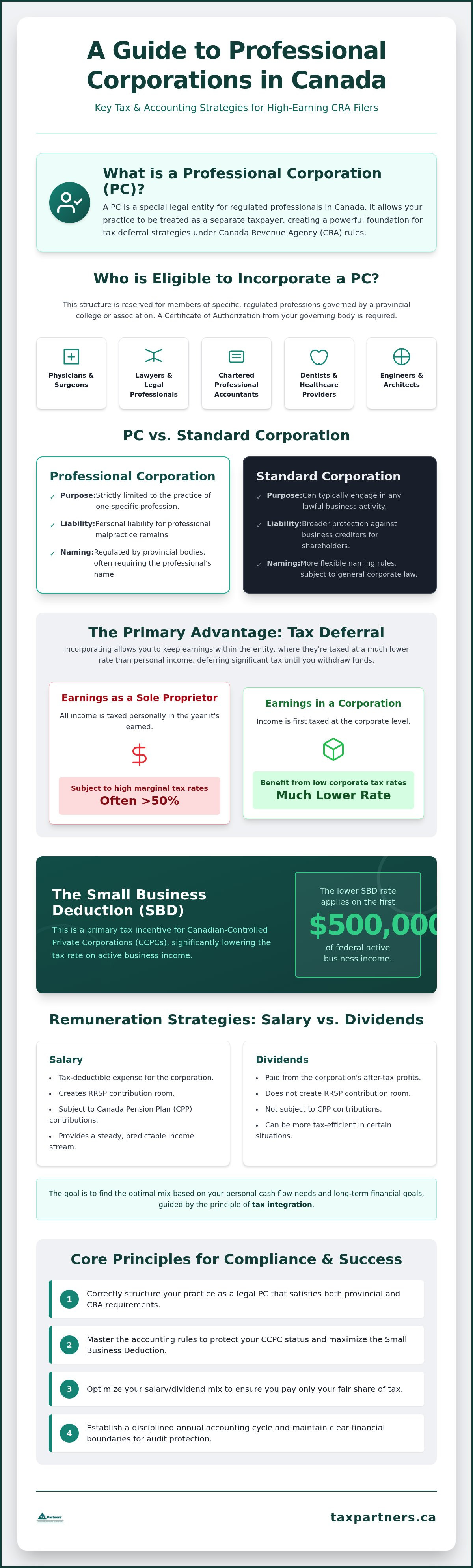
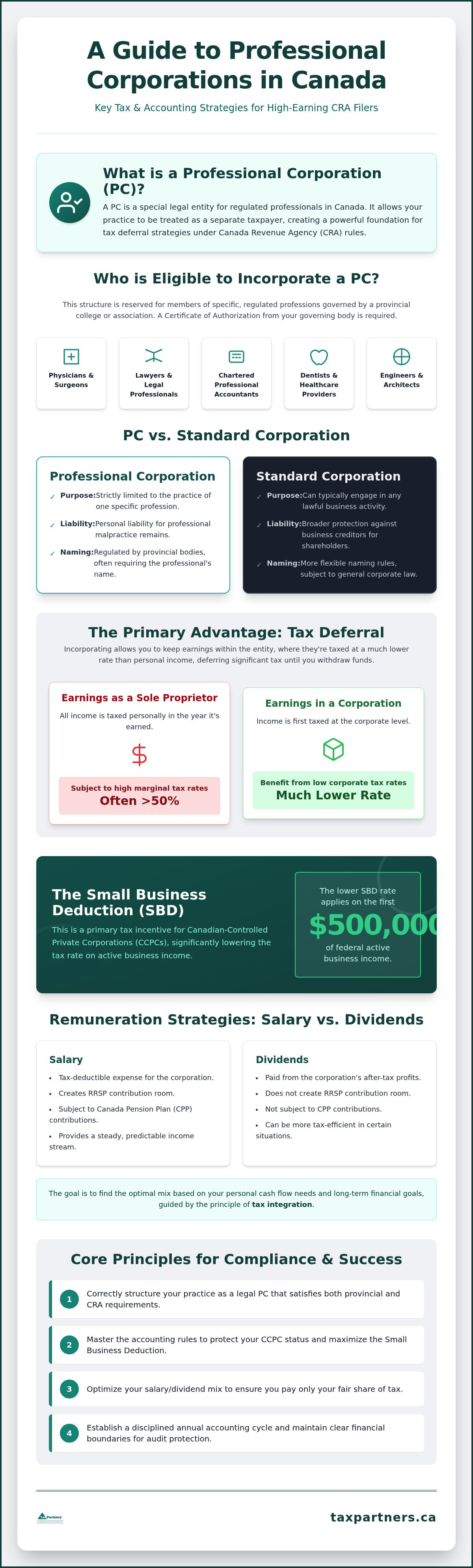
A Professional Corporation (PC) is a distinct legal entity designed specifically for individuals in regulated professions. While it shares many characteristics with a standard business, it operates under a unique set of rules mandated by both provincial legislation and the Canada Revenue Agency. This structure allows you to treat your practice as a separate taxpayer, which is the foundation of effective tax planning.
It's a common misconception that incorporating protects you from all risks. While a PC provides some protection against general business creditors, your professional liability for negligence or malpractice remains personal. You'll still require robust professional liability insurance alongside your corporate structure to ensure total protection.
Most PCs are formed under provincial statutes, such as the Ontario Business Corporations Act, or the federal Canada Business Corporations Act. These laws ensure that your practice maintains the high ethical standards required by your governing body. At the same time, they allow you to access the significant corporate tax benefits available to Canadian-Controlled Private Corporations (CCPCs).
Who Can Incorporate a PC in Canada?
Understanding who is eligible to incorporate is the first step in mastering the accounting for professional corporations Canada. This structure is reserved for members of specific, regulated professions who are governed by a provincial college or association. Common eligible professionals include:
- Physicians and surgeons.
- Lawyers and legal professionals.
- Chartered Professional Accountants.
- Dentists and specialized healthcare providers.
- Engineers and architects.
Before you can file your first corporate tax return as a CRA filer, you must obtain a Certificate of Authorization from your provincial governing body. This document confirms that your corporation meets all professional standards. Shareholders are usually restricted to members of the profession, though some provinces allow family members to hold non-voting shares under specific conditions.
PC vs. Standard Corporation: Key Differences
A standard corporation can typically engage in any lawful business activity. In contrast, a PC is strictly limited to the practice of one specific profession and activities that are directly auxiliary to that practice. You cannot, for example, run an unrelated retail business through your medical professional corporation.
Provincial regulators also enforce strict naming conventions for these entities. Most jurisdictions require the legal name to include the professional's name followed by "Professional Corporation" or a similar designation. These rules ensure transparency for the public and the CRA while maintaining the prestige of the profession.
Because of these restrictions, specialized accounting is essential for long-term success. Managing the accounting for professional corporations Canada requires a deep understanding of how these limitations interact with the Small Business Deduction. We focus on ensuring your corporate records reflect these unique legal requirements to prevent any challenges to your CCPC status.
Maximizing Tax Deferral and the Small Business Deduction
The primary financial advantage of incorporating your practice is the ability to defer taxes. When you earn income personally, you're immediately subject to high marginal tax brackets that can exceed 50% in many provinces. By contrast, accounting for professional corporations Canada allows you to keep earnings within the entity, where they're taxed at a much lower corporate rate.
This strategy creates a "tax deferral" because you only pay personal tax on the funds you actually withdraw for your lifestyle. The remaining capital stays inside the corporation, where it can be reinvested or used to fund future retirement goals. It's a powerful way to grow your net worth faster than would be possible as a sole proprietor.
Effective tax planning ensures you utilize the gap between corporate and personal rates to your advantage. If you don't need your full professional income for daily expenses, the corporation acts as a specialized savings vehicle. This approach requires a steady hand to manage the flow of funds while staying within the boundaries of the law.
The Power of the Small Business Deduction (SBD)
The Small Business Deduction is a crucial tax incentive for Canadian-Controlled Private Corporations (CCPCs). For 2026, the federal tax rate is 9% on the first $500,000 of active business income. This $500,000 limit is a general rule, though the actual amount available to you can change based on several factors under CRA filers' rules.
For instance, if you have associated corporations, you must share this $500,000 limit among all entities. Additionally, the CRA applies a "passive income grind" if your corporation earns more than $50,000 in investment income. This complex interaction highlights why proactive planning is vital to ensure you don't inadvertently lose your access to these preferred rates.
Eligibility for CCPC Status
To qualify for these significant tax savings, your practice must maintain its status as a CCPC. This means the corporation must be private, controlled by Canadian residents, and not controlled by public corporations or non-residents. Following the CRA Regulations for Professional Income is the only way to safeguard this status.
Losing your CCPC designation can lead to a drastic increase in your tax bill, as you'd move from the small business rate to the general corporate rate. This shift can happen unexpectedly if your residency changes or if corporate ownership structures are poorly managed. Ensuring your accounting for professional corporations Canada remains accurate is essential for Canadian corporate tax compliance.
If you're concerned about how these thresholds affect your specific practice, we can help you review your current corporate structure to ensure you're maximizing every available deduction.
Remuneration Strategies: Salary vs. Dividends for CRA Filers
Deciding how to withdraw money from your practice is a core pillar of accounting for professional corporations Canada. This decision, often called the "remuneration mix," isn't just about cash flow. It's a strategic choice that balances immediate tax costs with long-term retirement goals under CRA rules.
The Canada Revenue Agency operates on the principle of tax integration. This concept aims to ensure that an individual earns roughly the same after-tax income whether they receive a salary or dividends. While the system is designed for fairness, the subtle differences in how these payments are treated can significantly impact your total tax bill.
Finding the right balance requires more than just a spreadsheet. It involves a deep look at your lifestyle needs and your vision for the future. Proactive wealth management is essential to determine which split will best support your financial independence while remaining in total CRA compliance.
Drawing a Salary: Pros and Cons
For many CRA filers, a stable salary provides a sense of financial predictability. From a corporate perspective, salaries are a fully deductible expense. This means every dollar paid as a salary reduces the corporation's taxable income, which can be a valuable tool for managing your Small Business Deduction limits.
- RRSP Room: Paying a salary generates Registered Retirement Savings Plan (RRSP) contribution room. This allows you to build a tax-sheltered nest egg outside of your corporation.
- CPP Contributions: Salary earners must make mandatory Canada Pension Plan (CPP) contributions. While this is an added cost today, it secures a government-backed pension for your retirement.
- Personal Borrowing: Banks often view a steady T4 salary more favourably than fluctuating dividends when you apply for a mortgage or personal loan.
Issuing Dividends: A Flexible Alternative
Dividends offer a different kind of freedom. They are paid out of the corporation's after-tax profits, meaning the corporation has already paid its share of tax on those funds. Because dividends are not considered "earned income" by the CRA, they do not require CPP contributions, which can save you thousands of dollars in annual premiums.
However, dividends don't generate RRSP room, which can limit your future tax-planning options. When you receive a dividend, the CRA requires you to "gross-up" the amount on your personal tax return. This "gross-up" is a calculation that expresses the dividend as the pre-tax income the corporation originally earned.
To prevent double taxation, you then receive a "dividend tax credit." This credit accounts for the corporate taxes already paid, effectively lowering your personal tax rate on that income. Mastering these nuances is a vital part of accounting for professional corporations Canada and ensures you don't leave money on the table.
Essential Accounting and Filing Compliance for PCs
Maintaining a Professional Corporation (PC) requires a disciplined approach to administrative tasks that goes far beyond simple bookkeeping. You can't treat your corporate bank account like a personal wallet. Establishing a clear boundary between your personal finances and your practice's capital is the first rule of survival under CRA regulations. This begins with obtaining a Business Number (BN) and setting up specific accounts for corporate tax, GST/HST, and payroll remittances.
Mastering accounting for professional corporations Canada involves more than just keeping receipts in a folder. It's about following a predictable, annual rhythm that ensures you remain in good standing with the Canada Revenue Agency. Missing a single deadline can trigger penalties that quickly erode the tax deferral benefits you've worked hard to build. We focus on creating a guided journey through these requirements so you never feel rushed or uncertain as a deadline approaches.
Accurate corporate income tax preparation is the cornerstone of this process. It requires a precise reconciliation of your practice's activities to ensure every eligible deduction is claimed while maintaining total transparency. By treating your compliance as a proactive strategy rather than a reactive chore, you protect your professional reputation and your financial future.
The Annual Filing Requirements for Canadian PCs
Staying compliant under CRA rules involves a four-step cycle that repeats every fiscal year. It's essential to stay organized throughout the year to make this process seamless.
- Step 1: Prepare financial statements. You must produce a formal Balance Sheet and Income Statement that accurately reflect the corporation's financial position.
- Step 2: File the T2 Corporation Income Tax Return. This must be submitted within six months of your fiscal year-end. If your year-end is December 31, your filing deadline is June 30.
- Step 3: Manage GST/HST filings. Depending on your reporting period, you must file and remit GST/HST collected on your professional services to the CRA.
- Step 4: Issue T4 or T5 slips. You're required to report remuneration paid to yourself or employees by the end of February each year.
Bookkeeping Best Practices for Professionals
Effective accounting for professional corporations Canada relies on high-quality data. You should track professional dues, licensing fees, and malpractice insurance separately, as these are often significant deductible expenses for CRA filers. Keeping these records distinct from general office expenses ensures nothing is missed during tax season.
Digital record-keeping is no longer optional; it's a standard requirement under modern CRA regulations. You must maintain your records in a format that the CRA can easily verify if they ever request a review. Organized, digital records are your most powerful defence during a CRA audit, providing a clear trail of every transaction your corporation has made.
If you're feeling the weight of these administrative requirements, reach out to our compliance team to streamline your annual filings and secure your peace of mind.
Strategic Partnership for Professional Corporation Growth
Managing the accounting for professional corporations Canada is a significant responsibility that extends far beyond simple math. While the temptation to handle filings yourself might exist, a DIY approach often carries hidden risks that can jeopardize your CCPC status. Small errors in tracking passive income or miscalculating the remuneration mix can lead to costly reassessments from the Canada Revenue Agency. You've spent years building your expertise in your profession; you shouldn't have to spend your nights mastering the intricacies of the Income Tax Act.
At Tax Partners, we act as a seasoned, authoritative mentor for medical, legal, and engineering professionals. We bring over 40 years of institutional wisdom to every client relationship, ensuring your practice is built on a foundation of ethical steadfastness. Having filed over 495,000 returns and saved our clients more than $87M, we understand the specific pressures you face. We offer a boutique experience that prioritizes personalized care over the distant, institutional feel of larger firms.
The Value of Proactive Tax Planning
Securing your financial future requires a strategy that looks forward, not just backward. We provide integrated services that encompass payroll, bookkeeping, and estate planning to ensure your corporation remains a powerful tool for wealth accumulation. By staying ahead of 2026 provincial tax rate changes and CRA threshold adjustments, we help you keep more of your hard-earned income. It's about more than just compliance; it's about building a legacy through precise financial foresight.
Navigating CRA Challenges with Confidence
The threat of a CRA audit often brings a current of stress to even the most successful practices. Our firm provides a proactive guardian role, offering robust audit support and corporate compliance expertise to alleviate that burden. We've earned over 1,390 five-star Google reviews by being responsive, attentive, and genuinely invested in our clients' long-term stability. You can move forward with the confidence that your filings are accurate and your interests are protected.
If you're ready to move from a state of uncertainty to a feeling of total control, we're here to guide you. We invite you to contact us today for a customized consultation tailored to your specific professional practice.
Secure Your Professional Legacy
Mastering the intricacies of your practice's finances is the only way to ensure your professional success translates into long-term personal wealth. By optimizing your Small Business Deduction and choosing the right remuneration mix, you protect your hard-earned income from the highest personal tax brackets while staying in total CRA compliance. These strategic choices don't just solve today's tax problems; they define your financial trajectory for years to come.
Professional accounting for professional corporations Canada requires a proactive guardian who looks well beyond the next filing deadline. Our GTA-based team brings over 40 years of Canadian CPA expertise to professionals across the country, providing the steady hand you need to focus entirely on your clients. We understand the specific regulatory pressures and opportunities facing medical, legal, and engineering practitioners in the current landscape.
With over 1,390 five-star reviews from professionals like you, we've built a reputation for deep reliability and personalized care. You don't have to manage these complexities alone. Secure your professional future with a Tax Partners consultation today and take the first step toward total financial clarity and peace of mind.
Frequently Asked Questions
What is the main tax advantage of a professional corporation in Canada?
Tax deferral is the primary benefit for CRA filers. By keeping earnings within the corporation, they are taxed at the much lower small business rate rather than your high personal marginal rate. This strategy allows you to retain more capital inside the practice for reinvestment or future retirement goals, which effectively accelerates your wealth accumulation over time.
How much can I save on taxes by incorporating my professional practice?
Your total savings depend on your province and how much income you leave in the corporation. The benefit is the gap between the small business tax rate, such as the 9% federal rate for CCPCs, and your personal tax bracket. If you don't need your full income for lifestyle expenses, the deferral can be substantial; however, you should check current provincial rates with the CRA.
Do I need a separate bank account for my professional corporation?
Yes, maintaining a separate corporate bank account is a mandatory requirement for accounting for professional corporations Canada. This ensures a clear legal and financial boundary between your personal assets and the corporation's capital. A dedicated account simplifies your annual filings and is your first line of defence if the Canada Revenue Agency conducts an audit of your practice.
Can I pay my family members a salary from my professional corporation?
You can pay family members a salary if they perform legitimate work for the corporation. The amount must be reasonable for the tasks they complete, similar to what you would pay a third party. It's vital to be mindful of the CRA's Tax on Split Income (TOSI) rules, which can apply high tax rates to certain payments made to family members.
What are the annual filing deadlines for a Canadian professional corporation?
Your T2 Corporation Income Tax Return must be filed within six months of your fiscal year-end. For example, if your year ends on December 31, your filing deadline is June 30. It's important to remember that most CCPCs must actually pay their corporate taxes within three months of the year-end to avoid interest charges from the CRA.
Is a professional corporation protected from malpractice lawsuits?
No, incorporating does not shield you from professional liability or malpractice claims. Your responsibility for professional negligence remains personal under the regulations of your provincial governing body. The corporation only provides limited liability for general business debts, such as office leases or supplier contracts, which is why robust insurance remains essential for every practitioner.
What is the difference between a salary and a dividend for a PC owner?
A salary is a deductible expense for the corporation that generates RRSP room but requires mandatory CPP contributions. Dividends are paid from after-tax profits and don't generate RRSP room or require CPP payments. Choosing the right balance between the two is a fundamental part of accounting for professional corporations Canada and depends on your long-term retirement strategy.
When should a professional consider incorporating their practice?
You should consider incorporating when your practice's income consistently exceeds your personal lifestyle needs. If you're able to leave a significant amount of money in the corporation each year, the tax deferral benefits usually outweigh the additional accounting and legal costs. Most professionals find this transition beneficial once they reach the highest personal tax brackets in their province.

Article by
Mahad Mohamed
Mahad Mohamed is an accountant and the CEO of Tax Partners, with over 26+ years of Canadian and international tax and accounting experience. His expertise includes corporate reorganization, cross-border tax structuring (Canada & US), tax disputes, CRA audits, and tax planning for small owner-managed private corporations. Most recently, Mahad is a pioneer in Canadian crypto taxation and founded Block3 Finance.
Previously, Mahad worked for the Canada Revenue Agency (CRA), Big4 accounting firms, and served as a Rulings Officer for the Federal Tax Authority of the UAE before acquiring Tax Partners in 2014.
Tax Partners has 44 full-time accountants and over 18,400+ clients.
Disclaimer
This article provides general information only and is current as of its publication date. It has not been updated and may be out of date. It does not constitute legal advice and should not be relied upon as such. Every tax situation is unique and may differ from the examples discussed in this article. If you have specific questions, you should seek the advice of our accountants for your unique circumstances. Book a FREE Initial Consultation Today!
Frequently Asked Questions
Who Can Incorporate a PC in Canada?
Understanding who is eligible to incorporate is the first step in mastering the accounting for professional corporations Canada. This structure is reserved for members of specific, regulated professions who are governed by a provincial college or association. Common eligible professionals include: Before you can file your first corporate tax return as a CRA filer, you must obtain a Certificate of Authorization from your provincial governing body. This document confirms that your corporation meets all professional standards. Shareholders are usually restricted to members of the profession, though some provinces allow family members to hold non-voting shares under specific conditions.
What is the main tax advantage of a professional corporation in Canada?
Tax deferral is the primary benefit for CRA filers. By keeping earnings within the corporation, they are taxed at the much lower small business rate rather than your high personal marginal rate. This strategy allows you to retain more capital inside the practice for reinvestment or future retirement goals, which effectively accelerates your wealth accumulation over time.
How much can I save on taxes by incorporating my professional practice?
Your total savings depend on your province and how much income you leave in the corporation. The benefit is the gap between the small business tax rate, such as the 9% federal rate for CCPCs, and your personal tax bracket. If you don't need your full income for lifestyle expenses, the deferral can be substantial; however, you should check current provincial rates with the CRA.
Do I need a separate bank account for my professional corporation?
Yes, maintaining a separate corporate bank account is a mandatory requirement for accounting for professional corporations Canada. This ensures a clear legal and financial boundary between your personal assets and the corporation's capital. A dedicated account simplifies your annual filings and is your first line of defence if the Canada Revenue Agency conducts an audit of your practice.
Can I pay my family members a salary from my professional corporation?
You can pay family members a salary if they perform legitimate work for the corporation. The amount must be reasonable for the tasks they complete, similar to what you would pay a third party. It's vital to be mindful of the CRA's Tax on Split Income (TOSI) rules, which can apply high tax rates to certain payments made to family members.
What are the annual filing deadlines for a Canadian professional corporation?
Your T2 Corporation Income Tax Return must be filed within six months of your fiscal year-end. For example, if your year ends on December 31, your filing deadline is June 30. It's important to remember that most CCPCs must actually pay their corporate taxes within three months of the year-end to avoid interest charges from the CRA.
Is a professional corporation protected from malpractice lawsuits?
No, incorporating does not shield you from professional liability or malpractice claims. Your responsibility for professional negligence remains personal under the regulations of your provincial governing body. The corporation only provides limited liability for general business debts, such as office leases or supplier contracts, which is why robust insurance remains essential for every practitioner.
What is the difference between a salary and a dividend for a PC owner?
A salary is a deductible expense for the corporation that generates RRSP room but requires mandatory CPP contributions. Dividends are paid from after-tax profits and don't generate RRSP room or require CPP payments. Choosing the right balance between the two is a fundamental part of accounting for professional corporations Canada and depends on your long-term retirement strategy.
When should a professional consider incorporating their practice?
You should consider incorporating when your practice's income consistently exceeds your personal lifestyle needs. If you're able to leave a significant amount of money in the corporation each year, the tax deferral benefits usually outweigh the additional accounting and legal costs. Most professionals find this transition beneficial once they reach the highest personal tax brackets in their province.