Foreign tax credit in Canada: how the calculation works

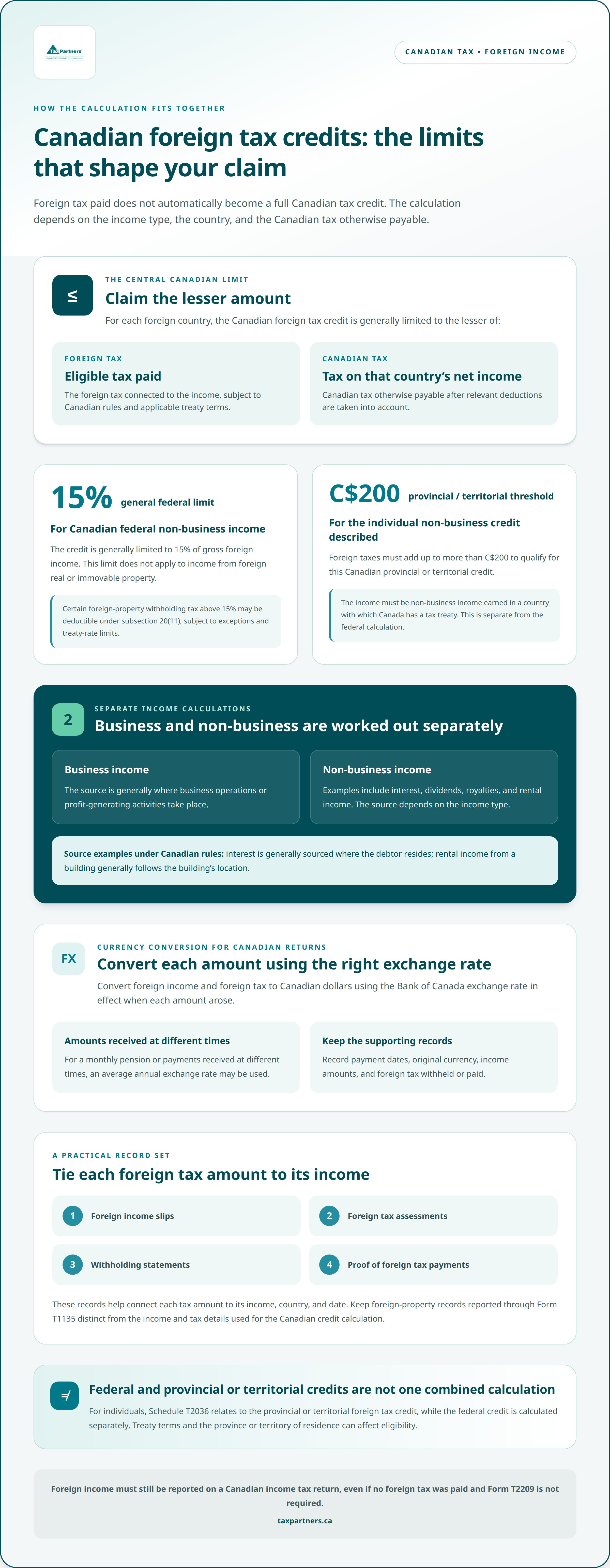
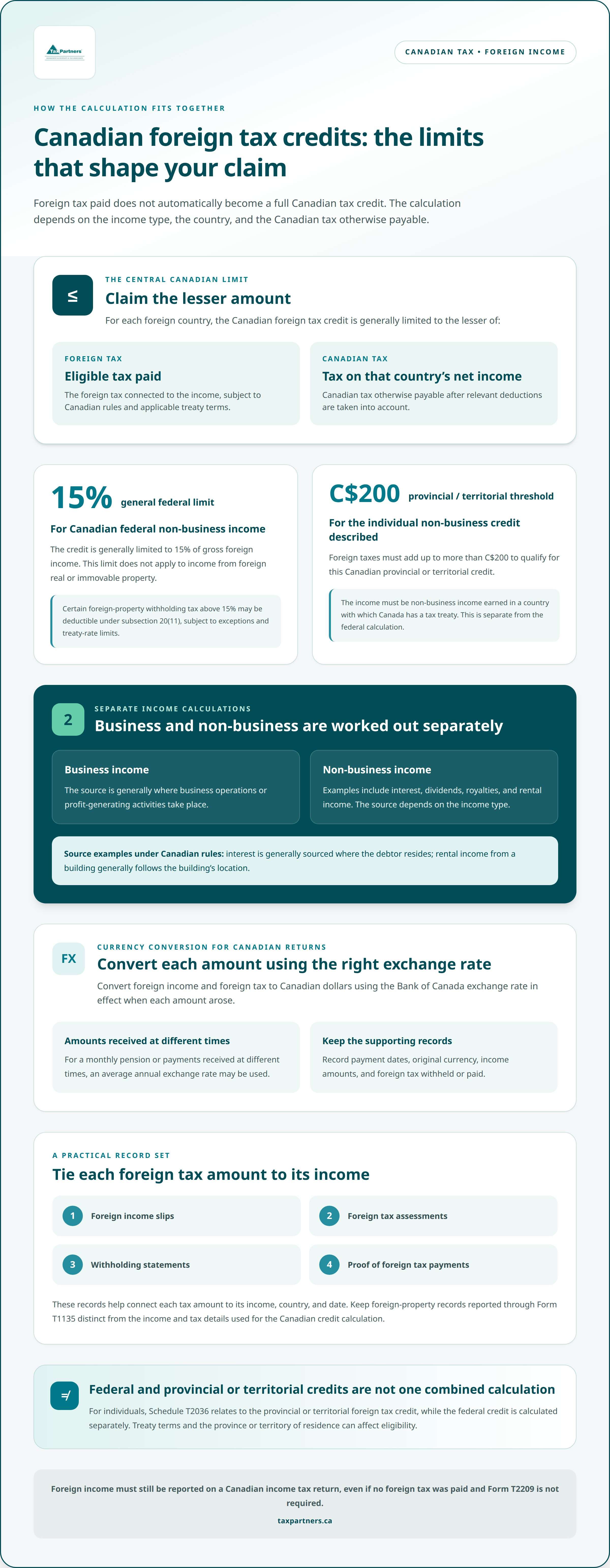
Paying foreign tax doesn’t automatically mean you can claim the full amount as a credit in Canada. A foreign tax credit, which reduces Canadian tax on eligible income taxed abroad, is generally limited for each country to the lesser of foreign income tax paid and Canadian tax otherwise payable on that country’s net income after relevant deductions. Convert foreign income and tax to Canadian dollars using the exchange rate in effect when each amount arose.
It’s understandable to expect one calculation to cover all your foreign income, but the result can vary by income type, country and province or territory. Business and non-business income are calculated separately, and the rules determine how much foreign tax can reduce your Canadian tax.
This article explains which exchange rate applies and how federal, provincial or territorial, and country-specific calculations fit together. It also shows how income-related expenses and the Canadian tax limit affect the result, so you can understand the calculation as you prepare your return.
Key Takeaways
- Foreign income and tax generally need to be converted to Canadian dollars using the exchange rate in effect when each amount arose.
- Business and non-business income require separate calculations, so the income type affects how the credit is worked out.
- Foreign tax credits are generally calculated separately for each country, with provincial or territorial calculations also relevant.
- For the 2025 Canadian tax year, the Canada Revenue Agency says to report the federal foreign tax credit on line 40500 of the federal tax return.
- Explore how a tax professional’s worked examples can clarify the limits that shape the credit you may claim.
Which exchange rate will a tax professional use to convert your foreign income?
For a foreign tax credit calculation in Canada, convert foreign income and tax into Canadian dollars using the Bank of Canada exchange rate in effect when each amount arose. For a monthly pension or payments received at different times, you can use the average annual exchange rate. Keep records of payment dates, original currency, income amounts, and foreign tax withheld or paid.
Useful documents include foreign income slips, tax assessments, withholding statements and proof of tax payments. They help connect each tax amount to its income, country and date. If the file includes Form T1135 information, the professional keeps those foreign-property records distinct from the income and tax details used for the credit calculation.
Currency conversion is only one part of the calculation. Canadian rules require separate calculations for business and non-business income, such as interest, dividends, royalties or rental income. The source country depends on the income type: business income is generally sourced where operations or profit-generating activities take place, while interest is generally sourced where the debtor resides. Rental income from a building generally follows the building’s location.
For federal non-business income, the credit is generally limited to 15% of gross foreign income, except income from foreign real or immovable property. For certain foreign property income, withholding tax above 15% may be deductible under subsection 20(11), subject to exceptions and treaty-rate limits. A Canadian tax treaty can set specific rules, so the treaty applicable to the income may affect the result. Foreign tax paid voluntarily above the amount required by the foreign country cannot be claimed as a credit.
The C$200 threshold applies to the provincial or territorial non-business foreign tax credit described for individuals: the foreign taxes must add up to more than C$200 to qualify. This is separate from the federal calculation and its 15% limit. Tax professionals distinguish these limits rather than treating the total foreign tax paid as automatically creditable.
Foreign income must still be reported on a Canadian income tax return even if no foreign tax was paid and Form T2209 isn’t required. The professional can reconcile income records with any foreign-property information carried into Form T1135, while keeping the reporting purposes separate. Canadian tax support can also address how these records fit into Canadian tax services.
What is a Foreign Tax Credit?
A Canadian foreign tax credit can reduce income tax otherwise payable when foreign income has already been taxed abroad. For individuals, provincial or territorial eligibility and corporate rules add another layer to the calculation.
Provincial and Territorial Foreign Tax Credits
An individual may be eligible for a provincial or territorial foreign tax credit on qualifying foreign non-business income. This is a separate calculation from the federal credit, not one combined amount.
The foreign tax must exceed C$200 to qualify for the provincial or territorial credit described for individuals. The income must be non-business income earned in a country with which Canada has a tax treaty. A tax professional considers the applicable treaty and the province or territory of residence when determining whether this credit applies.
Schedule T2036 is the provincial or territorial foreign tax credit schedule identified for this calculation. Its result relates to provincial or territorial tax, while the federal credit is calculated separately. This distinction helps prevent foreign tax from being treated as a direct reduction of every Canadian tax balance.
Corporate Foreign Tax Credits by Jurisdiction
For corporations, provincial or territorial foreign tax credits can reduce provincial or territorial tax otherwise payable on foreign non-business income. Each province and territory allows a corporate credit for qualifying tax paid to another country, but a corporation must meet the jurisdiction’s eligibility conditions.
A corporation must be resident in Canada throughout the tax year, have a permanent establishment in the province or territory at some time during that year, and have foreign investment income. It can claim the provincial or territorial amount only when foreign non-business income tax paid exceeds the federal foreign non-business income tax credit deductible for the year.
Quebec and Alberta collect their own income taxes, so corporations cannot claim foreign tax credits for those provinces on the federal return. The jurisdiction matters: corporate calculations and reporting must reflect where the business has a permanent establishment.
Credits Compared With Foreign Tax Deductions
A foreign tax credit reduces Canadian tax payable, while a deduction reduces the income used to calculate tax. A deduction does not subtract the same amount directly from your tax bill.
For non-business income, subsection 20(12) may allow a deduction for foreign tax paid, while subsection 20(11) may apply to certain withholding tax above 15% of foreign property income, subject to limitations and treaty rules. A deduction under subsection 20(12) is excluded from non-business income tax for foreign tax credit purposes. The professional weighs the available treatment against the income and foreign tax involved.
When foreign income, treaty terms and provincial rules intersect, discussing your Canadian tax situation can help clarify which calculation applies.
Separate calculations by province and foreign country
For Canadian tax purposes, the foreign tax credit is generally calculated separately for each foreign country and income type. Matching income, foreign tax paid and Canadian tax otherwise payable to the correct source is essential.
Country-by-Country Credit Calculations
Country-by-country calculations keep each foreign country’s income and tax paid distinct. When total foreign taxes paid to all countries exceed C$200, taxpayers generally calculate the credit separately for each country. If foreign income came from more than one country, a separate foreign income tax credit form is required for each country.
This separation shows which foreign tax relates to income earned in each country. For example, if a Canadian resident reports interest from one country and rental income from another, the records must identify each source country. The return must disclose the country and the related profits, losses and gains. Combining foreign amounts into one total can obscure which income supports each credit calculation.
Capital gains also need a clear source. For gains on immovable property, the source is generally the country where the property is located. A Canadian filer with a gain on foreign real property should identify the gain and related foreign tax with that country, rather than group them with unrelated income.
Federal Credit Calculations by Country
The federal foreign tax credit is calculated country by country, using eligible foreign tax and Canadian tax connected with net income from that country. In most cases, the credit for each country is limited to the lesser of foreign income tax actually paid and Canadian tax otherwise payable on that country’s net income. Tax paid in one country does not automatically increase the credit for another.
Income type matters too. Canada requires separate calculations for business and non-business income, so tax paid on business income is not simply combined with tax paid on interest, dividends or rent. The federal calculation reflects both the income category and source country.
Individuals claim the credit on the federal return and provincial or territorial Form 428. A separate country form supports each foreign country’s calculation. Together, these records make the link between foreign income earned, tax paid abroad and the Canadian credit traceable.
Limits by Country and Income Type
The limit is calculated separately for each country and for business and non-business income. For each country, the federal credit is generally capped at the lower of foreign income tax paid and Canadian tax otherwise payable on net income from that country. The result depends on both the foreign tax paid and the Canadian tax attributable to that income.
Suppose you earn business income in one country and receive interest from another. Separate the income and related foreign tax by country and category, then apply the relevant Canadian limit to each calculation. For Canadian entrepreneurs navigating European business structures and local tax rules, platforms like intercompanysolutions.com can provide helpful international insights, but the tax credit result for one foreign source cannot simply be transferred to another.
Provincial or territorial calculations add another jurisdictional layer. Corporations claiming those credits must calculate them separately for each province or territory and each foreign country where tax was paid. For individuals, the federal return and provincial or territorial Form 428 keep the claims distinct. Clear records of country, income type, profits, losses, gains and tax paid support those calculations.
Federal foreign tax credit calculation
A federal foreign tax credit can reduce Canadian tax otherwise payable when a taxpayer reports foreign-source income and pays eligible foreign income tax. A tax professional checks eligibility, separates income categories and calculates the federal claim using Form T2209.
Federal Credit Eligibility
An individual may generally claim the federal credit if they were resident in Canada at any time during the year and reported foreign-source income taxed abroad. The tax must relate to business or non-business income. Foreign income alone does not establish eligibility: qualifying foreign tax must also have been paid on that income.
The federal credit is non-refundable for a Canadian resident, so it reduces tax payable rather than creating a refund beyond that tax. The calculation also accounts for Canadian tax otherwise payable on eligible foreign income. A tax professional reviews the income type, source country and foreign tax records before calculating the claim.
Qualifying Foreign Taxes
Qualifying foreign taxes are income taxes paid to another country on foreign-source business or non-business income reported in Canada. Non-business income includes dividends, interest, royalties and rental income. The connection between the tax and reported income matters: the federal calculation matches foreign tax paid to the relevant income and country.
Keep business income tax separate from non-business income tax rather than combining the categories. Foreign tax required under the other country’s rules may qualify, subject to Canadian limits. If a treaty applies, its terms can also affect how the foreign tax is treated for Canadian tax purposes.
Foreign Taxes That Do Not Qualify
Foreign tax paid voluntarily above the amount required by the foreign country cannot be claimed as a Canadian foreign tax credit. If a payment includes both required tax and an excess amount, the excess is not eligible simply because it was paid.
Tax that does not relate to eligible foreign-source income also does not support the credit. For example, a foreign payment connected to income that isn’t reported as taxable income in Canada may not qualify. A tax professional reviews the foreign assessment and payment records to identify the required income tax amount and exclude ineligible payments.
Federal T2209 calculation steps a tax professional follows
For the 2025 Canadian tax year, taxpayers calculate their federal foreign tax credits using Form T2209. The calculation generally limits the credit for each country to the lesser of foreign income tax actually paid and Canadian tax otherwise payable on that country’s net income. The federal credit amount from line 12 of Form T2209 goes to line 40500.
For the 2025 Canadian tax year, the Canada Revenue Agency says the federal foreign tax credit is reported on line 40500 of the federal tax return. For business income across multiple jurisdictions, the federal calculation uses amounts from Part 2 of Form T2203. According to the Canada Revenue Agency, unused Canadian foreign tax credits can generally be carried forward for up to 10 years and carried back up to 3 years.
Foreign tax credit calculation examples
Worked examples show why foreign tax paid doesn’t automatically equal the Canadian credit. A tax professional compares eligible foreign income tax with Canadian tax otherwise payable, while keeping each country and income category separate.
Consider a Canadian taxpayer with C$10,000 of foreign income and C$2,000 of foreign tax paid. If Canadian tax otherwise payable on that income is C$1,500, the credit is limited to C$1,500, the lower amount.
A separate non-business example illustrates the effect of expenses. A taxpayer receives C$20,000 in US dividends, pays C$3,000 in US withholding tax and has C$12,000 of interest expense on a loan used to buy those shares. The resulting net US non-business income is C$8,000, and the worked calculation limits the credit to C$2,400.
That example uses a 45% marginal tax rate, total net income of C$100,000 and tax otherwise payable of C$30,000. The figures show why a professional assesses the relationship between foreign income, related expenses and Canadian tax. A treaty may also affect the tax treatment, so the applicable treaty terms belong in the review.
Not every unused amount can be carried forward. In a separate non-business example, C$600 of foreign tax isn’t credited and can’t be carried forward or back. This differs from the general carryover rules for unused Canadian foreign tax credits, so income type matters when assessing what happens to an unused amount.
A professional also distinguishes a credit from a deduction. If foreign tax exceeds the available credit limit, certain deductions may apply under Canadian rules, including subsection 20(11) or subsection 20(12), subject to their conditions. The right treatment depends on the income, foreign tax paid and any treaty terms, not simply on which amount appears larger.
These examples are guides to the mechanics, not a substitute for matching a return’s actual income and tax records. A tax professional prepares the separate calculations, identifies the applicable limits and determines whether a deduction is relevant. To discuss a professional review of your foreign tax credit calculation, share the income and foreign tax details for your situation.
Tax Partners
Tax Partners helps individuals and businesses assess foreign income and tax for Canadian returns. Its Canadian Accounting & Tax Services support situations involving multiple income types or related records.
Consider professional support when you’ve paid foreign tax, business and non-business income overlap, or treaty terms affect the calculation. Tax Partners can help organize the relevant information and apply Canadian rules to your circumstances.
Contact Tax Partners to discuss your foreign tax credit calculation.
Move ahead with a coordinated tax review
A foreign tax credit calculation in Canada can affect more than one part of your tax picture. When foreign income connects with business activity or payroll records, a coordinated review can help align your reporting and clarify the next filing steps.
Tax Partners offers Canadian Accounting & Tax Services and Bookkeeping and Payroll Services. The right support depends on how your foreign income and wider records fit together. Discuss the calculation alongside the related Canadian tax matters that apply to your circumstances.
Contact Tax Partners to discuss your tax situation. A clear next step can make complex reporting easier to approach with confidence.
Frequently Asked Questions
Do you need the T2209 if you paid no foreign tax?
No. If you paid no foreign tax, you generally don’t need Form T2209 to claim a foreign tax credit. You still need to report foreign income on your Canadian tax return, even when no tax was withheld abroad.
For example, foreign interest income remains reportable even if the payer deducted no tax. Keep income records separate from foreign tax receipts: reporting income and claiming a credit are different steps.
How much can you claim with the T2209?
The federal credit is generally limited to the lower of qualifying foreign income tax paid and Canadian tax otherwise payable on net income from that country. Calculate it separately for each country and for business or non-business income.
For instance, foreign tax paid on dividends from one country can’t simply be added to tax paid on business income from another. The amount entered on your return depends on the completed calculation.
What happens if your foreign tax is more than your Canadian tax?
If eligible foreign tax exceeds the Canadian tax limit for that income, the full amount may not be credited in that calculation. The treatment of the excess depends on the income category and applicable rules.
Some unused Canadian foreign tax credits may generally be carried back or forward, but an unclaimed non-business credit cannot be carried forward. A tax professional distinguishes an unused eligible credit from tax that cannot be credited.
What is a T2209 form?
Form T2209 is the Canadian federal form used to calculate foreign tax credits for eligible foreign income taxes. It helps determine the federal credit by organizing the relevant foreign income and tax, with separate calculations for countries and income categories.
The completed calculation provides the federal credit amount for your tax return. It does not replace reporting the foreign income, even if foreign tax was withheld.
Who should fill out a T2209?
A taxpayer who may claim a Canadian federal foreign tax credit generally needs a T2209 calculation when foreign income was taxed abroad. An individual may generally qualify if they were resident in Canada at some point during the year and reported foreign-source income subject to foreign business or non-business tax.
A tax professional can prepare the calculation using income and foreign tax records, including statements that identify the country and tax paid.
How does the Canadian foreign tax credit work?
The credit helps reduce Canadian tax when another country has also taxed your foreign income. The federal calculation compares eligible foreign income tax with the Canadian tax attributable to that income, subject to the applicable limit.
Provincial or territorial calculations may also apply. For example, foreign dividends and foreign business earnings are different income categories, so their related foreign taxes aren’t automatically combined.
Who can claim a foreign tax credit on a Canadian tax return?
An individual may generally claim the federal credit if they were resident in Canada at any time during the year, reported foreign-source income and paid foreign business or non-business income tax on it. The claim must relate to eligible tax, not an amount paid voluntarily above what the foreign country required.
Your income type, source country and tax records help establish whether you can claim a credit.
How does a tax professional calculate the federal foreign tax credit in Canada?
Sort foreign income and tax records by country and by business or non-business category, then calculate the eligible amount under Canadian rules. Compare foreign tax paid with the Canadian tax limit associated with that country’s net income.
Also account for relevant deductions and treaty terms, where applicable, and enter the calculated federal amount on the return. Clear records of income and tax payments support the calculation.

Article by
Mahad Mohamed
Mahad Mohamed is an accountant and the CEO of Tax Partners, with over 26+ years of Canadian and international tax and accounting experience. His expertise includes corporate reorganization, cross-border tax structuring (Canada & US), tax disputes, CRA audits, and tax planning for small owner-managed private corporations. Most recently, Mahad is a pioneer in Canadian crypto taxation and founded Block3 Finance.
Previously, Mahad worked for the Canada Revenue Agency (CRA), Big4 accounting firms, and served as a Rulings Officer for the Federal Tax Authority of the UAE before acquiring Tax Partners in 2014.
Tax Partners has 44 full-time accountants and over 18,400+ clients.
Disclaimer
This article provides general information only and is current as of its publication date. It has not been updated and may be out of date. It does not constitute legal advice and should not be relied upon as such. Every tax situation is unique and may differ from the examples discussed in this article. If you have specific questions, you should seek the advice of our accountants for your unique circumstances. Book a FREE Initial Consultation Today!
Frequently Asked Questions
Do you need the T2209 if you paid no foreign tax?
No. If you paid no foreign tax, you generally don’t need Form T2209 to claim a foreign tax credit. You still need to report foreign income on your Canadian tax return, even when no tax was withheld abroad. For example, foreign interest income remains reportable even if the payer deducted no tax. Keep income records separate from foreign tax receipts: reporting income and claiming a credit are different steps.
How much can you claim with the T2209?
The federal credit is generally limited to the lower of qualifying foreign income tax paid and Canadian tax otherwise payable on net income from that country. Calculate it separately for each country and for business or non-business income. For instance, foreign tax paid on dividends from one country can’t simply be added to tax paid on business income from another. The amount entered on your return depends on the completed calculation.
What happens if your foreign tax is more than your Canadian tax?
If eligible foreign tax exceeds the Canadian tax limit for that income, the full amount may not be credited in that calculation. The treatment of the excess depends on the income category and applicable rules. Some unused Canadian foreign tax credits may generally be carried back or forward, but an unclaimed non-business credit cannot be carried forward. A tax professional distinguishes an unused eligible credit from tax that cannot be credited.
What is a T2209 form?
Form T2209 is the Canadian federal form used to calculate foreign tax credits for eligible foreign income taxes. It helps determine the federal credit by organizing the relevant foreign income and tax, with separate calculations for countries and income categories. The completed calculation provides the federal credit amount for your tax return. It does not replace reporting the foreign income, even if foreign tax was withheld.
Who should fill out a T2209?
A taxpayer who may claim a Canadian federal foreign tax credit generally needs a T2209 calculation when foreign income was taxed abroad. An individual may generally qualify if they were resident in Canada at some point during the year and reported foreign-source income subject to foreign business or non-business tax. A tax professional can prepare the calculation using income and foreign tax records, including statements that identify the country and tax paid.
How does the Canadian foreign tax credit work?
The credit helps reduce Canadian tax when another country has also taxed your foreign income. The federal calculation compares eligible foreign income tax with the Canadian tax attributable to that income, subject to the applicable limit. Provincial or territorial calculations may also apply. For example, foreign dividends and foreign business earnings are different income categories, so their related foreign taxes aren’t automatically combined.
Who can claim a foreign tax credit on a Canadian tax return?
An individual may generally claim the federal credit if they were resident in Canada at any time during the year, reported foreign-source income and paid foreign business or non-business income tax on it. The claim must relate to eligible tax, not an amount paid voluntarily above what the foreign country required. Your income type, source country and tax records help establish whether you can claim a credit.
How does a tax professional calculate the federal foreign tax credit in Canada?
Sort foreign income and tax records by country and by business or non-business category, then calculate the eligible amount under Canadian rules. Compare foreign tax paid with the Canadian tax limit associated with that country’s net income. Also account for relevant deductions and treaty terms, where applicable, and enter the calculated federal amount on the return. Clear records of income and tax payments support the calculation.