Estate freeze for business succession: How it works

What if succession planning in Canada didn’t require you to give up control of your business all at once? An estate freeze for business succession can fix the current value of an owner’s shares while directing future growth to new shareholders, such as family members, key employees or a family trust. It doesn’t eliminate tax, but it can help separate the value already built from the growth that may follow.
It’s understandable to view an estate freeze as a way to pass a business to the next generation. It can also separate voting control from economic ownership, allowing an owner to retain decision-making authority while successors share in future growth. A trust can hold growth shares and provide flexibility over who may benefit, but it isn’t required.
This article explains how an estate freeze works in Canada, how trusts and voting rights fit into the plan, and what to consider before choosing a structure. You’ll also learn how a freeze may support a family or management succession, and why a sale to an outside buyer may call for a different approach. The goal is to clarify the options and decisions involved.
Key Takeaways
- A freeze can fix the value of an owner’s existing shares while directing future business growth to successors.
- A family trust is optional; it can offer flexibility in who benefits from growth shares and how they’re allocated.
- Voting rights and economic ownership can be structured separately, allowing an owner to retain control while successors participate in growth.
- Family, management and third-party transitions have different financial and control considerations, so the structure should fit the intended route.
- A freeze is one part of succession planning. Retirement needs, business value and future tax consequences all matter when assessing its role.
How does a family trust fit into the plan?
In Canada, a family trust can hold new growth shares after an estate freeze. Canada’s 21-year trust rule deems trust assets disposed of at fair market value, meaning the price they would reasonably fetch in an open-market sale. That deemed sale can create capital gains tax, a tax on the increase in an asset’s value, unless the trust’s anniversary is addressed through planning.
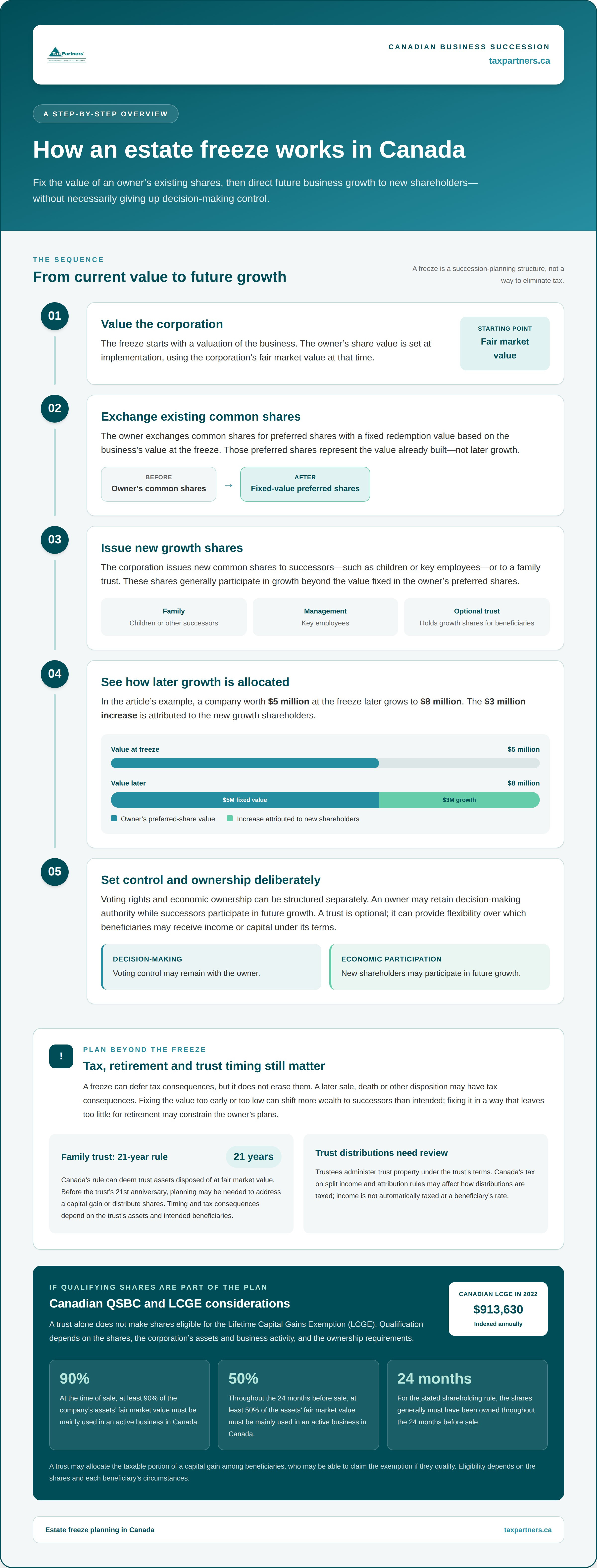
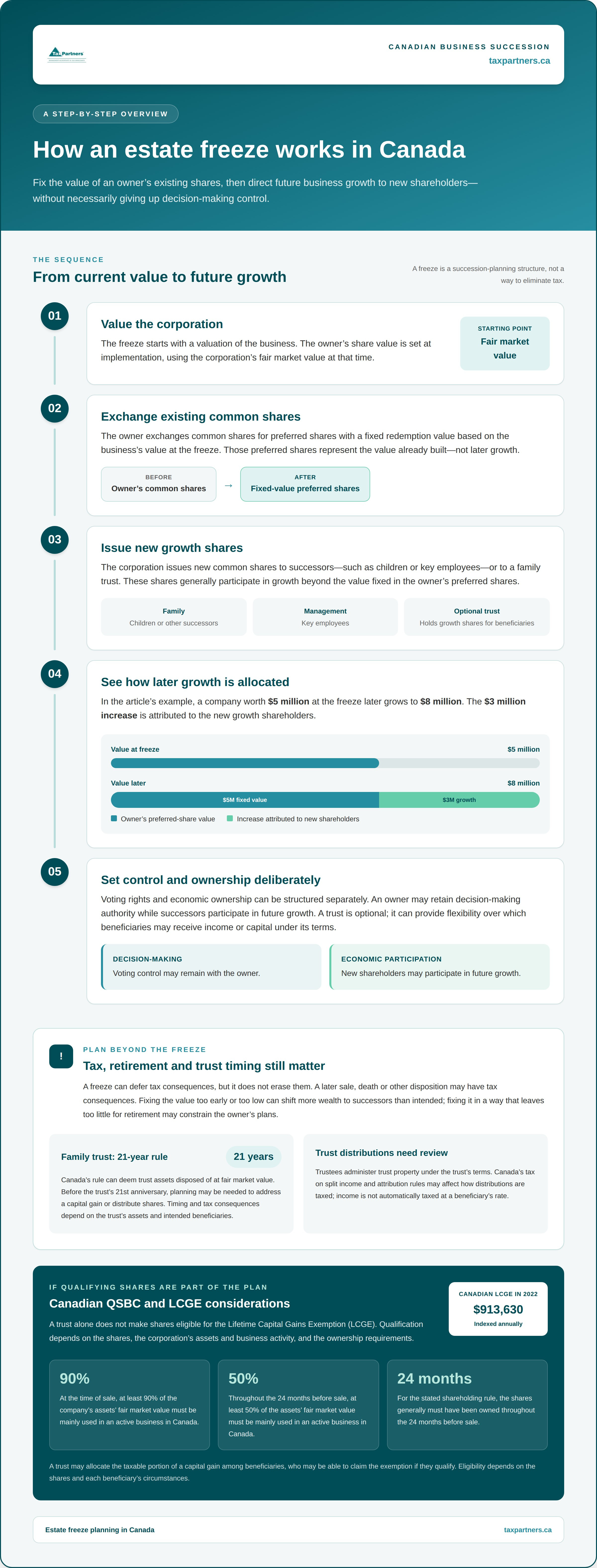
An estate freeze usually starts with a valuation of the corporation. The owner exchanges common shares for preferred shares with a fixed redemption value based on the business’s fair market value at that time. These preferred shares represent the owner’s existing business value, not future growth.
The corporation then issues new common shares to successors or a family trust. These shares generally participate in growth beyond the value fixed in the preferred shares. A trust can hold the growth shares for beneficiaries, such as children, while the owner retains preferred shares.
For example, if a company is worth $5 million when frozen and later grows to $8 million, the $3 million increase is attributed to new shareholders. If a family trust holds their shares, its terms provide flexibility over which beneficiaries receive income or capital. The trust does not replace the need to plan who makes business decisions.
Trustees administer trust property for beneficiaries under the trust’s terms. Where those terms allow discretion, trustees decide how to allocate income or capital. Canada’s tax on split income rules, which can tax certain income shared with family members, may affect distributions. Attribution rules, which can assign income or gains back to the person who transferred property, also need to be considered.
A trust can also be part of planning for the lifetime capital gains exemption (LCGE). This exemption can reduce taxable capital gains on qualifying shares, but the shares must meet Canada’s qualified small business corporation (QSBC) conditions. A trust’s ownership alone does not make shares qualify.
- At the time of sale, at least 90% of the company’s assets’ fair market value must be mainly used in an active business in Canada.
- Throughout the 24 months before sale, at least 50% of the assets’ fair market value must be mainly used in an active business in Canada.
- For the stated shareholding rule, the shares generally must have been owned throughout the 24 months before sale.
The Canadian LCGE was $913,630 in 2022 and is indexed annually. A trust can allocate the taxable portion of a capital gain on trust shares among beneficiaries, potentially allowing them to claim the exemption if they qualify. Eligibility depends on the shares and each beneficiary’s circumstances.
The 21-year rule also shapes the trust’s longer-term plan. Before its 21st anniversary, a trust may need to distribute shares to avoid a capital gain on distributing its assets. The timing and tax consequences of that distribution depend on the trust’s assets and intended beneficiaries. Including the anniversary in the succession timeline helps trustees plan for the transition.
What’s an estate freeze?
Under Canada’s Income Tax Act, an estate freeze can set an owner’s share value at implementation and direct later growth elsewhere. It doesn’t erase tax: subsection 70(5) generally deems a taxpayer to dispose of property at fair market value upon death.
A typical structure exchanges an owner’s common shares for fixed-value preferred shares. The corporation can issue new common shares to successors, separating the owner’s existing capital from future growth. A classic freeze may use a transfer under subsection 85(1) without immediate tax consequences.
The tax result depends on the transaction, share value and ownership structure. Sections 51, 85 and 86 of Canada’s Income Tax Act are rollover mechanisms that can be used for an estate freeze. A rollover generally defers tax rather than removing it, so the owner’s fixed-value shares can still carry tax consequences later.
Consider a company valued at $5 million when its owner freezes the shares. If it later reaches $8 million, the $3 million increase generally belongs to the new growth shareholders. The owner’s preferred shares remain tied to the value established at the freeze, subject to their terms.
New shareholders may include children, key employees or a family trust. If a trust holds shares, its trustees may allocate income or capital among beneficiaries according to the trust’s terms. Canada’s tax on split income and attribution rules can affect the tax treatment, so distributions aren’t automatically taxed at a beneficiary’s rate.
For an owner, a key risk is fixing the value too early or too low. If the business grows beyond expectations, successors may receive more wealth than intended. If the freeze leaves too little value for retirement, the owner’s plans may be constrained. A sale earlier than planned can also shift substantial value to growth shareholders sooner than expected.
The Lifetime Capital Gains Exemption (LCGE) may matter if shares qualify as qualified small business corporation (QSBC) shares. Qualification depends on requirements involving the corporation’s assets, business activity and share ownership. A freeze alone doesn’t make shares eligible. A trust structure also needs to account for who owns the shares and who may claim an exemption.
Capital gains planning should consider both the gain already built into the owner’s shares and growth after the freeze. The structure can defer some tax consequences, but tax may arise on a later sale, death or other disposition. For example, an owner’s estate may face a deemed disposition at fair market value under subsection 70(5).
These Canadian rules and the owner’s retirement needs should be assessed together before the transaction. A focused consultation about the tax structure can help clarify how share value, income allocation and succession goals interact.
Family, management and third-party succession routes
Choosing a successor shapes the share structure, financing and control arrangements. In Canada, an estate freeze can support a family or management transition, but it doesn’t complete the succession plan on its own.
Choosing a Succession Route
A succession route identifies who will own or acquire the business and how the transition will work. The choice matters because a child, key employee and outside buyer may have different financing capacity, decision-making roles and expectations.
For a family transition, consider whether the next generation wants to operate the corporation and whether family members agree on their roles. Selling shares to a child at fair market value creates a taxable disposition for the seller and a financing obligation for the child. A direct purchase may be difficult if the business is valuable and the child lacks funds.
A management succession can transfer ownership to key employees who understand the company’s operations. The plan needs to address how they’ll fund an acquisition and when authority will change hands. If a family member remains involved, clear decision-making arrangements can prevent confusion between the new owners and the former owner.
A sale to a third party may suit an owner without a willing family or management successor. Unlike a gradual transfer to the next generation, an outside sale centres on the buyer’s offer, whether shares or assets are sold, and the owner’s intended exit. A shareholders’ agreement can help define valuation and exit arrangements when there are multiple owners.
Family dynamics deserve as much attention as the corporation’s financial objectives. For example, if one child manages the company and another does not, equal ownership may not reflect their contributions or responsibilities. The succession structure should account for the family’s goals, the owner’s retirement needs and the intended balance between fair treatment and effective business leadership.
Trusts, Holding Corporations and Costs
A family trust or holding corporation can form part of a succession structure, but each has a different role. A trust can hold shares for beneficiaries; a holding corporation can hold shares or other corporate investments. Choosing between them affects ownership and administration, so the structure should reflect the intended transfer.
The cost depends on the case and is provided after a quote request; factors include valuation work, share restructuring, trust or corporate documents, and ongoing administration. These needs vary with the number of owners, the corporation’s structure and the succession route. A simple transfer and a trust-based plan can involve different work.
In Canada, a unanimous shareholders’ agreement can set out decision-making, exit arrangements, share valuation and how a buyout will be funded. For a family-owned company, its terms can address what happens if a successor leaves or a proposed sale occurs. A contingency plan also matters if the owner’s preferred successor cannot take over.
For a business valued at C$5 million, a child’s purchase at fair market value may require substantial financing. A freeze may help separate the owner’s existing value from later growth, but it doesn’t make the purchase affordable by itself. The plan should connect ownership, repayment capacity and the family’s control objectives before the transfer proceeds.
Separating voting control from economic ownership
A Canadian corporation can separate who directs the business from who benefits from its growth. In an estate freeze, the owner’s preferred shares can retain voting rights while new common shares participate in future growth. This distinction lets an owner plan a gradual transition without automatically transferring day-to-day authority along with economic value.
The share terms determine how this separation works. Preferred shares can carry votes and a fixed redemption value, while common shares issued to successors can carry growth rights. These rights need to be set out in the corporation’s share structure. The labels alone don’t determine who can approve major decisions or receive business value.
For example, an owner-manager may keep voting preferred shares after issuing growth shares to a child or key employee. The owner can continue directing operations while the new shareholder participates in the business’s growth. This arrangement can support a staged handover, but it doesn’t establish when management responsibilities will change.
Business owners should distinguish voting power from practical authority. A shareholder may hold votes without managing daily operations, while an owner-manager may lead the business under separate arrangements. The plan should identify who makes routine decisions, who approves significant corporate actions and how disagreements are handled.
- Voting rights can remain attached to the owner’s preferred shares.
- A separate voting share class can distinguish governance rights from growth rights.
- A family trust or carefully designed share rights may help an owner-manager retain control while growth shares pass to the next generation.
Each option offers different flexibility. Keeping voting rights on preferred shares can preserve a direct connection between the owner and corporate decisions. A separate voting class can make the division more explicit. The corporation’s governing documents and share terms need to work together so voting rights match the intended transition.
Control also needs a succession timetable. An owner might retain voting authority while a successor learns the business, then transfer decision-making as responsibilities shift. If the owner intends to continue leading indefinitely, the successor’s economic interest may not provide the influence they expect. Clear roles help prevent that mismatch.
A unanimous shareholders’ agreement can address decision-making, exits, share valuation and how a buyout is funded. For example, it can clarify what happens if a successor wants to leave or owners disagree about a proposed sale. These terms complement share rights; they don’t replace a clear plan for who votes and who manages.
Before a freeze, map each shareholder’s economic interest, voting rights and operational role. Then consider how those rights would change if the owner retires, becomes unable to manage, or the corporation is sold. This review helps keep control arrangements aligned with succession goals as ownership evolves.
Estate freeze purposes in business succession
An estate freeze can help a Canadian owner separate succession timing from the transfer of future growth. Its value depends on the owner’s retirement needs, intended successors and plans for the business.
A sale transfers ownership to a buyer in exchange for sale proceeds. A family succession plan sets out how relatives may take over. A freeze can support that plan by directing future growth to successors, but it doesn’t transfer control on its own.
For a family business, the goal may be to help children participate in future growth while the owner retains value in preferred shares. This structure can suit a child preparing to lead the company, but it doesn’t resolve disagreements about roles, ownership or how other family members will be treated.
A traditional freeze can shift future growth to the next generation, while a partial freeze lets the owner retain some growth shares. The choice affects how later increases in business value are shared. A family trust may hold shares for beneficiaries, but it isn’t necessary for every succession plan.
The Lifetime Capital Gains Exemption (LCGE) may also shape the plan. If successors eventually sell shares, their ability to claim the exemption depends on whether those shares meet the qualified small business corporation share requirements. A freeze doesn’t make shares qualify automatically, so exemption planning needs to consider the corporation’s assets and business activity.
Timing matters. An owner who freezes all future growth too early may leave insufficient business value for retirement. Before shifting growth, the plan should account for personal assets, expected retirement needs and the value remaining in the owner’s preferred shares.
A freeze can also be unsuitable if a sale is likely soon. If the business sells earlier than expected, substantial value may pass to growth shareholders before the owner intended. A reversible or partial structure may offer flexibility, but changing ownership later involves tax considerations and may require cooperation from children or other shareholders.
In Canada, the freeze mechanisms described operate under the federal Income Tax Act, while provincial tax can affect the overall tax payable. An Ontario example uses a combined federal and Ontario marginal tax rate of 53.53%, illustrating why location can matter to the calculation.
Owners may also need to revisit the structure if the original valuation assumptions prove too optimistic. A refreeze can be considered, but it may require the owner to regain growth ownership and the family to agree. Starting succession planning well before the intended transition leaves more room to address valuation, retirement and control goals.
To weigh these purposes against your retirement and succession objectives, discuss your estate-freeze plan with a tax professional.
Tax Partners
Tax Partners helps business owners assess Canadian tax and financial-planning considerations related to succession. Its Canadian Accounting & Tax Services can support analysis of share values, potential tax consequences and how a proposed transition fits the owner’s broader financial picture.
Turn to Tax Partners when weighing a family transfer, management succession or future sale, or when changing business value may affect an existing plan. Wealth Management & Financial Planning can help connect succession decisions with personal assets and retirement objectives.
Start by identifying the transition questions that matter most to you, then bring them into a focused planning conversation. Contact Tax Partners about succession planning to discuss a considered path forward for your business.
Put the next decisions in motion
Succession planning is more useful when it connects ownership decisions with the business’s future operations and your personal financial plans. Consider what needs to happen before a transition, what information decision-makers will need, and how the plan should adapt as circumstances change. An estate freeze for business succession is one part of that larger process, not a substitute for a complete transition plan.
Tax Partners offers Canadian Accounting & Tax Services to help assess Canadian tax considerations. Bookkeeping and Payroll Services can support the financial records and payroll processes involved in ongoing operations. The right support depends on the decisions your succession plan needs to address.
Start by identifying the transition questions that matter most to you, then bring them into a focused planning conversation. Contact Tax Partners about succession planning to discuss a considered path forward for your business.
Frequently Asked Questions
Does Every Business Owner Need This Type of Tax Planning?
No. An estate freeze suits some Canadian owners, but not every business or succession objective. It’s most relevant when an owner wants to plan for future growth, a transfer to successors, or the tax consequences of holding shares over time. If the owner expects to sell soon, needs more business value for retirement, or has no clear successor, other planning routes may better fit those circumstances.
What are the potential benefits?
A freeze can help define how existing business value and later growth are shared while allowing the owner to plan the timing of a transition. In a family company, it can help successors build an economic interest before assuming management. Planning can also consider the Lifetime Capital Gains Exemption if shares qualify. These are planning opportunities, not automatic tax savings, and depend on the company’s circumstances and the eventual transaction.
When should I start planning?
Start well before the intended transition, while there’s time to assess the business, successors and the owner’s retirement needs. Early planning also gives the family and management team room to discuss roles and address a possible change in direction. For example, an owner considering retirement can begin planning before a child or key employee is ready to assume leadership, rather than waiting until the handover is imminent.
What is an estate freeze for business succession in Canada?
In Canada, an estate freeze for business succession is a corporate share-restructuring strategy that fixes the value of the owner’s existing shares and directs subsequent growth to new shareholders. It can support a transfer to family members or key employees while the owner retains an interest in the corporation. The transaction doesn’t eliminate tax or complete succession on its own; its design needs to align with the owner’s broader transition plan.
How does an estate freeze work using preferred shares and common shares?
In a typical Canadian freeze, the owner exchanges existing common shares for preferred shares with a fixed value. The corporation then issues new common shares to successors or a trust. The preferred shares represent the owner’s existing value, while the new common shares participate in subsequent growth. Share terms also determine voting rights, so economic interests and decision-making roles need to be considered together.
How is the value of a Canadian business determined for an estate freeze?
A business valuation estimates fair market value at the time of the freeze, helping set the value represented by the owner’s preferred shares. The valuation should reflect the corporation’s circumstances, including its financial position, assets and prospects. For example, a recent change in earnings or a major business asset can affect the assessment. A clear valuation supports the share exchange and helps distinguish existing value from later growth.
What steps does a professional take to implement an estate freeze for a Canadian private corporation?
A professional typically reviews the owner’s objectives, retirement needs, succession route and corporate records before proposing a structure. The work can include assessing business value, considering the tax treatment of the share exchange, and coordinating preferred and common share terms with the intended ownership and voting arrangements. If a trust is involved, its role and future administration also need consideration. The plan should connect the transaction with the handover.
How can a family trust be used in an estate freeze, and what are the tax implications?
A family trust can hold new growth shares for beneficiaries, giving trustees discretion over who receives income or capital under the trust’s terms. In Canada, tax on split income and attribution rules can affect how distributions are taxed. The trust is also deemed to dispose of its assets at fair market value every 21 years, which can create a capital gains tax liability. Trust administration and anniversary planning therefore matter.

Article by
Mahad Mohamed
Mahad Mohamed is an accountant and the CEO of Tax Partners, with over 26+ years of Canadian and international tax and accounting experience. His expertise includes corporate reorganization, cross-border tax structuring (Canada & US), tax disputes, CRA audits, and tax planning for small owner-managed private corporations. Most recently, Mahad is a pioneer in Canadian crypto taxation and founded Block3 Finance.
Previously, Mahad worked for the Canada Revenue Agency (CRA), Big4 accounting firms, and served as a Rulings Officer for the Federal Tax Authority of the UAE before acquiring Tax Partners in 2014.
Tax Partners has 44 full-time accountants and over 18,400+ clients.
Disclaimer
This article provides general information only and is current as of its publication date. It has not been updated and may be out of date. It does not constitute legal advice and should not be relied upon as such. Every tax situation is unique and may differ from the examples discussed in this article. If you have specific questions, you should seek the advice of our accountants for your unique circumstances. Book a FREE Initial Consultation Today!
Frequently Asked Questions
Does Every Business Owner Need This Type of Tax Planning?
No. An estate freeze suits some Canadian owners, but not every business or succession objective. It’s most relevant when an owner wants to plan for future growth, a transfer to successors, or the tax consequences of holding shares over time. If the owner expects to sell soon, needs more business value for retirement, or has no clear successor, other planning routes may better fit those circumstances.
What are the potential benefits?
A freeze can help define how existing business value and later growth are shared while allowing the owner to plan the timing of a transition. In a family company, it can help successors build an economic interest before assuming management. Planning can also consider the Lifetime Capital Gains Exemption if shares qualify. These are planning opportunities, not automatic tax savings, and depend on the company’s circumstances and the eventual transaction.
When should I start planning?
Start well before the intended transition, while there’s time to assess the business, successors and the owner’s retirement needs. Early planning also gives the family and management team room to discuss roles and address a possible change in direction. For example, an owner considering retirement can begin planning before a child or key employee is ready to assume leadership, rather than waiting until the handover is imminent.
What is an estate freeze for business succession in Canada?
In Canada, an estate freeze for business succession is a corporate share-restructuring strategy that fixes the value of the owner’s existing shares and directs subsequent growth to new shareholders. It can support a transfer to family members or key employees while the owner retains an interest in the corporation. The transaction doesn’t eliminate tax or complete succession on its own; its design needs to align with the owner’s broader transition plan.
How does an estate freeze work using preferred shares and common shares?
In a typical Canadian freeze, the owner exchanges existing common shares for preferred shares with a fixed value. The corporation then issues new common shares to successors or a trust. The preferred shares represent the owner’s existing value, while the new common shares participate in subsequent growth. Share terms also determine voting rights, so economic interests and decision-making roles need to be considered together.
How is the value of a Canadian business determined for an estate freeze?
A business valuation estimates fair market value at the time of the freeze, helping set the value represented by the owner’s preferred shares. The valuation should reflect the corporation’s circumstances, including its financial position, assets and prospects. For example, a recent change in earnings or a major business asset can affect the assessment. A clear valuation supports the share exchange and helps distinguish existing value from later growth.
What steps does a professional take to implement an estate freeze for a Canadian private corporation?
A professional typically reviews the owner’s objectives, retirement needs, succession route and corporate records before proposing a structure. The work can include assessing business value, considering the tax treatment of the share exchange, and coordinating preferred and common share terms with the intended ownership and voting arrangements. If a trust is involved, its role and future administration also need consideration. The plan should connect the transaction with the handover.
How can a family trust be used in an estate freeze, and what are the tax implications?
A family trust can hold new growth shares for beneficiaries, giving trustees discretion over who receives income or capital under the trust’s terms. In Canada, tax on split income and attribution rules can affect how distributions are taxed. The trust is also deemed to dispose of its assets at fair market value every 21 years, which can create a capital gains tax liability. Trust administration and anniversary planning therefore matter.