FBAR Filing Guide for Canadians: 2026 IRS Requirements

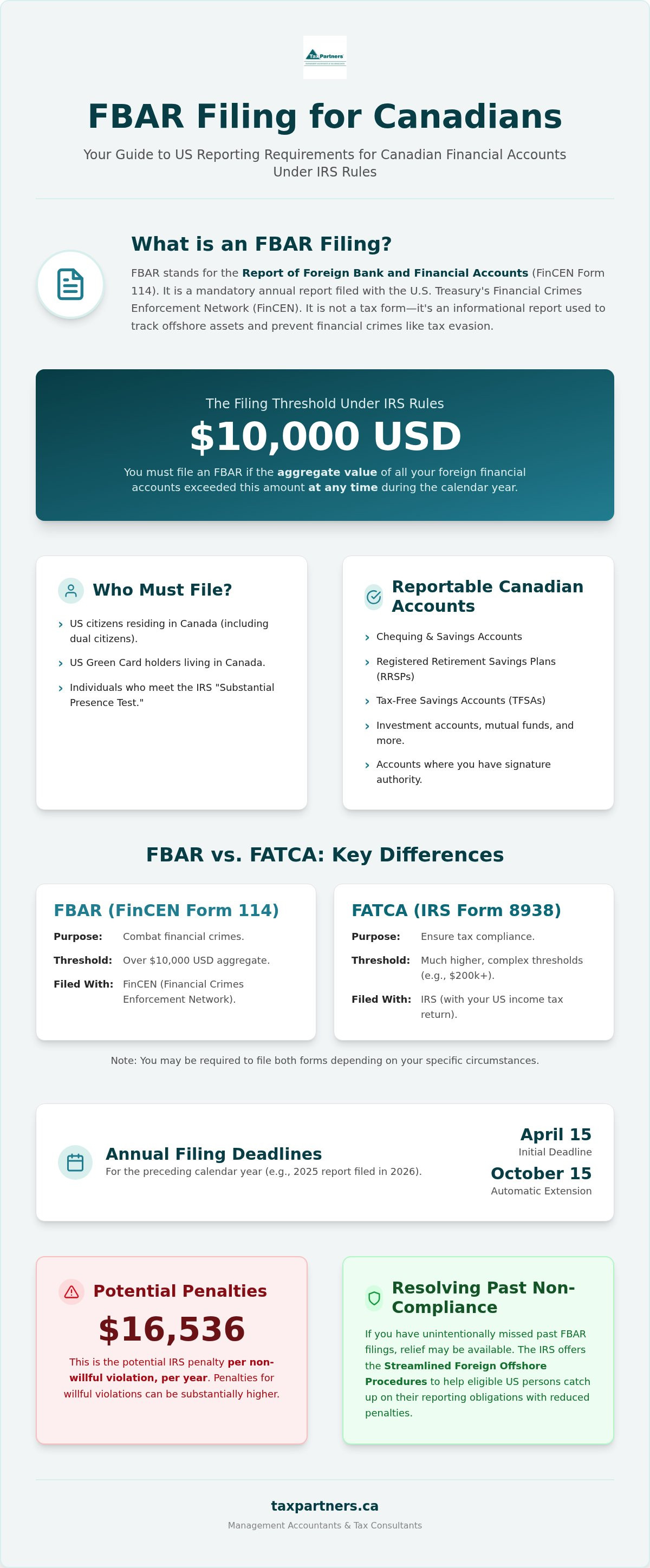
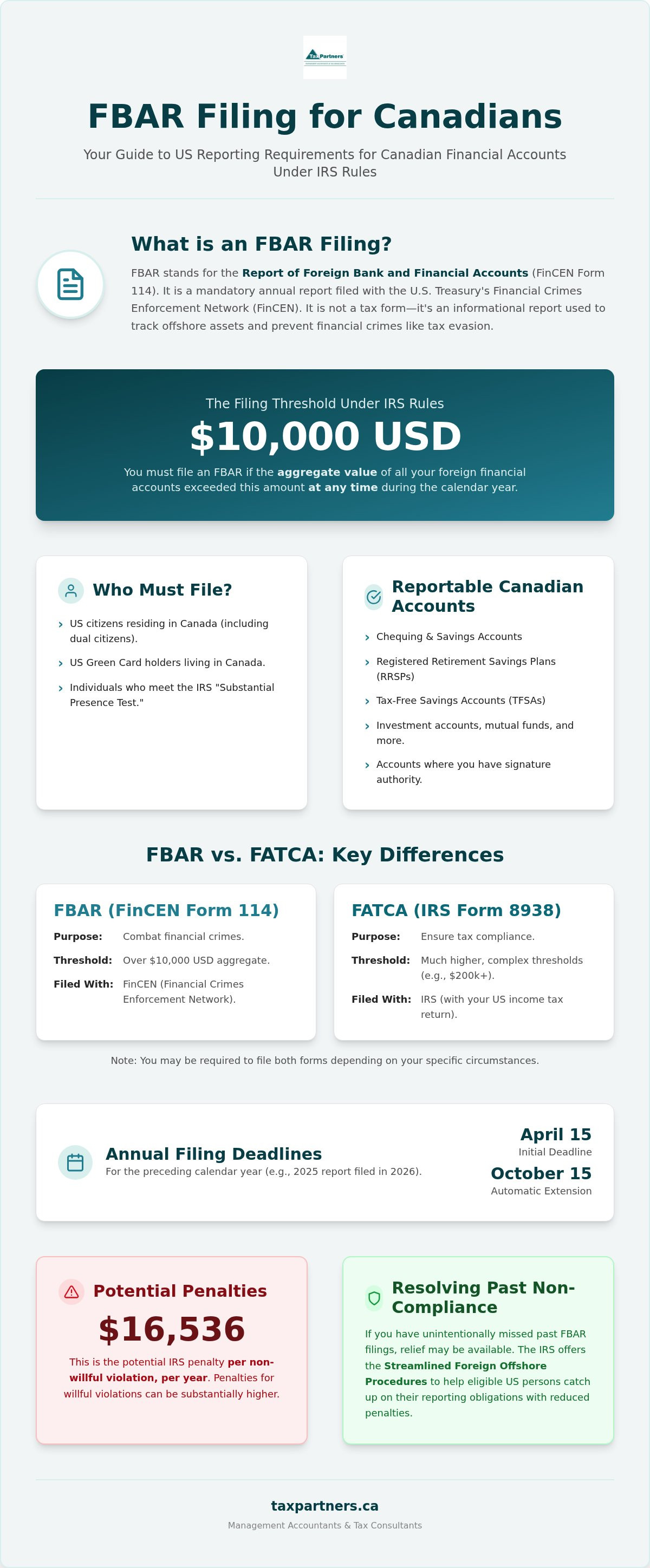
Did you know that a single oversight in reporting your Canadian bank accounts to the IRS could result in a non-willful penalty of $16,536 per year? A non-willful violation refers to a failure to report accounts that results from a genuine mistake or a misunderstanding of the law, rather than an intentional attempt to evade reporting.
For many Canadians with US filing obligations, the transition into 2026 brings a familiar sense of anxiety regarding the complexities of fbar filing. This term stands for the Report of Foreign Bank and Financial Accounts, which is a mandatory disclosure submitted electronically to the US Treasury to track offshore assets.
It's understandable to feel overwhelmed by the technicalities of aggregate balances and the nuances of cross-border compliance. We believe that financial transparency should provide security, not stress. This guide will help you organize your records and navigate the 2026 requirements under IRS rules to ensure your Canadian accounts remain fully compliant.
We'll clarify which accounts you must report, explain how to calculate your maximum balances in US dollars, and outline the relief procedures available if you need to catch up on previous years. By the end, you'll realize how manageable these requirements can be when you have a clear roadmap for your cross-border obligations.
Key Takeaways
- Determine if your total Canadian account balances meet the $10,000 USD aggregate threshold that triggers a mandatory fbar filing under IRS rules.
- Identify which Canadian assets, such as RRSPs and TFSAs, must be disclosed to the US Treasury to ensure your reporting remains fully compliant.
- Confirm the April 15 deadline and the automatic October 15 extension for 2026 filings of the US FinCEN Form 114.
- Learn how the IRS Streamlined Foreign Offshore Procedures allow you to resolve past reporting gaps through a non-willful certification process.
Understanding the FBAR Filing Requirement Under IRS Rules
The FBAR, officially known as the Report of Foreign Bank and Financial Accounts or FinCEN Form 114, is a mandatory disclosure for US persons holding financial interests outside the United States. Unlike your annual income tax return, an fbar filing doesn't involve calculating taxes or making payments. It's strictly an informational report that provides the US government with transparency regarding offshore assets.
The primary purpose of this requirement is to assist the government in tracking and preventing financial crimes. By monitoring assets held in foreign institutions, the authorities can better identify potential money laundering or tax evasion. For Canadians who hold US citizenship or permanent residency, this means your local chequing, savings, and investment accounts are subject to this oversight.
The trigger for this requirement is your status as a "US Person" combined with the value of your foreign holdings. This category includes US citizens living in Canada, Green Card holders, and individuals who meet the substantial presence test for residency. If you fall into these groups, the IRS expects you to maintain clear records of your Canadian financial activities.
The Role of the Bank Secrecy Act
The legal foundation for these reporting obligations is the Bank Secrecy Act of 1970. This legislation was designed to prevent individuals from using foreign bank accounts to hide taxable income. While the IRS handles the enforcement and auditing of these rules, the actual report is filed with the Financial Crimes Enforcement Network (FinCEN).
It's a common misconception that the FBAR is part of your standard tax package. In reality, you don't attach Form 114 to your 1040 tax return. It's a separate electronic submission handled through the BSA E-Filing System. This procedural distinction is vital for maintaining total compliance with US Treasury regulations.
FBAR vs. FATCA: Clearing the Confusion
Many clients find themselves confused by the similarities between FBAR and the Foreign Account Tax Compliance Act (FATCA). Under IRS rules, FBAR involves FinCEN Form 114, while FATCA reporting typically requires IRS Form 8938. Both forms serve to disclose foreign assets, yet they have different thresholds and reporting criteria.
- Thresholds: FBAR triggers at a $10,000 USD aggregate value, while FATCA thresholds are generally much higher.
- Account Types: FBAR often covers a broader range of accounts, including those where you only have signature authority.
- Filing Location: You file the FBAR with FinCEN, but Form 8938 goes directly to the IRS with your tax return.
It's quite possible for a Canadian resident to have a dual filing obligation for both forms. We provide specialized US and cross-border tax compliance services to help you determine exactly which forms apply to your situation. Ensuring you meet both requirements is the best way to protect your wealth and avoid significant penalties.
Determining Who Must File: The US Person and the $10,000 Threshold
Identifying your status as a "US person" is the first step in maintaining compliance under IRS rules. For Canadians, this category extends beyond those born in the United States to include dual citizens, Green Card holders, and individuals who spend enough time south of the border to meet the substantial presence test. Many "accidental Americans" living in Canada are surprised to learn that their residency in the North doesn't exempt them from an fbar filing.
The reporting obligation begins when the aggregate value of your foreign financial accounts exceeds $10,000 USD. It's vital to understand that this is a cumulative total across all your accounts, not a per-account limit. If you have five Canadian bank accounts with $2,500 each, your total is $12,500, which triggers the requirement to disclose every single one of them.
Timing is also a critical factor in this calculation. You must file if your combined account balances crossed that $10,000 mark at any time during the calendar year, even for just one day. Additionally, you must include accounts that produce no income, such as a basic chequing account or a non-interest-bearing savings account, in your final tally.
Defining Financial Interest and Signature Authority
Reporting isn't limited to accounts you personally own. Under the IRS FBAR Requirements, you must disclose accounts where you have "signature authority," meaning you can control the disposition of funds. This often applies to Canadians who serve as treasurers for non-profits or have signing power over their employer's corporate bank accounts.
Joint accounts require careful attention as well. If you share an account with a Canadian spouse who isn't a US person, you must still report 100% of the highest balance on your filing. This rule ensures the US Treasury has a complete picture of any assets a US person can access or influence.
Calculating the $10,000 Threshold in Canadian Dollars
Since your local accounts are held in Canadian dollars, you'll need to perform a specific conversion process to determine your filing status. You must use the official Treasury Reporting Rates of Exchange, specifically the rate published for the last day of the calendar year. This provides a uniform standard for all US filers, regardless of where their assets are located.
To start, review your monthly statements to find the highest balance for each individual account during the year in CAD. Add these peak values together to find your total Canadian aggregate balance. Once you have this sum, apply the year-end exchange rate to see if the value exceeds the $10,000 USD threshold.
Accuracy in these conversions is essential to avoid the steep penalties associated with under-reporting. If you find the conversion process confusing or have complex accounts to value, you can connect with our cross-border specialists for a professional review. We help you establish a precise reporting baseline that protects your financial standing in both countries.
Navigating Canadian Accounts: What Must Be Reported to the IRS?
Many Canadians assume that "registered" accounts are exempt from international disclosure because of their special status with the CRA. This is a common misconception that can lead to significant compliance gaps. Under IRS rules, almost any account held at a Canadian financial institution requires an fbar filing if you meet the $10,000 USD aggregate threshold.
The IRS maintains a broad definition of what constitutes a foreign financial account. This includes traditional bank accounts and more complex investment vehicles. You must report the following common Canadian holdings:
- Daily Banking: All chequing and savings accounts, including high-interest and US-dollar accounts held in Canada.
- Investment Portfolios: Brokerage accounts, mutual funds, and any accounts holding securities or commodities.
- Retirement Savings: Both Registered Retirement Savings Plans (RRSPs) and Registered Retirement Income Funds (RRIFs).
- Tax-Advantaged Accounts: Tax-Free Savings Accounts (TFSAs), which the IRS often views as simple investment accounts or foreign trusts.
- Education and Disability Plans: Registered Education Savings Plans (RESPs) and Registered Disability Savings Plans (RDSPs) where you are the subscriber or holder.
TFSAs are a high-priority item for the US Treasury. Because the IRS doesn't recognize the "tax-free" status of these accounts, they require meticulous reporting. Failing to include a TFSA in your aggregate balance calculation is one of the most frequent errors we see in cross-border filings.
Registered Accounts and Insurance Policies
While RRSPs are reportable, the US-Canada tax treaty generally protects the tax-deferred nature of the income earned within them. You must still disclose the highest balance of these accounts annually to remain compliant. Life insurance policies also fall under this umbrella if they are "Whole Life" or "Universal Life" plans that carry a cash surrender value. Term life insurance policies with no cash value don't need to be reported.
It's helpful to know what you can exclude from your report. Government-administered programmes like the Canada Pension Plan (CPP) and Old Age Security (OAS) are generally not considered reportable foreign financial accounts. These are social security benefits rather than personal financial accounts, which simplifies the process for many Canadian retirees.
Business and Corporate Accounts
If you own more than 50% of a Canadian corporation, you have a "financial interest" in that company's bank accounts under IRS rules, which may require you to evaluate Software-as-a-Service (SaaS) filing fees for specialized reporting tools. This means you must report those corporate accounts on your personal filing. Even if you don't own the company, having the authority to direct funds makes you a filer. This "signature authority" applies to employees or non-profit volunteers who can sign cheques or authorize transfers.
Managing the intersection of personal and corporate reporting requires a steady hand and precise records. You can explore our Tax Partners business solutions for specialized advice on how to organize your corporate structures for cross-border transparency. When you are ready to submit your data, you will use the FinCEN FBAR Filing Portal to complete the electronic disclosure process for the 2026 tax year.
The FBAR Filing Process: Deadlines, Forms, and Compliance
The calendar year for your fbar filing corresponds with the US tax year, making April 15 the primary deadline for reporting the previous year's accounts. If you miss this spring date, the IRS provides an automatic extension until October 15. You don't need to file any paperwork to request this extra time, which offers a helpful buffer for those gathering complex records from various Canadian institutions.
All submissions must be made electronically through the Financial Crimes Enforcement Network (FinCEN) BSA E-Filing System. Paper filings are no longer accepted under IRS rules, so you must use the digital portal to remain compliant. Once you've submitted your report, the IRS requires you to maintain your financial records for at least five years to support your disclosure if questioned.
Step-by-Step Electronic Filing
When you access the portal, you can choose between a discrete PDF-based filing or an online web-form. The PDF option is often preferred for its offline editing capabilities, while the web-form is more streamlined for simple disclosures. If you're filing jointly with a spouse, you must also complete FinCEN Form 114a to authorize a single submission on behalf of both individuals.
Managing these digital requirements can be time-consuming, especially when dealing with multiple Canadian accounts and conversion rates. Many clients prefer to use professional US and cross-border tax services to ensure every box is checked and every balance is converted correctly. This proactive approach reduces the risk of technical errors that could trigger an unwanted audit.
Penalties for Non-Compliance
The IRS distinguishes between "non-willful" and "willful" violations when assessing penalties for missed filings. A non-willful violation occurs due to a genuine mistake or a misunderstanding of the law, whereas a willful violation involves a conscious effort to avoid reporting. Under IRS rules, penalties are adjusted annually for inflation, meaning the cost of non-compliance increases every year.
The consequences for failing to report foreign assets are severe and can quickly erode your cross-border wealth. Even a non-willful error can lead to a significant fine for each year the form was omitted. If you're concerned about your current compliance status or have realized you missed previous years, you should contact us today to discuss a strategy for rectification.
Resolving Non-Compliance: The IRS Streamlined Filing Procedures
Discovering that you've missed years of fbar filing can be a source of significant anxiety. Fortunately, the IRS offers a proactive way to correct these errors without facing the heavy penalties typically associated with non-compliance. This pathway is designed for individuals who were unaware of their reporting obligations while living abroad.
The Streamlined Foreign Offshore Procedures (SFOP) provide a path to amnesty for eligible US persons residing in Canada. This program allows you to come forward voluntarily and catch up on your reporting obligations under IRS rules. It's an effective way to transition from a state of uncertainty to one of total control over your financial standing.
To qualify for this program, you must certify that your failure to file was non-willful. This means your lack of disclosure resulted from a mistake, inadvertence, or a good-faith misunderstanding of the law. Under IRS rules, the submission requirements include:
- Three years of delinquent or amended US income tax returns.
- Six years of delinquent fbar filing submissions.
- A detailed, signed statement certifying the non-willful nature of your past conduct.
The Benefits of Voluntary Disclosure
For many Canadians, the primary benefit of the SFOP is the potential for a 0% penalty on unreported foreign assets. This program encourages transparency rather than punishment for those who genuinely didn't realize their obligations. You can find more details in our complete guide to IRS streamlined procedures.
Achieving total compliance through this method provides lasting peace of mind and protects you from the risk of a future IRS audit. It allows you to move forward with a clean slate, knowing your cross-border wealth is secure and properly documented. The process effectively resolves historical gaps and establishes a reliable baseline for all future filings.
Working with a Cross-Border Specialist
Certifying non-willfulness is a sensitive legal step that requires professional oversight to ensure your statement meets IRS standards. A cross-border specialist can help you organize years of financial data and present a clear, accurate narrative to the authorities. This precision is vital for a successful submission and for avoiding further inquiries from the US Treasury.
At Tax Partners, we act as a steady hand, guiding you through the complexities of historical reporting with precision and care. We help you gather the necessary records and ensure your certification is robust and compliant. We invite you to contact us for a confidential consultation to begin your journey toward full compliance.
Secure Your Cross-Border Compliance with Precision
Managing your cross-border obligations requires a clear understanding of the $10,000 USD aggregate threshold and the specific Canadian accounts that trigger a report. Whether you're reporting a simple savings account or a complex TFSA, precision in your fbar filing is the key to maintaining a standing of total compliance under IRS rules. This proactive approach ensures that your wealth remains protected from the risks of non-compliance and unnecessary scrutiny.
If you've realized that previous years were missed, the IRS Streamlined Procedures offer a reliable path to amnesty without the burden of heavy penalties. Our team brings over 40 years of cross-border tax experience to every case, providing expert guidance for dual citizens and US expats who need a steady hand at the helm. We specialize in resolving these historical gaps with the care and attention your individual situation deserves.
Don't let the complexities of international reporting overshadow your financial success. You can secure your cross-border compliance with Tax Partners today. We're here to help you move forward with confidence and total peace of mind regarding your status with the IRS.
Frequently Asked Questions
What is the FBAR filing deadline for the 2026 tax year?
The deadline for your 2025 fbar filing is April 15, 2026. However, under IRS rules, all filers receive an automatic extension to October 15, 2026. You don't need to submit a specific request to utilize this extra time. This provides you with a helpful window to gather your Canadian bank statements and calculate your peak balances accurately for the US Treasury.
Do I need to report my Canadian RRSP or TFSA on an FBAR?
Yes, the IRS requires you to disclose both Registered Retirement Savings Plans (RRSPs) and Tax-Free Savings Accounts (TFSAs). While these accounts have special tax status for CRA filers, the US government views them as reportable foreign financial accounts. If your total Canadian holdings exceed the $10,000 USD threshold, these specific accounts must be included on your FinCEN Form 114 submission.
What happens if I have never filed an FBAR and just realized I need to?
You should consider the Streamlined Filing Compliance Procedures offered by the IRS. This programme allows non-willful taxpayers to catch up on missed filings without facing the heavy penalties typically associated with non-compliance. By submitting three years of back taxes and six years of reports, you can achieve total compliance. It's the most effective way to resolve past oversights and secure your cross-border financial future.
Is the $10,000 threshold based on a single account or all accounts combined?
The $10,000 threshold is based on the aggregate value of all your foreign financial accounts combined. You must add the highest balance of every Canadian account you own or have authority over during the calendar year. If the sum exceeds $10,000 USD at any point, you must file. This rule applies even if no single account ever held more than $10,000 on its own.
Do I need to file an FBAR if my Canadian accounts did not earn any interest?
Yes, you must file regardless of whether your accounts earned interest or dividends. An fbar filing is an informational disclosure of your offshore holdings, not a tax on your income. The IRS uses this data to track the movement of assets rather than to calculate a tax bill. Even a basic chequing account with a high balance triggers this mandatory reporting requirement under US law.
Are joint accounts with my Canadian (non-US) spouse subject to FBAR reporting?
Yes, joint accounts held with a non-US spouse are fully reportable under IRS rules. You must report the full maximum value of the account on your disclosure, even if the funds belong primarily to your spouse. Your spouse does not need to file unless they are also a US person. This requirement ensures the US Treasury has a complete view of all assets you can access or influence.
Can I file a paper FBAR form through the mail?
No, you cannot submit a paper form through the mail for this requirement. The US Treasury requires all reports to be filed electronically through the FinCEN BSA E-Filing System. This digital-only mandate ensures that your data is processed quickly and securely. If you find the online portal difficult to use, professional cross-border tax services can handle the electronic submission on your behalf to ensure accuracy.
How do I convert my Canadian account balances to US dollars for FBAR?
You must use the official Treasury Reporting Rates of Exchange to convert your Canadian balances for the IRS. Specifically, you should apply the exchange rate published for December 31 of the reporting year. First, identify the highest balance in Canadian dollars for each individual account throughout the year. Then, apply the year-end rate to your total aggregate sum to determine if you've met the mandatory $10,000 USD threshold.

Article by
Mahad Mohamed
Mahad Mohamed is an accountant and the CEO of Tax Partners, with over 26+ years of Canadian and international tax and accounting experience. His expertise includes corporate reorganization, cross-border tax structuring (Canada & US), tax disputes, CRA audits, and tax planning for small owner-managed private corporations. Most recently, Mahad is a pioneer in Canadian crypto taxation and founded Block3 Finance.
Previously, Mahad worked for the Canada Revenue Agency (CRA), Big4 accounting firms, and served as a Rulings Officer for the Federal Tax Authority of the UAE before acquiring Tax Partners in 2014.
Tax Partners has 44 full-time accountants and over 18,400+ clients.
Disclaimer
This article provides general information only and is current as of its publication date. It has not been updated and may be out of date. It does not constitute legal advice and should not be relied upon as such. Every tax situation is unique and may differ from the examples discussed in this article. If you have specific questions, you should seek the advice of our accountants for your unique circumstances. Book a FREE Initial Consultation Today!
Frequently Asked Questions
What is the FBAR filing deadline for the 2026 tax year?
The deadline for your 2025 fbar filing is April 15, 2026. However, under IRS rules, all filers receive an automatic extension to October 15, 2026. You don't need to submit a specific request to utilize this extra time. This provides you with a helpful window to gather your Canadian bank statements and calculate your peak balances accurately for the US Treasury.
Do I need to report my Canadian RRSP or TFSA on an FBAR?
Yes, the IRS requires you to disclose both Registered Retirement Savings Plans (RRSPs) and Tax-Free Savings Accounts (TFSAs). While these accounts have special tax status for CRA filers, the US government views them as reportable foreign financial accounts. If your total Canadian holdings exceed the $10,000 USD threshold, these specific accounts must be included on your FinCEN Form 114 submission.
What happens if I have never filed an FBAR and just realized I need to?
You should consider the Streamlined Filing Compliance Procedures offered by the IRS. This programme allows non-willful taxpayers to catch up on missed filings without facing the heavy penalties typically associated with non-compliance. By submitting three years of back taxes and six years of reports, you can achieve total compliance. It's the most effective way to resolve past oversights and secure your cross-border financial future.
Is the $10,000 threshold based on a single account or all accounts combined?
The $10,000 threshold is based on the aggregate value of all your foreign financial accounts combined. You must add the highest balance of every Canadian account you own or have authority over during the calendar year. If the sum exceeds $10,000 USD at any point, you must file. This rule applies even if no single account ever held more than $10,000 on its own.
Do I need to file an FBAR if my Canadian accounts did not earn any interest?
Yes, you must file regardless of whether your accounts earned interest or dividends. An fbar filing is an informational disclosure of your offshore holdings, not a tax on your income. The IRS uses this data to track the movement of assets rather than to calculate a tax bill. Even a basic chequing account with a high balance triggers this mandatory reporting requirement under US law.
Are joint accounts with my Canadian (non-US) spouse subject to FBAR reporting?
Yes, joint accounts held with a non-US spouse are fully reportable under IRS rules. You must report the full maximum value of the account on your disclosure, even if the funds belong primarily to your spouse. Your spouse does not need to file unless they are also a US person. This requirement ensures the US Treasury has a complete view of all assets you can access or influence.
Can I file a paper FBAR form through the mail?
No, you cannot submit a paper form through the mail for this requirement. The US Treasury requires all reports to be filed electronically through the FinCEN BSA E-Filing System. This digital-only mandate ensures that your data is processed quickly and securely. If you find the online portal difficult to use, professional cross-border tax services can handle the electronic submission on your behalf to ensure accuracy.
How do I convert my Canadian account balances to US dollars for FBAR?
You must use the official Treasury Reporting Rates of Exchange to convert your Canadian balances for the IRS. Specifically, you should apply the exchange rate published for December 31 of the reporting year. First, identify the highest balance in Canadian dollars for each individual account throughout the year. Then, apply the year-end rate to your total aggregate sum to determine if you've met the mandatory $10,000 USD threshold.