Estate Planning Accountant Ontario: A Guide for CRA Filers

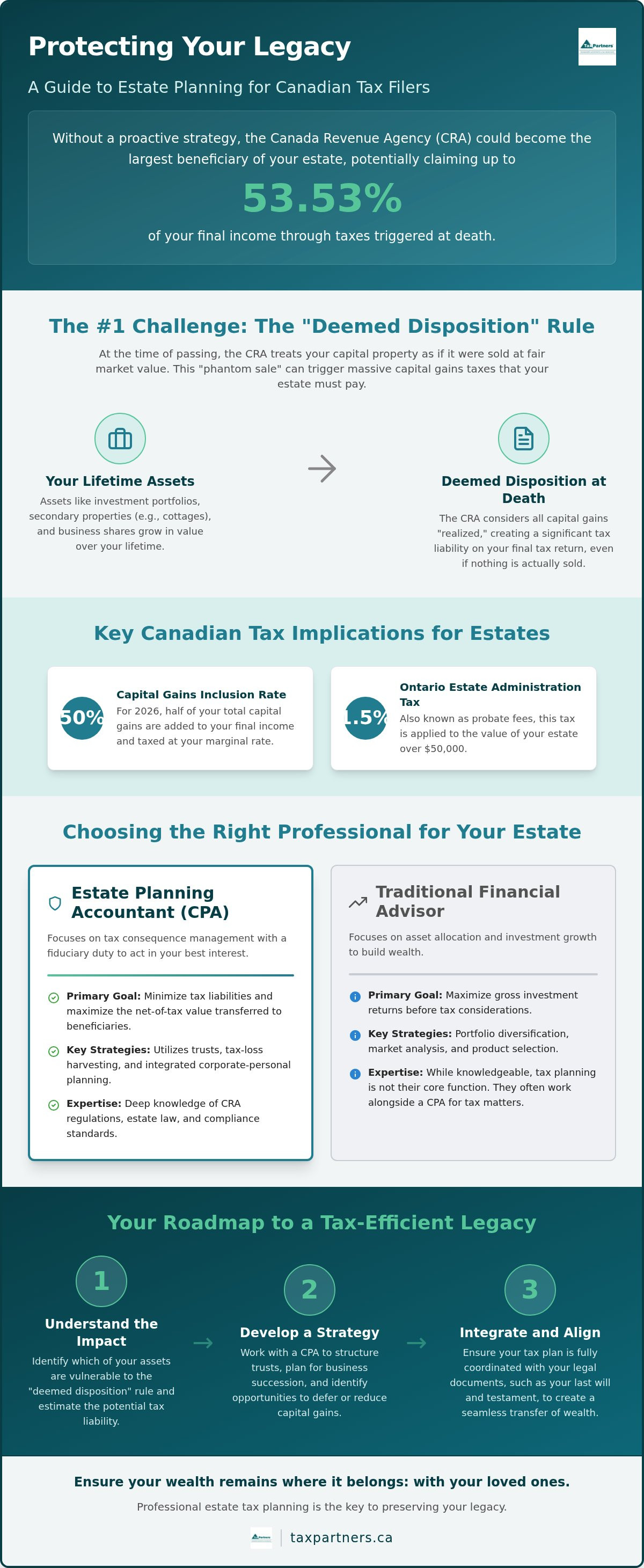
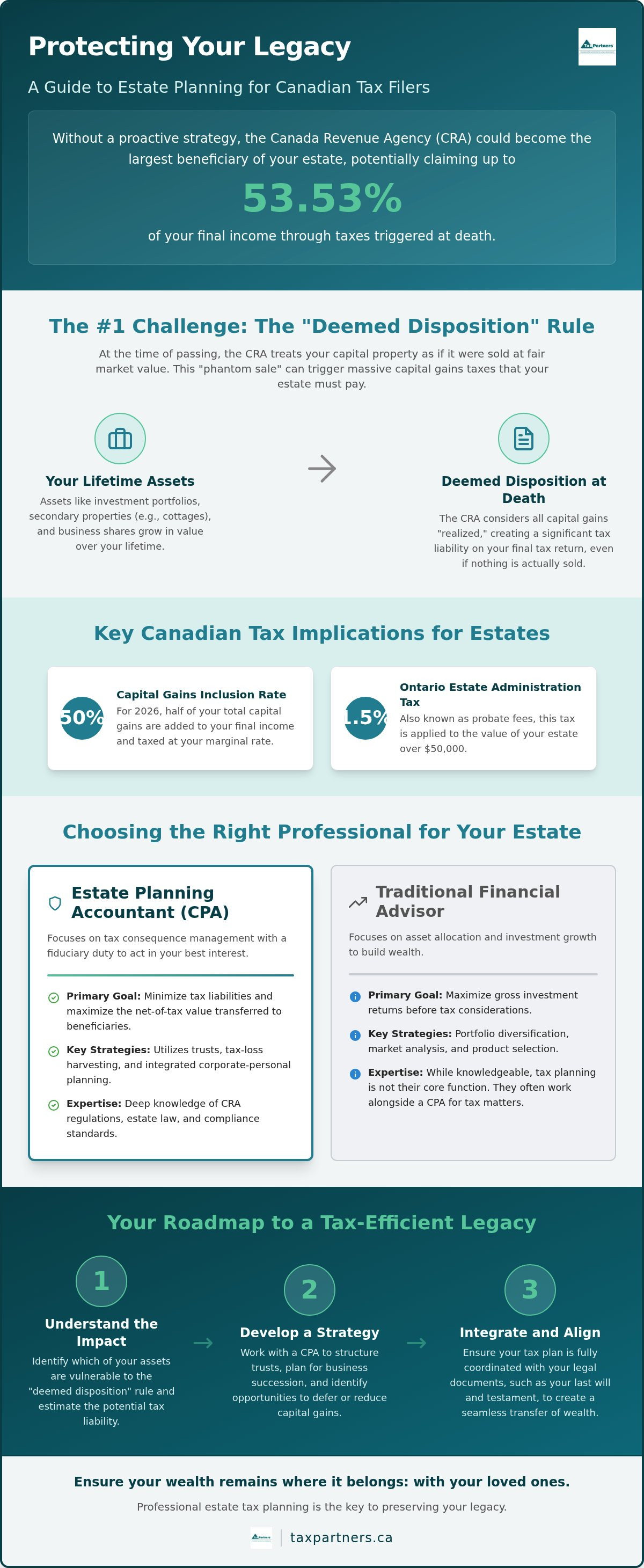
Did you know that without a proactive strategy, the CRA could effectively become the largest beneficiary of your estate, claiming up to 53.53% of your final income? It's a daunting reality for many families who realize that a lifetime of building a business or investment portfolio could be significantly diminished by the "deemed disposition" rule upon their passing.
At Tax Partners, we understand the stress of navigating complex tax codes and the fear that your legacy might not reach the next generation intact. Partnering with a specialized estate planning accountant provides the professional oversight needed to coordinate your investments with a tax-centric strategy. You deserve the peace of mind that comes from knowing your family's future is protected by a steady, experienced hand.
This guide offers a clear roadmap to help you minimize probate fees and capital gains taxes while ensuring your family business remains viable during succession. We'll show you how a regulated CPA integrates precise tax planning to safeguard what you've built and keep more of your wealth where it belongs: with your loved ones.
Key Takeaways
- Understand the impact of the CRA "deemed disposition" rule and how it affects the valuation of your assets at the time of passing.
- Discover how a specialized estate planning accountant Ontario identifies tax-loss harvesting opportunities and trust structures to minimize future liabilities.
- Learn the vital distinction between asset allocation and tax consequence management when choosing between a financial advisor and a CPA.
- Identify the essential components of a business succession strategy that maintains operational stability and capital during a leadership transition.
- Gain a clear roadmap for integrating your corporate and personal tax planning to ensure a seamless, tax-efficient transfer of your legacy.
What is Estate Planning for CRA Filers?
Estate planning is the strategic arrangement of your assets to ensure they transition to your loved ones with minimal friction. For CRA filers, this process focuses heavily on tax-efficient transfers. It isn't merely about drafting a will; it's about protecting the value of your life's work from avoidable erosion. Without a dedicated plan, a significant portion of your wealth could be redirected to the federal government instead of your beneficiaries.
The primary challenge for Canadians is that the CRA doesn't wait for a physical sale to collect its share. Instead, the government applies a "deemed disposition" rule at the time of death. This means the CRA treats your capital property as if it were sold at fair market value immediately before you passed away. This phantom sale can trigger massive capital gains taxes that your heirs must settle before they receive their inheritance.
The Concept of Deemed Disposition
Deemed disposition refers to the CRA treating your assets as sold at death, even if they aren't actually liquidated. This rule applies to a wide variety of holdings, including secondary properties like cottages, investment portfolios, and shares in a family business. While your principal residence is typically exempt from this tax, other assets remain highly vulnerable. For 2026, the federal capital gains inclusion rate stands at 50%, meaning half of your asset's growth is added to your final income and taxed at your marginal rate. Understanding Inheritance law in Ontario is essential because these tax liabilities can quickly consume a large percentage of the estate's liquid cash.
Why an Ontario CPA is Essential
Navigating these complex federal and provincial regulations requires the precision of an estate planning accountant Ontario. These professionals must adhere to the rigorous ethical and professional standards established by CPA Ontario. This background ensures they act as a proactive guardian of your assets, providing a level of reliability that general financial advisors cannot match. A CPA has a fiduciary duty to act in your best interest, ensuring that your wealth transfer is as seamless as possible.
By integrating specialized knowledge of estate income tax with your broader financial goals, a CPA provides several critical advantages:
- Identifying specific strategies to defer or reduce capital gains.
- Ensuring compliance with Ontario's Estate Administration Tax, which is 1.5% for estate values over $50,000.
- Coordinating with legal counsel to align your tax strategy with your last will and testament.
This level of professional oversight moves you from a state of potential uncertainty toward a feeling of total control over your legacy. It's a methodical journey that ensures your family remains the primary beneficiary of your hard work.
The Strategic Advantage of an Estate Planning Accountant
Many people mistake a high estate value for a high inheritance. The difference lies in the tax man's share. An estate planning accountant Ontario serves as a proactive guardian, ensuring your hard-earned assets aren't unnecessarily depleted by the CRA. They look beyond simple filing to identify tax-loss harvesting opportunities. This involves selling underperforming assets to offset capital gains, which is a vital move given the 50% inclusion rate for 2026.
A specialized accountant also provides structured advice on using trusts. These vehicles can protect assets from creditors and ensure wealth passes to the right hands without excessive taxation. If you own a business, synchronizing your corporate and personal filings is essential. Integrated planning prevents double taxation and ensures you're utilizing every available credit to keep the business capitalized during a transition.
Tax laws aren't static. A specialized accountant monitors changing CRA legislation, such as the recently cancelled proposal to increase capital gains inclusion rates. They adjust your plan in real-time to reflect the current legal environment. This ensures your strategy stays relevant according to the CRA guide for a deceased person, which outlines the rigorous requirements for final tax returns.
Maximizing Net-of-Tax Returns
Gross returns look great on paper, but net-of-tax returns determine what your family actually keeps. Different types of income are treated uniquely under CRA rules. Interest income is taxed at your full marginal rate, whereas dividends and capital gains receive more favourable treatment. An accountant manages the timing of asset liquidation to protect your wealth. By spreading out sales over several years, you can avoid jumping into a higher tax bracket in your final years of life.
Proactive Wealth Preservation
A CPA acts as an authoritative mentor, guiding you from a state of uncertainty to total control. Wealth preservation isn't a one-time event during tax season; it's a year-round commitment. Proactive reviews of your asset structure can uncover inefficiencies before they become costly mistakes. This continuous oversight provides a steady hand at the helm of your financial future. If you're ready to secure your family's future, you can contact us to begin a comprehensive review of your asset structure.
This methodical approach moves you quickly from a problem to a sense of resolution. It ensures that every decision made today strengthens the legacy you leave behind tomorrow.
CPA vs. Financial Advisor: Choosing the Right Professional
Choosing between a financial advisor and a CPA isn't an "either-or" decision. It's about understanding their distinct roles in your legacy. Financial advisors usually focus on growth and asset allocation. In contrast, an estate planning accountant Ontario focuses on the tax consequences of those assets. This distinction is vital when managing the complex requirements of a terminal return for CRA filers.
A CPA offers a unique advantage: the authority to represent you directly before the CRA. If a dispute or audit arises regarding your estate's valuation or capital gains, your accountant acts as your primary advocate. This professional standing provides a layer of protection that most financial planners simply can't offer. Choosing an estate planning accountant Ontario ensures you have a professional who is not just reacting to requirements but is actively looking ahead to secure a better outcome.
For business owners, the CPA's role is even more critical. They provide a sophisticated analysis of the financial statements of your private Canadian corporation. This ensures that corporate surpluses are extracted in the most tax-efficient manner, protecting the capital you've built over decades. Many CPAs also operate on a transparent fee-for-service model. This structure removes the potential conflict of interest often found in commission-based product sales, ensuring the advice you receive is purely in your best interest.
Credential Oversight and Public Protection
While many professionals hold a CFP (Certified Financial Planner) designation, the CPA is widely considered the gold standard for tax efficient wealth management. This is because CPAs are governed by strict provincial regulatory bodies like CPA Ontario. These organizations ensure professional accountability and ethical steadfastness through rigorous standards. When you work with a CPA, you're benefiting from a proactive guardian who prioritizes your financial integrity above all else.
The Risk of Siloed Advice
The greatest threat to a legacy is siloed advice. An investment advisor might sell a stock to lock in a gain without realizing the tax implications for that specific fiscal year. Without an integrated view, these trades can trigger "tax surprises" that drastically diminish your estate's liquidity. The Ontario government guide to estate planning emphasizes the importance of a well-coordinated strategy. Integrated advice prevents these errors by ensuring your tax professional and investment advisor are in constant communication. This single point of accountability provides the peace of mind you need to focus on what matters most.
Succession Planning and Asset Transfer Strategies
Transitioning a family business is often the most significant financial event in an entrepreneur's life. It requires more than a simple handshake; it demands a formal strategy to ensure the enterprise remains capitalized and operational during the transfer. An estate planning accountant Ontario helps you navigate the specific CRA criteria required to protect the value you've spent decades building.
Under CRA rules, the Lifetime Capital Gains Exemption (LCGE) serves as a powerful tool for tax relief. For 2026, the LCGE limit is approximately $1,275,000, providing a substantial shield for qualified small business corporation shares. However, accessing this exemption is not automatic. Your business must meet strict "active business asset" tests and holding period requirements, which usually span at least 24 months before a sale or transfer.
The Estate Freeze Strategy
An estate freeze is a cornerstone of Canadian tax planning for business owners. This manoeuvre "locks in" the current value of the company for the founder, usually through the issuance of preferred shares. Any future growth in the company's value is then attributed to the next generation through common shares. This effectively defers significant tax liabilities until the shares are eventually sold or deemed disposed. Incorporating a family trust within this structure adds a layer of flexibility, allowing you to control asset distribution while protecting the business from external creditors.
Transferring Wealth to the Next Generation
Effective wealth transfer involves more than just passing down shares. A formal succession planning for family business strategy ensures that leadership transitions are as smooth as the financial ones. Spousal rollovers are another essential component, allowing assets to transfer to a surviving spouse at their original cost base. This defers the tax hit until the second spouse passes away, preserving liquidity for the family in the interim. You might also consider charitable giving, as donations can generate tax credits that offset the estate's final liabilities while supporting a meaningful legacy.
Securing your business's future requires proactive oversight and a steady hand. If you're ready to implement a robust transition plan, you should contact us to speak with an estate planning accountant Ontario. We'll help you move from a state of uncertainty to a position of total control over your corporate legacy.
Securing Your Legacy with Tax Partners
Protecting a legacy isn't just about what you leave behind; it's about the active measures you take today to safeguard your life's work. Tax Partners offers a sophisticated blend of professional authority and approachable warmth, ensuring that your financial transition is as smooth as possible. We act as a proactive guardian for our clients, looking ahead to identify potential CRA risks before they evolve into costly liabilities. By choosing a dedicated estate planning accountant Ontario, you're securing a partnership rooted in stability and long-term success.
Our team provides a methodical approach to wealth management that prioritizes your family's stability above all else. We understand that the complexities of "deemed disposition" and probate fees can feel overwhelming. That's why we guide you through each step with a steady hand, combining decades of institutional wisdom with a forward-thinking outlook. Whether you're managing local investments or complex global assets, our goal is to move you from a state of uncertainty toward a feeling of total control.
The Tax Partners Difference
What sets us apart is a proven track record of ethical steadfastness and tangible results. We've leveraged our 40 years of experience to save our clients more than $87M through meticulous, tax-centric planning. This isn't just about numbers; it's about the 1,390+ five-star Google reviews that reflect our reliability and client-first culture. We invite you to contact us for a bespoke estate consultation where we can tailor a strategy to your specific needs.
Integrated Financial Guardianship
True financial security requires a holistic view of your assets. We combine tax compliance, bookkeeping, and wealth management under one roof to ensure your corporate and personal plans never clash. This integrated approach prevents the "siloed advice" mentioned earlier in this guide, where investment trades might inadvertently trigger unnecessary tax hits. By synchronizing every aspect of your financial life, we help you keep more of what you earn for the next generation.
The regulatory environment in Ontario is constantly shifting, but your legacy doesn't have to be vulnerable to these changes. We remain deeply invested in the success of our clients, acting as an authoritative mentor through every transition. With Tax Partners at the helm, you can rest assured that your estate is managed with the precision and customization it deserves. Let us help you protect your past and secure your family's future with confidence.
Protect Your Legacy with Confidence
You've spent a lifetime building your assets; now it's time to ensure they reach the next generation exactly as you intended. Proactive planning helps you navigate the "deemed disposition" rule and manage Ontario's probate fees effectively. A specialized estate planning accountant Ontario provides the precise oversight needed to integrate your corporate and personal tax strategies; this ensures your legacy remains intact and your family business stays operational.
At Tax Partners, we leverage over 40 years of Canadian tax and wealth management expertise to safeguard your wealth. Our methodical approach has saved clients more than $87 million to date, a record reflected in our 1,390+ five-star Google reviews. We pride ourselves on being a steady hand at the helm, moving you from uncertainty to a position of total control over your financial future.
Book a consultation with our estate planning experts to protect your legacy. We're here to help you build a tax-efficient roadmap that honours your hard work and provides lasting peace of mind for your loved ones.
Frequently Asked Questions
What is the difference between a financial planner and a wealth management CPA?
Wealth management CPAs specialize in the tax implications of your investments rather than just asset selection. While a financial planner helps you choose stocks or funds, an estate planning accountant Ontario ensures those choices don't trigger unnecessary tax liabilities under CRA rules.
A CPA also has the authority to represent you directly before the CRA during an audit. This provides a layer of professional protection and advocacy that most financial planners cannot offer.
How much does an estate planning accountant in Ontario typically cost?
Fees for estate planning vary based on the complexity of your assets and whether you require corporate succession strategies. Most firms provide quotes based on an hourly rate or a fixed project fee for a comprehensive plan.
It's best to discuss your specific needs directly with a professional to receive a transparent estimate. This ensures the service is customized to your unique financial situation and long-term goals.
Do I need an estate planning accountant if I already have a will?
Yes, because a will only dictates where your assets go; it doesn't settle the tax bill left behind. An accountant manages the "deemed disposition" and ensures the CRA is paid accurately so your heirs receive their full intended inheritance.
Without professional tax planning, the CRA could claim a significant portion of your estate's value. A CPA works alongside your legal counsel to align your tax strategy with your last will and testament.
What are the tax benefits of using a holding company for estate planning in Canada?
Holding companies allow you to defer personal income tax by keeping earnings within a corporate structure. They are also essential for executing an estate freeze, which locks in your current tax liability and passes future growth to your beneficiaries.
This structure can also help you multiply the Lifetime Capital Gains Exemption among family members. It's a sophisticated way to keep the family business capitalized while preparing for a leadership transition.
How does the 'deemed disposition' rule affect my family's inheritance?
The "deemed disposition" rule treats your assets as sold at fair market value immediately before death. For 2026, 50% of these capital gains are added to your final income and taxed at your marginal rate.
This can result in a significant tax bill that must be paid by the estate before any assets are distributed. Proper planning ensures there is enough liquidity to settle this debt without forcing the sale of family property or business shares.
Can a CPA help reduce probate fees in Ontario?
Yes, a CPA can significantly reduce Ontario's Estate Administration Tax, commonly known as probate fees. By using strategies like family trusts or specific beneficiary designations, assets can bypass the probate process entirely.
This saves the estate 1.5% on every $1,000 of value over the $50,000 exemption threshold. For a $1,000,000 estate, these strategies can save your beneficiaries approximately $14,250 in unnecessary taxes.
How often should I review my estate plan with my accountant?
You should review your plan every three to five years or whenever a major life event occurs, such as a marriage or the sale of a business. Legislative changes, such as the 2026 updates to capital gains inclusion rates, also necessitate a professional review.
This proactive approach ensures your strategy remains optimized for current CRA regulations. Regular check-ins allow you to adjust for changes in asset value and family circumstances in real-time.
What is the Lifetime Capital Gains Exemption and how do I qualify?
The Lifetime Capital Gains Exemption (LCGE) allows you to shield up to approximately $1,275,000 in gains from tax for the 2026 tax year. To qualify, you must own shares in a Qualified Small Business Corporation (QSBC) and meet specific holding period and asset usage tests.
Working with an estate planning accountant Ontario is the best way to ensure your business meets these rigorous CRA requirements. Early planning is essential, as some qualification tests require a 24-month look-back period.

Article by
Mahad Mohamed
Mahad Mohamed is an accountant and the CEO of Tax Partners, with over 26+ years of Canadian and international tax and accounting experience. His expertise includes corporate reorganization, cross-border tax structuring (Canada & US), tax disputes, CRA audits, and tax planning for small owner-managed private corporations. Most recently, Mahad is a pioneer in Canadian crypto taxation and founded Block3 Finance.
Previously, Mahad worked for the Canada Revenue Agency (CRA), Big4 accounting firms, and served as a Rulings Officer for the Federal Tax Authority of the UAE before acquiring Tax Partners in 2014.
Tax Partners has 44 full-time accountants and over 18,400+ clients.
Disclaimer
This article provides general information only and is current as of its publication date. It has not been updated and may be out of date. It does not constitute legal advice and should not be relied upon as such. Every tax situation is unique and may differ from the examples discussed in this article. If you have specific questions, you should seek the advice of our accountants for your unique circumstances. Book a FREE Initial Consultation Today!
Frequently Asked Questions
What is the difference between a financial planner and a wealth management CPA?
Wealth management CPAs specialize in the tax implications of your investments rather than just asset selection. While a financial planner helps you choose stocks or funds, an estate planning accountant Ontario ensures those choices don't trigger unnecessary tax liabilities under CRA rules. A CPA also has the authority to represent you directly before the CRA during an audit. This provides a layer of professional protection and advocacy that most financial planners cannot offer.
How much does an estate planning accountant in Ontario typically cost?
Fees for estate planning vary based on the complexity of your assets and whether you require corporate succession strategies. Most firms provide quotes based on an hourly rate or a fixed project fee for a comprehensive plan. It's best to discuss your specific needs directly with a professional to receive a transparent estimate. This ensures the service is customized to your unique financial situation and long-term goals.
Do I need an estate planning accountant if I already have a will?
Yes, because a will only dictates where your assets go; it doesn't settle the tax bill left behind. An accountant manages the "deemed disposition" and ensures the CRA is paid accurately so your heirs receive their full intended inheritance. Without professional tax planning, the CRA could claim a significant portion of your estate's value. A CPA works alongside your legal counsel to align your tax strategy with your last will and testament.
What are the tax benefits of using a holding company for estate planning in Canada?
Holding companies allow you to defer personal income tax by keeping earnings within a corporate structure. They are also essential for executing an estate freeze, which locks in your current tax liability and passes future growth to your beneficiaries. This structure can also help you multiply the Lifetime Capital Gains Exemption among family members. It's a sophisticated way to keep the family business capitalized while preparing for a leadership transition.
How does the 'deemed disposition' rule affect my family's inheritance?
The "deemed disposition" rule treats your assets as sold at fair market value immediately before death. For 2026, 50% of these capital gains are added to your final income and taxed at your marginal rate. This can result in a significant tax bill that must be paid by the estate before any assets are distributed. Proper planning ensures there is enough liquidity to settle this debt without forcing the sale of family property or business shares.
Can a CPA help reduce probate fees in Ontario?
Yes, a CPA can significantly reduce Ontario's Estate Administration Tax, commonly known as probate fees. By using strategies like family trusts or specific beneficiary designations, assets can bypass the probate process entirely. This saves the estate 1.5% on every $1,000 of value over the $50,000 exemption threshold. For a $1,000,000 estate, these strategies can save your beneficiaries approximately $14,250 in unnecessary taxes.
How often should I review my estate plan with my accountant?
You should review your plan every three to five years or whenever a major life event occurs, such as a marriage or the sale of a business. Legislative changes, such as the 2026 updates to capital gains inclusion rates, also necessitate a professional review. This proactive approach ensures your strategy remains optimized for current CRA regulations. Regular check-ins allow you to adjust for changes in asset value and family circumstances in real-time.
What is the Lifetime Capital Gains Exemption and how do I qualify?
The Lifetime Capital Gains Exemption (LCGE) allows you to shield up to approximately $1,275,000 in gains from tax for the 2026 tax year. To qualify, you must own shares in a Qualified Small Business Corporation (QSBC) and meet specific holding period and asset usage tests. Working with an estate planning accountant Ontario is the best way to ensure your business meets these rigorous CRA requirements. Early planning is essential, as some qualification tests require a 24-month look-back period.