Corporate Tax for Real Estate in Ontario: 2026 Guide

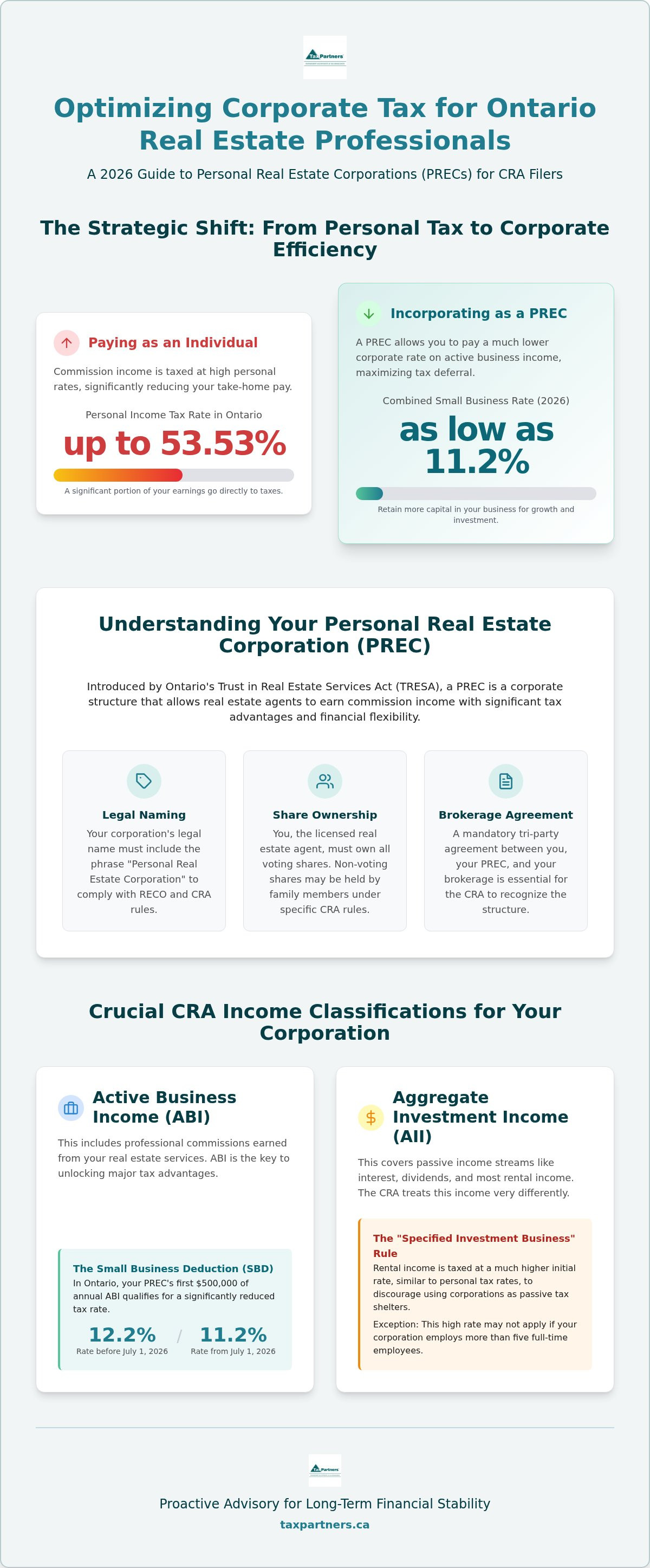
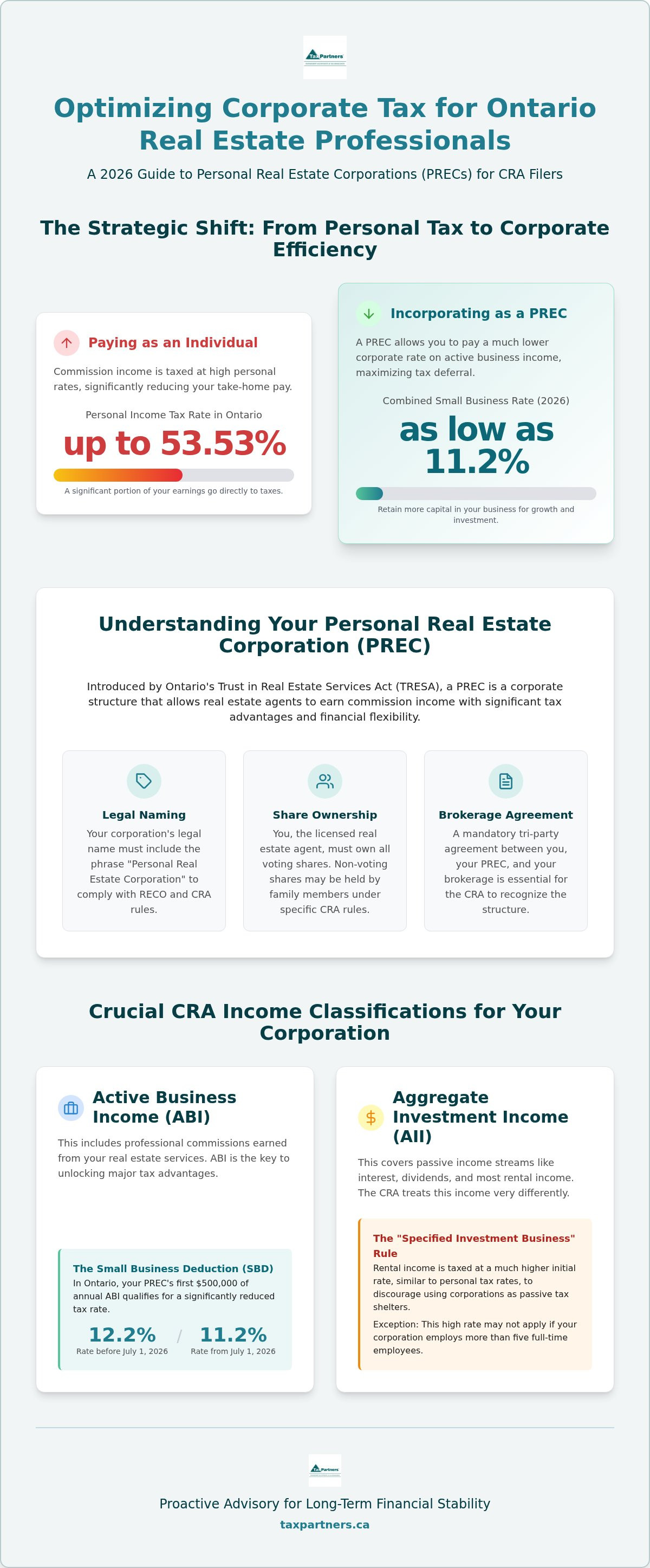
Why are you still paying personal income tax rates of up to 53.53% on your commissions when a strategic corporate structure could significantly lighten that burden? Managing corporate tax for real estate companies Ontario often feels like a constant balancing act between staying compliant and protecting your hard-earned income. It's frustrating to watch your wealth-building efforts stall because your tax strategy hasn't kept pace with your professional success.
We realize the stress involved in distinguishing between active business income and passive investment income while trying to avoid a CRA audit. This 2026 guide will show you how to optimize your corporate structure to maximize CRA-approved deferrals and lower your total tax bill. We'll help you address the nuances of the Ontario tax system with the precision your business deserves.
You'll gain a clear understanding of Personal Real Estate Corporation (PREC) regulations and the latest Ontario tax rate changes effective for 2026. We'll provide a reliable compliance framework to ensure you move forward with total confidence and a steady hand at the helm. This journey will transform your uncertainty into a proactive plan for long-term financial stability.
Key Takeaways
- Understand how a Personal Real Estate Corporation (PREC) functions under Ontario's TRESA to effectively manage and protect your commission income.
- Learn the critical distinction between Active Business Income and Aggregate Investment Income to ensure your CRA filings remain accurate and optimized.
- Discover how to utilize corporate tax for real estate companies Ontario to maximize tax deferrals and keep more of your capital working within your business.
- Establish a robust compliance framework for your T2 returns and GST/HST obligations to protect your corporation during potential CRA audits.
- Realize the benefits of a proactive advisory approach to navigate complex regulatory changes that generic accounting software often misses.
The Framework of Real Estate Incorporation in Ontario
The 2020 introduction of the Trust in Real Estate Services Act (TRESA) fundamentally altered the professional lives of Ontario agents. It paved the way for Personal Real Estate Corporations (PRECs), allowing registrants to earn commission income within a corporate structure. This shift provided a new level of financial flexibility that was previously unavailable to individual real estate professionals.
By 2026, the landscape has matured significantly. Simply having a PREC is no longer a competitive advantage; the focus has shifted to how effectively you manage that structure. Optimizing corporate tax for real estate companies Ontario now requires a level of precision that goes beyond basic bookkeeping and enters the realm of strategic wealth preservation.
A solid foundation starts with understanding how provincial rules interact with the Canadian federal corporate tax framework. This synergy determines your ultimate tax liability and your ability to defer income successfully. At Tax Partners, we act as a proactive guardian for your corporate income tax strategy, ensuring your business stays ahead of regulatory shifts.
Legislative Requirements for Ontario PRECs
To remain in good standing with both RECO and the CRA, your PREC must follow strict protocols. For instance, the corporation's legal name must include the phrase "Personal Real Estate Corporation" without exception. The registrant must also own all voting shares, though non-voting shares can sometimes be held by family members under specific conditions that align with federal tax rules.
You must also maintain a valid agreement between yourself, your PREC, and your brokerage. This tri-party contract is a cornerstone of the structure. It ensures the CRA recognizes the corporation as the rightful recipient of commissions, which is essential for maintaining your corporate status.
Beyond PRECs: Real Estate Investment Corporations
It is vital to distinguish a PREC from a standard real estate investment or holding company. While a PREC handles service-based commission income, an investment corporation typically holds physical property assets. The way the CRA treats these entities varies based on whether the income is considered active or passive.
Managing corporate tax for real estate companies Ontario that hold rental properties involves different rules regarding passive income and capital gains inclusion rates. Using a corporate shell for multi-property portfolios or development projects provides a layer of liability protection. It also offers more flexible options for reinvesting profits into new acquisitions without triggering immediate personal tax hits.
Navigating CRA Income Classifications for Property Corporations
The way the CRA categorizes your earnings determines whether you pay a lower preferential tax rate or a significantly higher one. For those managing corporate tax for real estate companies Ontario, the distinction between Active Business Income (ABI) and Aggregate Investment Income (AII) is the most critical factor in your annual planning. ABI generally includes the professional commissions earned by realtors, whereas AII covers passive streams like interest, dividends, and most rental income.
The CRA applies a "specified investment business" rule to corporations whose primary purpose is to earn income from property. Unless your corporation employs more than five full-time employees, your rental income is taxed at a much higher rate than active commission income. This high initial rate is designed to prevent individuals from using a corporation as a tax shelter for personal investments. If you find these rules confusing, it may be time to speak with our team to clarify your specific classification.
Active Business Income for Real Estate Agents
For CRA filers, the Small Business Deduction (SBD) acts as a powerful tool for wealth accumulation. In Ontario, active business income earned by a PREC is eligible for a significantly lower tax rate on the first $500,000 of annual profit. For the 2026 taxation year, the combined federal and Ontario small business tax rate is 12.2% before July 1, and 11.2% from July 1 onwards. This allows you to retain approximately 88% of your earnings within the corporation to reinvest in new listings, marketing, or future property acquisitions.
Passive Income and the Refundable Tax Mechanism
Passive income earned within a corporation is initially taxed at a rate often exceeding 50% to maintain parity with top personal tax brackets. However, the Canadian tax system uses a mechanism called Refundable Dividend Tax on Hand (RDTOH) to mitigate this. When the corporation pays out dividends to shareholders, a portion of this high initial tax is refunded to the company. This ensures that the total tax paid is roughly the same whether the income was earned personally or through a corporate shell.
Strategic investors often blend active and passive income to stay below the $50,000 passive income threshold. Once your passive investment income exceeds this limit, the CRA begins to reduce your eligibility for the small business deduction on your active income. You should review the specific income tax considerations for rental properties to understand how these thresholds impact your long-term portfolio growth. Balancing these two income types requires foresight to avoid the "passive income grind" that can inadvertently raise your overall tax bill.
Strategic Advantages of Real Estate Incorporation in 2026
Incorporating your real estate ventures offers more than just a formal business structure. It provides a sophisticated toolkit for wealth accumulation that isn't available to sole proprietors. When managing corporate tax for real estate companies Ontario, the focus shifts from simple compliance to long-term financial engineering.
One primary advantage involves the Lifetime Capital Gains Exemption (LCGE). While physical real estate itself doesn't qualify, the shares of a corporation that operates an active real estate business might. This could potentially allow you to shield a significant portion of capital gains from tax upon the sale of your business shares, provided you meet specific CRA holding period and asset tests.
Beyond immediate tax hits, incorporation opens doors to advanced retirement vehicles. You might consider an Individual Pension Plan (IPP), which often allows for higher contribution limits than a standard RRSP under Canadian rules. This proactive approach ensures your corporate success translates directly into a secure personal future.
Maximizing Tax Deferral Opportunities
The math behind tax deferral remains one of the strongest arguments for incorporation in 2026. With Ontario's top personal tax rate sitting at approximately 53.53%, the gap between personal and corporate rates is substantial. By keeping profits inside the company, you're essentially utilizing an interest-free loan from the government to fuel your next acquisition.
- Capital Growth: Reinvesting at the lower corporate rate allows for faster portfolio compounding.
- Timing Distributions: You can choose to withdraw funds during lower-income years to minimize your personal tax bracket impact.
- Expense Management: Corporate structures allow for a more organized approach to deducting legitimate business costs before personal taxes are calculated.
Estate Planning and Succession for Real Estate Owners
A corporation acts as a steady vehicle for transferring wealth across generations. In Ontario, assets held within a corporation can sometimes be structured to bypass the probate process through dual will planning. This significantly reduces the Estate Administration Tax, ensuring more of your legacy reaches your heirs rather than the provincial treasury.
Succession planning also becomes more methodical with a share-based structure. You can gradually transition ownership through different share classes without losing operational control of your properties. Integrating these strategies into your broader Wealth Management & Financial Planning ensures every piece of your portfolio works in harmony. This level of foresight is what separates a standard landlord from a true real estate professional.
Essential Corporate Compliance and Reporting for CRA Filers
Compliance is the bedrock of a healthy corporate structure. Managing corporate tax for real estate companies Ontario requires staying ahead of the strict CRA calendar. Missing a deadline doesn't just result in financial penalties; it erodes the trust you've built with regulators and can lead to increased scrutiny of your future filings.
For CRA filers, the T2 Corporate Income Tax Return is due six months after your fiscal year-end. However, your actual tax payment is usually due much earlier, often within two or three months of that same year-end. Failing to distinguish between the filing deadline and the payment deadline is a common mistake that leads to avoidable interest charges.
Compensating yourself as a shareholder also demands careful reporting through T4 or T5 slips. Salaries require monthly payroll remittances and contribute to your Canada Pension Plan (CPP) limits. Dividends offer a simpler administrative path but don't create RRSP contribution room, which makes a balanced approach essential for long-term wealth.
GST/HST Requirements for Real Estate Entities
Ontario's 13% HST must be collected on commissions and most commercial rental income once your revenue exceeds the $30,000 threshold. You can recover the HST paid on business-related expenses, such as marketing or office supplies, through Input Tax Credits (ITCs). Between April 1, 2026, and March 31, 2027, be aware of the enhanced Ontario HST New Housing Rebate for qualifying properties valued up to $1,000,000. For a deeper look at these requirements, see The Comprehensive Guide to Canadian Corporate Tax Compliance in 2026.
CRA Audit Triggers for Real Estate Corporations
The CRA frequently flags real estate corporations that claim high "lifestyle" deductions. Expenses like luxury vehicle leases, international travel, or home office renovations are primary targets for auditors. If your business deductions seem disproportionate to your actual revenue, you may face a detailed review of your entire ledger. Our Corporate Income Tax Services help you build a robust documentation trail that stands up to questioning. This proactive approach ensures your corporation remains a tool for growth rather than a source of stress.
If you're concerned about your current reporting accuracy or want to review your deduction strategy, connect with our compliance experts today for a professional assessment.
Optimizing Your Real Estate Tax Position with Professional Advisory
Generic accounting software often treats every business the same. It lacks the nuance required to manage the specific complexities inherent in the Ontario real estate market. Relying on automated tools can leave you vulnerable to missed deductions or, worse, unintended CRA audit triggers that a human expert would immediately spot.
Professional advisory provides the foresight needed to distinguish between simple bookkeeping and strategic tax planning. Managing corporate tax for real estate companies Ontario requires a partner who understands the logic behind the numbers. We act as your proactive guardian, ensuring your corporate structure remains resilient against changing provincial and federal regulations.
Tax Partners brings over 40 years of specialized experience to your corner. With more than 495,000 returns filed and 1,390 five-star Google reviews, our track record speaks to a deep-seated reliability. We've guided thousands of clients through the transition from solo agents to sophisticated corporate entities, providing a steady hand at the helm during every stage of growth.
Customized Strategies for the Real Estate Sector
The real estate ecosystem involves a diverse range of professionals beyond just sales agents. We provide bespoke planning for architects, engineers, and construction firms who must navigate unique overhead and project-based tax challenges. Our specialized Accounting for Construction and Real Estate services ensure that your corporate tax strategy aligns perfectly with your long-term wealth preservation goals.
We realize that your business isn't just a series of transactions; it's a vehicle for your personal and family future. By integrating your corporate filings with a broader financial outlook, we help you build a legacy that lasts. This holistic approach ensures that every dollar earned is a dollar working toward your ultimate objectives.
Your Next Steps Toward Tax Efficiency
Transitioning into a corporate structure is a significant milestone that demands a comprehensive year-end review. This process allows us to capture all available CRA-approved deferrals and ensure your compensation mix is optimized for the current tax year. We invite you to move from a state of uncertainty toward a feeling of total control over your financial destiny.
Take the first step toward a more secure and efficient business model. Contact Tax Partners for a Comprehensive Real Estate Tax Review and discover how a bespoke approach can transform your bottom line.
Secure Your Professional Future
Success in the Ontario real estate market requires more than just high sales volume; it demands a sophisticated tax architecture. By mastering the distinctions between active and passive income and leveraging the PREC framework, you position your business for sustainable growth. Managing corporate tax for real estate companies Ontario effectively ensures your hard-earned commissions remain a tool for reinvestment rather than an immediate tax liability.
Our specialized real estate industry accounting team understands the unique pressures you face as a developer or agent. With 40+ years of GTA and national tax experience and over 1,390 five-star Google reviews, we provide the steady hand you need to navigate CRA complexities. We act as a proactive guardian for your wealth, helping you realize long-term financial stability through precise and ethical planning.
You've built a reputation for excellence, and now it's time to ensure your financial foundation is just as strong. Secure your real estate wealth with expert corporate tax planning from Tax Partners. We look forward to helping you achieve total control over your corporate tax position.
Frequently Asked Questions
What is a Personal Real Estate Corporation (PREC) in Ontario?
A PREC is a legal entity that allows real estate agents to receive their commission income through a corporation rather than as individuals. Under the Trust in Real Estate Services Act (TRESA), this structure provides agents with the same financial flexibility as other business owners in Ontario. It's a powerful tool for those looking to optimize their tax position and defer income for future business growth.
Can I split income with my family members through a real estate corporation?
Income splitting with family members is possible but strictly regulated by the CRA's Tax on Split Income (TOSI) rules. Generally, family members must be actively engaged in the business on a regular, continuous, and substantial basis to receive dividends without triggering the highest tax rate. You should obtain a professional review of your specific family involvement to ensure you remain compliant with these complex federal regulations.
What are the corporate tax rates for real estate companies in Ontario for 2026?
For 2026, the combined federal and Ontario small business corporate tax rate is 12.2% before July 1 and 11.2% from July 1 onwards for eligible active business income. For income that doesn't qualify for the small business deduction, the general combined rate is 26.5%. These rates are essential to understand when calculating the corporate tax for real estate companies Ontario to determine your potential for annual tax deferral.
Is it worth incorporating if I earn less than $100,000 in commissions?
Incorporation is generally most beneficial when your professional income exceeds your personal lifestyle needs, allowing you to leave surplus funds in the company. If you earn less than $100,000 and spend most of it on personal expenses, the administrative costs of maintaining a corporation might outweigh the tax benefits. However, if you plan to reinvest for growth, it's often worth a consultation to evaluate your long-term trajectory.
What expenses can a real estate corporation deduct under CRA rules?
Under CRA rules, a real estate corporation can deduct any reasonable expense incurred to earn business income. This includes brokerage fees, marketing costs, professional development, and office expenses. You must keep meticulous records and receipts for every deduction to protect your business during a potential audit, especially regarding mixed-use items like vehicle expenses or home office costs.
How does GST/HST work for real estate agents who have incorporated?
Incorporated real estate agents in Ontario must collect the 13% HST on all commissions and remit it to the CRA. The corporation can then claim Input Tax Credits (ITCs) to recover the HST paid on business-related purchases like advertising or equipment. This process requires precise bookkeeping to ensure you aren't overpaying your net tax or missing out on legitimate recoveries.
What is the deadline for filing a corporate T2 return in Canada?
The deadline for filing a corporate T2 return in Canada is exactly six months after the end of your corporation's fiscal year. If your year-end is December 31, 2025, your filing deadline is June 30, 2026. It's important to remember that any tax owing is usually due much earlier, typically within three months of the year-end for most Canadian-controlled private corporations.
How can I move existing properties into a new corporation without triggering immediate tax?
You can move properties into a corporation using a Section 85 rollover under the Income Tax Act to defer immediate capital gains. This process involves rolling the property into the company in exchange for shares at its original cost base rather than its current market value. Because this requires specific legal and tax documentation to satisfy the CRA, it's vital to have a professional handle the election forms.

Article by
Mahad Mohamed
Mahad Mohamed is an accountant and the CEO of Tax Partners, with over 26+ years of Canadian and international tax and accounting experience. His expertise includes corporate reorganization, cross-border tax structuring (Canada & US), tax disputes, CRA audits, and tax planning for small owner-managed private corporations. Most recently, Mahad is a pioneer in Canadian crypto taxation and founded Block3 Finance.
Previously, Mahad worked for the Canada Revenue Agency (CRA), Big4 accounting firms, and served as a Rulings Officer for the Federal Tax Authority of the UAE before acquiring Tax Partners in 2014.
Tax Partners has 44 full-time accountants and over 18,400+ clients.
Disclaimer
This article provides general information only and is current as of its publication date. It has not been updated and may be out of date. It does not constitute legal advice and should not be relied upon as such. Every tax situation is unique and may differ from the examples discussed in this article. If you have specific questions, you should seek the advice of our accountants for your unique circumstances. Book a FREE Initial Consultation Today!
Frequently Asked Questions
What is a Personal Real Estate Corporation (PREC) in Ontario?
A PREC is a legal entity that allows real estate agents to receive their commission income through a corporation rather than as individuals. Under the Trust in Real Estate Services Act (TRESA), this structure provides agents with the same financial flexibility as other business owners in Ontario. It's a powerful tool for those looking to optimize their tax position and defer income for future business growth.
Can I split income with my family members through a real estate corporation?
Income splitting with family members is possible but strictly regulated by the CRA's Tax on Split Income (TOSI) rules. Generally, family members must be actively engaged in the business on a regular, continuous, and substantial basis to receive dividends without triggering the highest tax rate. You should obtain a professional review of your specific family involvement to ensure you remain compliant with these complex federal regulations.
What are the corporate tax rates for real estate companies in Ontario for 2026?
For 2026, the combined federal and Ontario small business corporate tax rate is 12.2% before July 1 and 11.2% from July 1 onwards for eligible active business income. For income that doesn't qualify for the small business deduction, the general combined rate is 26.5%. These rates are essential to understand when calculating the corporate tax for real estate companies Ontario to determine your potential for annual tax deferral.
Is it worth incorporating if I earn less than $100,000 in commissions?
Incorporation is generally most beneficial when your professional income exceeds your personal lifestyle needs, allowing you to leave surplus funds in the company. If you earn less than $100,000 and spend most of it on personal expenses, the administrative costs of maintaining a corporation might outweigh the tax benefits. However, if you plan to reinvest for growth, it's often worth a consultation to evaluate your long-term trajectory.
What expenses can a real estate corporation deduct under CRA rules?
Under CRA rules, a real estate corporation can deduct any reasonable expense incurred to earn business income. This includes brokerage fees, marketing costs, professional development, and office expenses. You must keep meticulous records and receipts for every deduction to protect your business during a potential audit, especially regarding mixed-use items like vehicle expenses or home office costs.
How does GST/HST work for real estate agents who have incorporated?
Incorporated real estate agents in Ontario must collect the 13% HST on all commissions and remit it to the CRA. The corporation can then claim Input Tax Credits (ITCs) to recover the HST paid on business-related purchases like advertising or equipment. This process requires precise bookkeeping to ensure you aren't overpaying your net tax or missing out on legitimate recoveries.
What is the deadline for filing a corporate T2 return in Canada?
The deadline for filing a corporate T2 return in Canada is exactly six months after the end of your corporation's fiscal year. If your year-end is December 31, 2025, your filing deadline is June 30, 2026. It's important to remember that any tax owing is usually due much earlier, typically within three months of the year-end for most Canadian-controlled private corporations.
How can I move existing properties into a new corporation without triggering immediate tax?
You can move properties into a corporation using a Section 85 rollover under the Income Tax Act to defer immediate capital gains. This process involves rolling the property into the company in exchange for shares at its original cost base rather than its current market value. Because this requires specific legal and tax documentation to satisfy the CRA, it's vital to have a professional handle the election forms.