Capital Gains Tax in Canada: A Comprehensive Guide for 2026

The looming threat of a 66.7% inclusion rate has officially vanished, yet many Canadians are still structuring their portfolios based on outdated fears. It’s a common frustration; you work hard to build your assets only to feel like the regulatory goalposts are constantly shifting. We understand that the complexity of the capital gains tax can feel overwhelming, particularly when cross-border assets or intricate calculations like the Adjusted Cost Base are involved. You deserve a financial strategy rooted in stability rather than uncertainty.
This guide provides the clarity you need to move forward with total confidence. We’ll help you master the current 50% inclusion rate and explore strategic exemptions, such as the 2026 Lifetime Capital Gains Exemption estimated at $C1,275,000, to protect your wealth. By the end of this article, you’ll have a precise understanding of the math and the legal frameworks available to minimize your tax liability. We are going to walk through everything from tax-loss harvesting deadlines to the nuances of provincial tax variations, ensuring you remain the proactive guardian of your financial future.
Key Takeaways
- Learn to distinguish between realized and unrealized gains to time your asset disposals effectively and manage your annual taxable income.
- Master the specific formula for your Adjusted Cost Base to ensure you don't overpay capital gains tax under the current 2026 rules.
- Identify how to fully leverage the Principal Residence Exemption and registered accounts to shield your most significant assets from taxation.
- Discover strategic ways to apply capital losses against your profits using the CRA's carryback and carryforward provisions.
- Recognize the value of professional oversight for cross-border compliance and complex wealth transitions to secure your financial legacy.
Understanding Capital Gains: How the CRA Views Your Profit
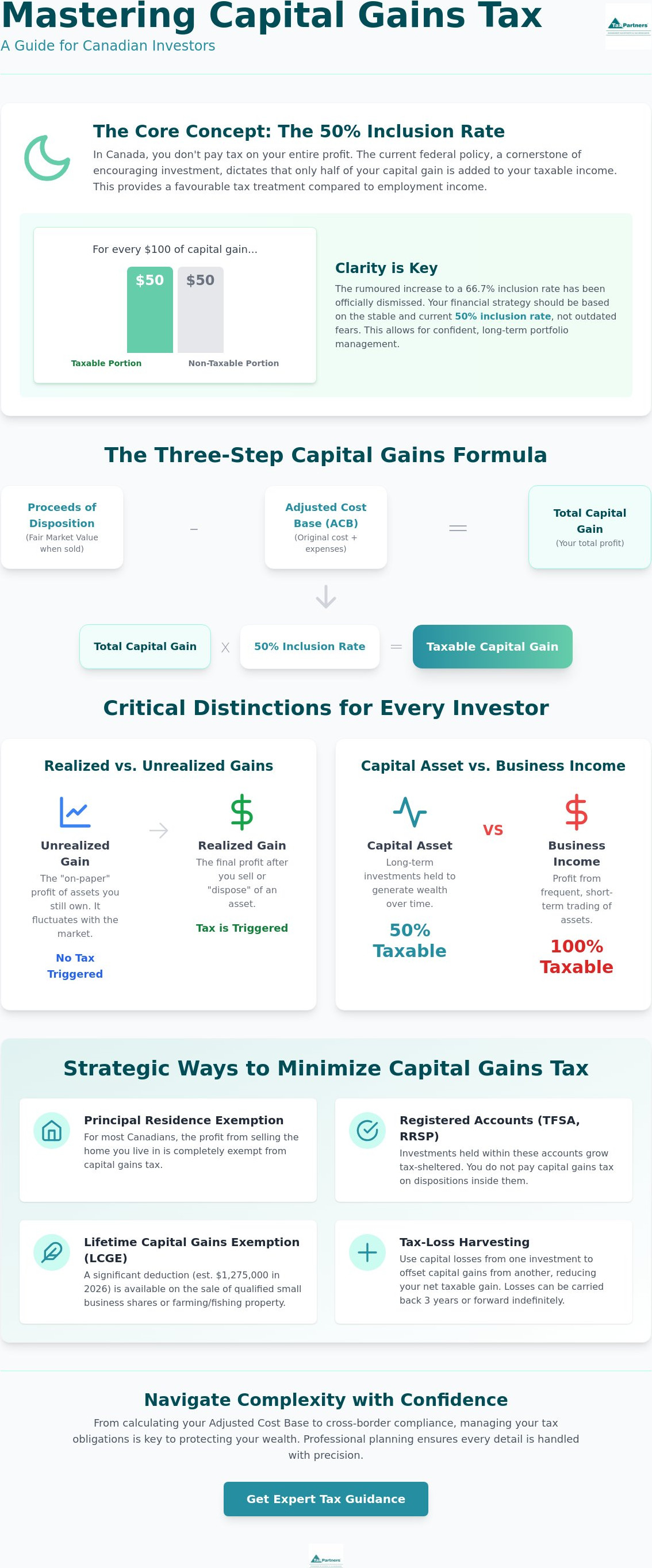
Capital property represents the engine of your long-term wealth. Whether it's a portfolio of blue-chip stocks, a commercial warehouse, or a collection of vintage watches, these assets are defined by their potential to grow over time. The Canada Revenue Agency (CRA) views these holdings differently than your salary or interest income. Because you've taken a calculated risk with your after-tax dollars, the tax system offers a more lenient structure. Currently, only 50% of your profit is subject to capital gains tax, which effectively reduces your tax burden compared to standard wages. This favourable treatment is a cornerstone of Canadian fiscal policy, designed to encourage citizens to invest in the economy and build personal security.
A "disposition" is the specific event that triggers a tax consequence. While most people associate this with a simple sale, the CRA has a broader definition. A disposition occurs when you sell an asset, but it also happens if you gift property to someone other than a spouse, change a property's use from personal to income-producing, or even when you emigrate from the country. Understanding these triggers allows you to plan your exits with precision, ensuring you aren't surprised by a sudden tax bill. Our Canadian accounting and tax services focus on identifying these moments before they happen, allowing for a more controlled financial journey.
Realized vs. Unrealized Gains
The distinction between a gain on paper and a gain in your pocket is where many taxpayers find relief. You aren't penalized for being a savvy investor while you hold your assets. An unrealized gain is essentially a potential profit that fluctuates with market conditions. It doesn't affect your tax return until you decide to part with the asset. This delay is a powerful tool for compounding your wealth over decades. High-level capital gains tax in Canada research confirms that timing your disposition is one of the few ways you can legally influence your tax bracket for a specific year. A realized gain is the final profit after a legal transfer of ownership.
Capital Assets vs. Business Income
The CRA maintains a watchful eye on the line between investing and active trading. If you’re buying and selling assets with high frequency, you risk being classified as a business. This change is costly. Business income is 100% taxable at your marginal rate, stripping away the 50% inclusion advantage. To determine your status, the CRA examines your intent at the time of purchase. They look at whether your transactions are frequent, if you hold assets for short durations, and if you spend a significant amount of time managing these trades. For most individuals, occasional rebalancing of a retirement portfolio won't trigger a business classification, but clarity is essential for those with more active strategies. Consistent record-keeping is your best defence against an audit that seeks to reclassify your hard-earned gains as business profit.
The Math of Taxes: Calculating Your Adjusted Cost Base and Inclusion Rate
Precision is the antidote to tax-related anxiety. When you calculate your capital gains tax, you aren't just guessing at a number; you're following a structured formula designed to recognize the true profit of your investment. The CRA uses a rigid equation: Fair Market Value (FMV) minus the Adjusted Cost Base (ACB) and any outlays or expenses. This result determines your total capital gain. By focusing on the details of this calculation, you can ensure that you only pay what is legally required and not a cent more. Understanding these mechanics is the first step toward maintaining a sense of control over your financial future.
Mastering the Adjusted Cost Base (ACB)
Your ACB is the total cost of your property, but it's rarely just the initial purchase price. To lower your eventual tax bill, you must track every dollar that improves the asset's value. For real estate, this includes major capital improvements like a new roof or a structural addition. For stocks, it includes the commission fees paid during the acquisition. These costs are added to your base, which reduces the gap between what you paid and what you earned. Meticulous record-keeping is vital here. If you can't prove an expense with a receipt, the CRA may disallow the adjustment, leading to a higher tax bill. Tracking these figures over decades can feel tedious, but the savings are substantial when it's time to sell.
The 2026 Inclusion Rate Explained
The 2026 landscape is defined by the cancellation of previously proposed tax hikes. While there was significant confusion regarding a shift to a 66.7% inclusion rate for gains over a $250,000 threshold, those changes were officially rescinded in March 2025. Consequently, the 50% inclusion rate remains the standard for individuals, corporations, and trusts alike. This means you don't need to worry about a tiered tax system based on the size of your gain this year. Following the official CRA guidelines on capital gains ensures that you are reporting these figures correctly on Schedule 3. Only the taxable portion of the gain is added to your personal income.
Outlays and expenses are the final pieces of the puzzle. These are the costs associated with selling the asset, such as legal fees, real estate commissions, or advertising costs. You subtract these directly from your gain before applying the inclusion rate. If you find the math of ACB adjustments or cross-border asset tracking complex, our Canadian accounting and tax services can provide the precise oversight needed to protect your margins. Every expense you document is a shield against unnecessary taxation, ensuring your hard-earned wealth remains exactly where it belongs.
Strategic Exemptions: Protecting Your Principal Residence and Registered Investments
While mastering the math of your Adjusted Cost Base is essential, identifying which assets are entirely shielded from the CRA is the most effective way to preserve your net worth. Canada offers several robust provisions that allow you to grow your wealth without the friction of annual taxation. These exemptions aren't merely loopholes; they are intentional structural advantages designed to reward long-term residency and entrepreneurship. By aligning your portfolio with these rules, you can significantly reduce or even eliminate your capital gains tax liability.
The Principal Residence Exemption Nuances
Your home is likely your most significant asset, and the Principal Residence Exemption (PRE) ensures its growth remains yours to keep. To qualify, you or a family member must have "ordinarily inhabited" the property during the year. This definition is surprisingly flexible, often extending to seasonal cottages if you haven't designated another property as your primary residence for that specific period. When you transition between homes, the "+1 year" rule provides a vital buffer, allowing you to treat both properties as principal residences for the year of the move. You must report the sale on your T1 Income Tax and Benefit Return, even if the entire gain is exempt. Neglecting this reporting requirement can result in a late-filing penalty of up to $C8,000, as detailed in the Canada Revenue Agency guide on capital gains.
Registered Accounts: The Tax-Free Advantage
Registered accounts act as a powerful perimeter around your investments. The Tax-Free Savings Account (TFSA) is the premier vehicle for high-growth assets because every dollar earned, including capital gains, is completely shielded from tax. For 2026, the annual TFSA contribution limit is $C7,000, with a cumulative total for eligible individuals reaching $C109,000. The Registered Retirement Savings Plan (RRSP) offers a different advantage by deferring taxes until your retirement years, when you'll likely sit in a lower income bracket. The RRSP contribution limit for 2026 is $C33,810. It's vital to remember that these accounts do not allow for capital loss claims. If an investment within a TFSA or RRSP loses value, you cannot use that loss to offset gains in your non-registered accounts.
For business owners and farmers, the Lifetime Capital Gains Exemption (LCGE) provides a final, high-impact layer of protection. As of 2026, the LCGE is approximately $C1,275,000, indexed to inflation to maintain its purchasing power. This exemption applies to the sale of qualified small business corporation shares and qualified farm or fishing property. Utilizing this requires proactive planning, as the "holding period" and "asset use" tests must be met for at least 24 months before the sale. Comparing Wealth Management and Financial Advisory Fees is a key step for those seeking professional guidance to navigate these timelines and ensure a tax-efficient business exit.
Offsetting Gains: Leveraging Capital Losses and Tax-Loss Harvesting
Market volatility is an inherent part of investing, but a decline in asset value doesn't have to be a total loss. Within the Canadian tax framework, these downturns can be transformed into strategic tools to preserve your capital. A capital loss is realized when you dispose of an asset for less than its Adjusted Cost Base plus any associated selling costs. While the experience of a loss is often stressful, the ability to apply these amounts against your profits provides a significant measure of relief. These losses act as a direct counterbalance to your capital gains tax obligations, ensuring that your tax bill reflects your actual net progress rather than just your successes.
The Mechanics of Loss Application
The CRA dictates a specific hierarchy for how you must use these losses. You are first required to apply any capital losses realized in the current year against your capital gains from the same period. If your losses exceed your gains, the resulting "net capital loss" becomes a versatile asset for future planning. You have the option to carry these losses back to any of the three preceding taxation years, which can trigger a welcome refund of taxes you've already paid. If a carryback isn't advantageous, you can carry the losses forward indefinitely to reduce your future capital gains tax when markets recover. It's a firm boundary that capital losses cannot be used to offset regular employment income or interest; they are reserved exclusively for offsetting capital property gains.
Strategic Year-End Planning
As the calendar turns to December, proactive investors begin the process of tax-loss harvesting. This strategy involves intentionally realizing losses on underperforming assets to neutralize gains realized earlier in the year. To be effective for the 2026 tax year, these transactions must be completed by the December 31 deadline. You must remain vigilant regarding the "superficial loss" rule, which the CRA uses to prevent artificial tax claims. If you or an affiliated person, such as a spouse or a corporation you control, buys the same or an identical asset within 30 days before or after the sale, the loss is disallowed. Tax-loss harvesting should never override sound investment fundamentals. Our wealth management and financial planning services ensure that your year-end adjustments serve your long-term goals without inviting unnecessary scrutiny from the CRA.
Navigating Complexity: Why Professional Planning Protects Your Wealth
The structural framework of the capital gains tax system is designed for precision. However, the application of these rules in a real-world portfolio is often where the most costly errors occur. A minor miscalculation in your Adjusted Cost Base or an improperly documented exemption claim can trigger a chain reaction of CRA inquiries. These aren't just administrative hurdles. They are financial risks that can erode decades of diligent saving. Relying on institutional wisdom provides a necessary layer of protection against the unpredictability of regulatory shifts.
Digital assets represent a modern frontier for the CRA. The agency treats cryptocurrency gains primarily as capital property, provided you aren't trading as a business. This evolving sector requires a forward-thinking outlook. Precise tracking of every exchange is essential to satisfy the government's demand for transparency. Without a steady hand at the helm, the decentralized nature of these assets can lead to significant reporting gaps. Our Canadian accounting and tax services ensure that your digital portfolio remains as compliant as your traditional holdings.
The Cross-Border Challenge
Dual citizens and Canadian expats face a unique layer of complexity that standard tax software cannot resolve. Because the United States taxes based on citizenship rather than just residency, you must report your global capital gains to both the IRS and the CRA. This dual reporting requirement creates a high risk of double taxation if not managed with foresight. Coordinating these filings simultaneously allows you to leverage foreign tax credits effectively. It ensures that a gain realized anywhere in Canada isn't penalized twice. It requires a synchronized approach to maintain compliance on both sides of the border. We specialize in US and cross-border accounting and tax services, providing the clarity needed to manage these overlapping jurisdictions.
Bespoke Advisory for High-Stakes Dispositions
When you are preparing for a business exit or a complex succession plan, the stakes move beyond simple arithmetic. These high-value transitions require customized strategies that balance immediate liquidity needs with long-term tax efficiency. Proactive audit protection is a core component of this process. By ensuring your documentation meets the highest CRA standards from the outset, you eliminate the stress of future challenges. Secure your financial future with a personalized tax strategy from Tax Partners. Our firm brings over 40 years of experience to every client engagement, acting as a proactive guardian for your wealth. We combine deep-seated reliability with a modern understanding of the capital gains tax landscape to provide a seamless, end-to-end experience.
Secure Your Financial Legacy
Mastering the nuances of capital gains tax isn't just about compliance; it's about empowerment. You've seen how a meticulously calculated Adjusted Cost Base and the strategic timing of dispositions can significantly lower your tax burden. By leveraging powerful exemptions like the Principal Residence Exemption and registered accounts, you can shield your most vital assets from erosion. These tools provide the stability you need to build a lasting financial future for yourself and your family. Understanding the rules is the first step toward moving from a state of uncertainty to one of total control.
Complexity doesn't have to mean stress when you have a proactive guardian on your side. With over 40 years of tax expertise and more than 495,000 returns filed, we bring deep-seated reliability to every client partnership. Our 1,390+ five-star Google reviews reflect a commitment to transparency and personalized care that defines our firm. Book a consultation with our seasoned tax mentors today to ensure your strategy remains as precise as your goals. You have the power to take total control of your wealth, and we're here to provide the steady hand you deserve.
Frequently Asked Questions
How much is capital gains tax in Canada for 2026?
Canada doesn't have a specific, flat tax rate for capital gains. Instead, 50% of your realized profit is added to your total income and taxed at your personal marginal rate. Following the official cancellation of proposed tax hikes in March 2025, this 50% inclusion rate remains the standard for all individuals and corporations throughout the 2026 tax year.
Do I pay capital gains tax on my primary home?
You generally don't pay tax on the profit from selling your home thanks to the Principal Residence Exemption. To qualify, you must designate the property as your primary residence and have ordinarily inhabited it during the years of ownership. It's vital to report the sale on your T1 return to maintain this exempt status and avoid potential CRA penalties.
Can I use a capital loss to reduce my salary income tax?
You cannot apply a capital loss against your employment or salary income. The CRA requires that capital losses be used exclusively to offset capital gains. If your losses exceed your gains in the current year, you have the flexibility to carry that net loss back three years or forward indefinitely to reduce your future tax obligations.
What is the $250,000 capital gains threshold for individuals?
The proposed $250,000 threshold for a higher 66.7% inclusion rate was officially cancelled in March 2025. This means you don't have to worry about a tiered tax system based on the size of your profit in 2026. The 50% inclusion rate applies to the entirety of your gains, providing a simpler and more predictable environment for your long-term financial planning.
How do I calculate the Adjusted Cost Base (ACB) of my stocks?
To find your ACB, add the total purchase price of the shares to any commissions or trading fees paid during the acquisition. If you buy the same stock at different prices over time, you must calculate the weighted average cost per share. This level of precision ensures you only report the actual profit and don't overpay when you eventually decide to sell.
Is cryptocurrency subject to capital gains tax in Canada?
Cryptocurrency is subject to capital gains tax because the CRA generally views digital assets as capital property rather than currency. Every time you sell, trade, or use crypto to buy a product, it triggers a disposition event. You must track the value in Canadian dollars at the time of each transaction to calculate your taxable profit or loss accurately.
What happens to capital gains when someone passes away?
Death triggers a "deemed disposition," meaning the CRA treats all assets as if they were sold at Fair Market Value immediately before the person passed away. This can create a significant tax liability for the estate. However, assets left to a surviving spouse can often be rolled over at cost, deferring the tax until the spouse eventually disposes of the property.
How long can I carry forward a capital loss in Canada?
You can carry a capital loss forward indefinitely to offset future gains. There is no expiry date on these amounts, which allows them to stay on your balance sheet as a permanent shield against future capital gains tax. This indefinite window provides a steady hand for your portfolio, ensuring you can wait for the most advantageous market conditions to realize your profits.

Article by
Mahad Mohamed
Mahad Mohamed is an accountant and the CEO of Tax Partners, with over 26+ years of Canadian and international tax and accounting experience. His expertise includes corporate reorganization, cross-border tax structuring (Canada & US), tax disputes, CRA audits, and tax planning for small owner-managed private corporations. Most recently, Mahad is a pioneer in Canadian crypto taxation and founded Block3 Finance.
Previously, Mahad worked for the Canada Revenue Agency (CRA), Big4 accounting firms, and served as a Rulings Officer for the Federal Tax Authority of the UAE before acquiring Tax Partners in 2014.
Tax Partners has 44 full-time accountants and over 18,400+ clients.
Disclaimer
This article provides general information only and is current as of its publication date. It has not been updated and may be out of date. It does not constitute legal advice and should not be relied upon as such. Every tax situation is unique and may differ from the examples discussed in this article. If you have specific questions, you should seek the advice of our accountants for your unique circumstances. Book a FREE Initial Consultation Today!
Frequently Asked Questions
Realized vs. Unrealized Gains
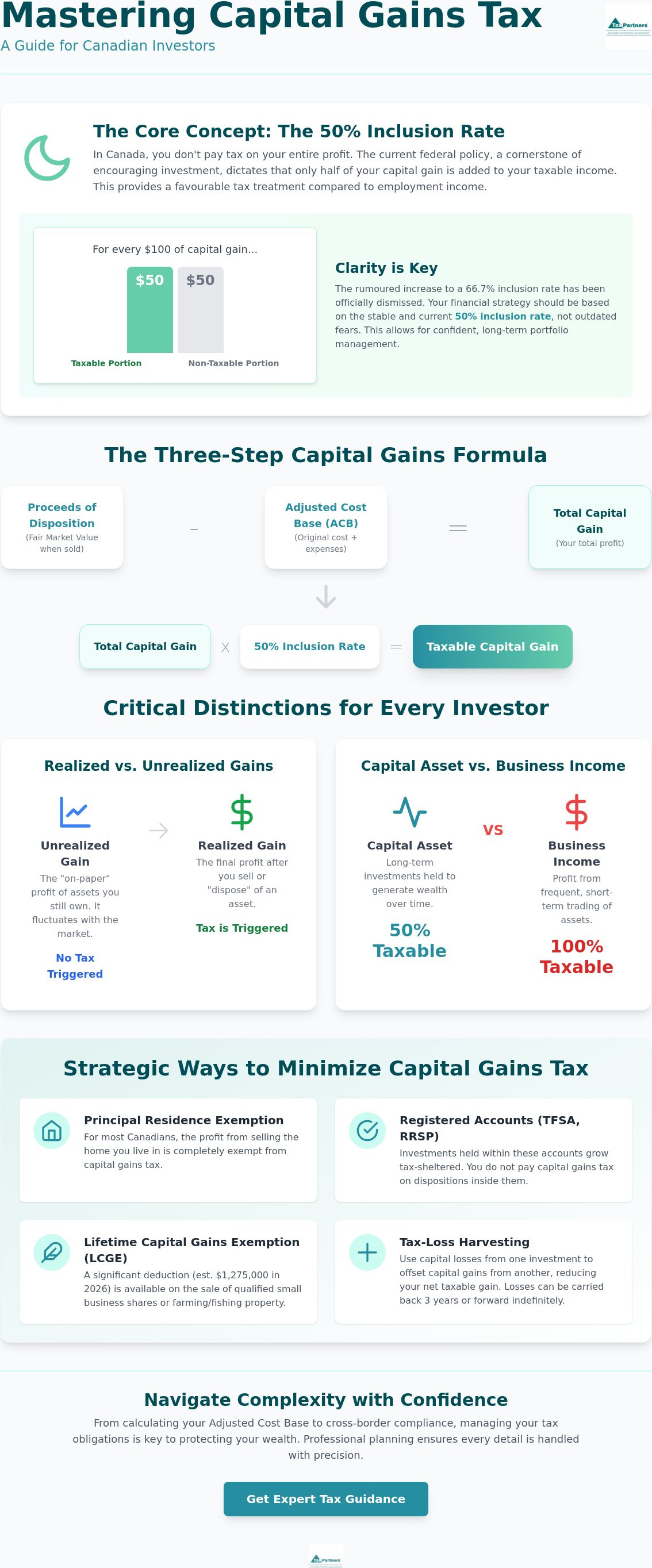
The distinction between a gain on paper and a gain in your pocket is where many taxpayers find relief. You aren't penalized for being a savvy investor while you hold your assets. An unrealized gain is essentially a potential profit that fluctuates with market conditions. It doesn't affect your tax return until you decide to part with the asset. This delay is a powerful tool for compounding your wealth over decades. High-level capital gains tax in Canada research confirms that timing your disposition is one of the few ways you can legally influence your tax bracket for a specific year. A realized gain is the final profit after a legal transfer of ownership.
Capital Assets vs. Business Income
The CRA maintains a watchful eye on the line between investing and active trading. If you’re buying and selling assets with high frequency, you risk being classified as a business. This change is costly. Business income is 100% taxable at your marginal rate, stripping away the 50% inclusion advantage. To determine your status, the CRA examines your intent at the time of purchase. They look at whether your transactions are frequent, if you hold assets for short durations, and if you spend a significant amount of time managing these trades. For most individuals, occasional rebalancing of a retirement portfolio won't trigger a business classification, but clarity is essential for those with more active strategies. Consistent record-keeping is your best defence against an audit that seeks to reclassify your hard-earned gains as business profit. Precision is the antidote to tax-related anxiety. When you calculate your capital gains tax, you aren't just guessing at a number; you're following a structured formula designed to recognize the true profit of your investment. The CRA uses a rigid equation: Fair Market Value (FMV) minus the Adjusted Cost Base (ACB) and any outlays or expenses. This result determines your total capital gain. By focusing on the details of this calculation, you can ensure that you only pay what is legally required and not a cent more. Understanding these mechanics is the first step toward maintaining a sense of control over your financial future.
Mastering the Adjusted Cost Base (ACB)
Your ACB is the total cost of your property, but it's rarely just the initial purchase price. To lower your eventual tax bill, you must track every dollar that improves the asset's value. For real estate, this includes major capital improvements like a new roof or a structural addition. For stocks, it includes the commission fees paid during the acquisition. These costs are added to your base, which reduces the gap between what you paid and what you earned. Meticulous record-keeping is vital here. If you can't prove an expense with a receipt, the CRA may disallow the adjustment, leading to a higher tax bill. Tracking these figures over decades can feel tedious, but the savings are substantial when it's time to sell.
The 2026 Inclusion Rate Explained
The 2026 landscape is defined by the cancellation of previously proposed tax hikes. While there was significant confusion regarding a shift to a 66.7% inclusion rate for gains over a $250,000 threshold, those changes were officially rescinded in March 2025. Consequently, the 50% inclusion rate remains the standard for individuals, corporations, and trusts alike. This means you don't need to worry about a tiered tax system based on the size of your gain this year. Following the official CRA guidelines on capital gains ensures that you are reporting these figures correctly on Schedule 3. Only the taxable portion of the gain is added to your personal income. Outlays and expenses are the final pieces of the puzzle. These are the costs associated with selling the asset, such as legal fees, real estate commissions, or advertising costs. You subtract these directly from your gain before applying the inclusion rate. If you find the math of ACB adjustments or cross-border asset tracking complex, our Canadian accounting and tax services can provide the precise oversight needed to protect your margins. Every expense you document is a shield against unnecessary taxation, ensuring your hard-earned wealth remains exactly where it belongs. While mastering the math of your Adjusted Cost Base is essential, identifying which assets are entirely shielded from the CRA is the most effective way to preserve your net worth. Canada offers several robust provisions that allow you to grow your wealth without the friction of annual taxation. These exemptions aren't merely loopholes; they are intentional structural advantages designed to reward long-term residency and entrepreneurship. By aligning your portfolio with these rules, you can significantly reduce or even eliminate your capital gains tax liability.
The Principal Residence Exemption Nuances
Your home is likely your most significant asset, and the Principal Residence Exemption (PRE) ensures its growth remains yours to keep. To qualify, you or a family member must have "ordinarily inhabited" the property during the year. This definition is surprisingly flexible, often extending to seasonal cottages if you haven't designated another property as your primary residence for that specific period. When you transition between homes, the "+1 year" rule provides a vital buffer, allowing you to treat both properties as principal residences for the year of the move. You must report the sale on your T1 Income Tax and Benefit Return, even if the entire gain is exempt. Neglecting this reporting requirement can result in a late-filing penalty of up to $C8,000, as detailed in the Canada Revenue Agency guide on capital gains.
Registered Accounts: The Tax-Free Advantage
Registered accounts act as a powerful perimeter around your investments. The Tax-Free Savings Account (TFSA) is the premier vehicle for high-growth assets because every dollar earned, including capital gains, is completely shielded from tax. For 2026, the annual TFSA contribution limit is $C7,000, with a cumulative total for eligible individuals reaching $C109,000. The Registered Retirement Savings Plan (RRSP) offers a different advantage by deferring taxes until your retirement years, when you'll likely sit in a lower income bracket. The RRSP contribution limit for 2026 is $C33,810. It's vital to remember that these accounts do not allow for capital loss claims. If an investment within a TFSA or RRSP loses value, you cannot use that loss to offset gains in your non-registered accounts. For business owners and farmers, the Lifetime Capital Gains Exemption (LCGE) provides a final, high-impact layer of protection. As of 2026, the LCGE is approximately $C1,275,000, indexed to inflation to maintain its purchasing power. This exemption applies to the sale of qualified small business corporation shares and qualified farm or fishing property. Utilizing this requires proactive planning, as the "holding period" and "asset use" tests must be met for at least 24 months before the sale. Wealth management and financial planning can help you navigate these timelines, ensuring your business exit is as tax-efficient as possible. Market volatility is an inherent part of investing, but a decline in asset value doesn't have to be a total loss. Within the Canadian tax framework, these downturns can be transformed into strategic tools to preserve your capital. A capital loss is realized when you dispose of an asset for less than its Adjusted Cost Base plus any associated selling costs. While the experience of a loss is often stressful, the ability to apply these amounts against your profits provides a significant measure of relief. These losses act as a direct counterbalance to your capital gains tax obligations, ensuring that your tax bill reflects your actual net progress rather than just your successes.
The Mechanics of Loss Application
The CRA dictates a specific hierarchy for how you must use these losses. You are first required to apply any capital losses realized in the current year against your capital gains from the same period. If your losses exceed your gains, the resulting "net capital loss" becomes a versatile asset for future planning. You have the option to carry these losses back to any of the three preceding taxation years, which can trigger a welcome refund of taxes you've already paid. If a carryback isn't advantageous, you can carry the losses forward indefinitely to reduce your future capital gains tax when markets recover. It's a firm boundary that capital losses cannot be used to offset regular employment income or interest; they are reserved exclusively for offsetting capital property gains.
Strategic Year-End Planning
As the calendar turns to December, proactive investors begin the process of tax-loss harvesting. This strategy involves intentionally realizing losses on underperforming assets to neutralize gains realized earlier in the year. To be effective for the 2026 tax year, these transactions must be completed by the December 31 deadline. You must remain vigilant regarding the "superficial loss" rule, which the CRA uses to prevent artificial tax claims. If you or an affiliated person, such as a spouse or a corporation you control, buys the same or an identical asset within 30 days before or after the sale, the loss is disallowed. Tax-loss harvesting should never override sound investment fundamentals. Our wealth management and financial planning services ensure that your year-end adjustments serve your long-term goals without inviting unnecessary scrutiny from the CRA. The structural framework of the capital gains tax system is designed for precision. However, the application of these rules in a real-world portfolio is often where the most costly errors occur. A minor miscalculation in your Adjusted Cost Base or an improperly documented exemption claim can trigger a chain reaction of CRA inquiries. These aren't just administrative hurdles. They are financial risks that can erode decades of diligent saving. Relying on institutional wisdom provides a necessary layer of protection against the unpredictability of regulatory shifts. Digital assets represent a modern frontier for the CRA. The agency treats cryptocurrency gains primarily as capital property, provided you aren't trading as a business. This evolving sector requires a forward-thinking outlook. Precise tracking of every exchange is essential to satisfy the government's demand for transparency. Without a steady hand at the helm, the decentralized nature of these assets can lead to significant reporting gaps. Our Canadian accounting and tax services ensure that your digital portfolio remains as compliant as your traditional holdings.
The Cross-Border Challenge
Dual citizens and Canadian expats face a unique layer of complexity that standard tax software cannot resolve. Because the United States taxes based on citizenship rather than just residency, you must report your global capital gains to both the IRS and the CRA. This dual reporting requirement creates a high risk of double taxation if not managed with foresight. Coordinating these filings simultaneously allows you to leverage foreign tax credits effectively. It ensures that a gain realized in Vancouver or Toronto isn't penalized twice. It requires a synchronized approach to maintain compliance on both sides of the border. We specialize in US and cross-border accounting and tax services, providing the clarity needed to manage these overlapping jurisdictions.
Bespoke Advisory for High-Stakes Dispositions
When you are preparing for a business exit or a complex succession plan, the stakes move beyond simple arithmetic. These high-value transitions require customized strategies that balance immediate liquidity needs with long-term tax efficiency. Proactive audit protection is a core component of this process. By ensuring your documentation meets the highest CRA standards from the outset, you eliminate the stress of future challenges. Secure your financial future with a personalized tax strategy from Tax Partners. Our firm brings over 40 years of experience to every client engagement, acting as a proactive guardian for your wealth. We combine deep-seated reliability with a modern understanding of the capital gains tax landscape to provide a seamless, end-to-end experience. Mastering the nuances of capital gains tax isn't just about compliance; it's about empowerment. You've seen how a meticulously calculated Adjusted Cost Base and the strategic timing of dispositions can significantly lower your tax burden. By leveraging powerful exemptions like the Principal Residence Exemption and registered accounts, you can shield your most vital assets from erosion. These tools provide the stability you need to build a lasting financial future for yourself and your family. Understanding the rules is the first step toward moving from a state of uncertainty to one of total control. Complexity doesn't have to mean stress when you have a proactive guardian on your side. With over 40 years of tax expertise and more than 495,000 returns filed, we bring deep-seated reliability to every client partnership. Our 1,390+ five-star Google reviews reflect a commitment to transparency and personalized care that defines our firm. Book a consultation with our seasoned tax mentors today to ensure your strategy remains as precise as your goals. You have the power to take total control of your wealth, and we're here to provide the steady hand you deserve.
How much is capital gains tax in Canada for 2026?
Canada doesn't have a specific, flat tax rate for capital gains. Instead, 50% of your realized profit is added to your total income and taxed at your personal marginal rate. Following the official cancellation of proposed tax hikes in March 2025, this 50% inclusion rate remains the standard for all individuals and corporations throughout the 2026 tax year.
Do I pay capital gains tax on my primary home?
You generally don't pay tax on the profit from selling your home thanks to the Principal Residence Exemption. To qualify, you must designate the property as your primary residence and have ordinarily inhabited it during the years of ownership. It's vital to report the sale on your T1 return to maintain this exempt status and avoid potential CRA penalties.
Can I use a capital loss to reduce my salary income tax?
You cannot apply a capital loss against your employment or salary income. The CRA requires that capital losses be used exclusively to offset capital gains. If your losses exceed your gains in the current year, you have the flexibility to carry that net loss back three years or forward indefinitely to reduce your future tax obligations.
What is the $250,000 capital gains threshold for individuals?
The proposed $250,000 threshold for a higher 66.7% inclusion rate was officially cancelled in March 2025. This means you don't have to worry about a tiered tax system based on the size of your profit in 2026. The 50% inclusion rate applies to the entirety of your gains, providing a simpler and more predictable environment for your long-term financial planning.
How do I calculate the Adjusted Cost Base (ACB) of my stocks?
To find your ACB, add the total purchase price of the shares to any commissions or trading fees paid during the acquisition. If you buy the same stock at different prices over time, you must calculate the weighted average cost per share. This level of precision ensures you only report the actual profit and don't overpay when you eventually decide to sell.
Is cryptocurrency subject to capital gains tax in Canada?
Cryptocurrency is subject to capital gains tax because the CRA generally views digital assets as capital property rather than currency. Every time you sell, trade, or use crypto to buy a product, it triggers a disposition event. You must track the value in Canadian dollars at the time of each transaction to calculate your taxable profit or loss accurately.
What happens to capital gains when someone passes away?
Death triggers a "deemed disposition," meaning the CRA treats all assets as if they were sold at Fair Market Value immediately before the person passed away. This can create a significant tax liability for the estate. However, assets left to a surviving spouse can often be rolled over at cost, deferring the tax until the spouse eventually disposes of the property.
How long can I carry forward a capital loss in Canada?
You can carry a capital loss forward indefinitely to offset future gains. There is no expiry date on these amounts, which allows them to stay on your balance sheet as a permanent shield against future capital gains tax. This indefinite window provides a steady hand for your portfolio, ensuring you can wait for the most advantageous market conditions to realize your profits.