Accounting for Canadian Holding Companies: A 2026 Guide

What if your most valuable business assets are currently sitting in a danger zone, exposed to the liabilities of your daily operations? Many business owners realize too late that their wealth is vulnerable because it isn't properly separated from their active company. Managing the nuances of accounting for Canadian holding companies can feel like a heavy burden, especially when you're trying to avoid the CRA passive income tax grind while moving money tax-free between entities.
We understand that the complexity of corporate structures often leads to more stress than security. You want to ensure your hard-earned capital is protected and that your tax strategy actually works for you, not against you. This guide promises to show you how to optimize your corporate structure, safeguard your assets, and manage intercorporate dividends effectively under current CRA regulations.
We'll walk you through the 'Holdco' model to help you reduce personal tax liability and build a steady foundation for long-term succession planning. By the end of this article, you'll have a clear roadmap to gain total control over your financial future and protect the legacy you've worked so hard to organize.
Key Takeaways
- Learn how a holding company structure effectively separates your accumulated wealth from the daily operational risks and liabilities of your active business.
- Discover the mechanism for transferring intercorporate dividends tax-free between connected corporations to reinvest capital more efficiently under CRA rules.
- Master the complexities of accounting for Canadian holding companies to manage passive income thresholds and protect your Small Business Deduction from the "SBD grind."
- Understand how "purification" techniques ensure your operating company remains eligible for the Lifetime Capital Gains Exemption when it comes time to sell or transition.
- Identify the specific annual compliance and filing requirements, including T2 returns and corporate minutes, necessary to maintain a robust and audit-ready structure.
What is a Canadian Holding Company and How Does it Work?
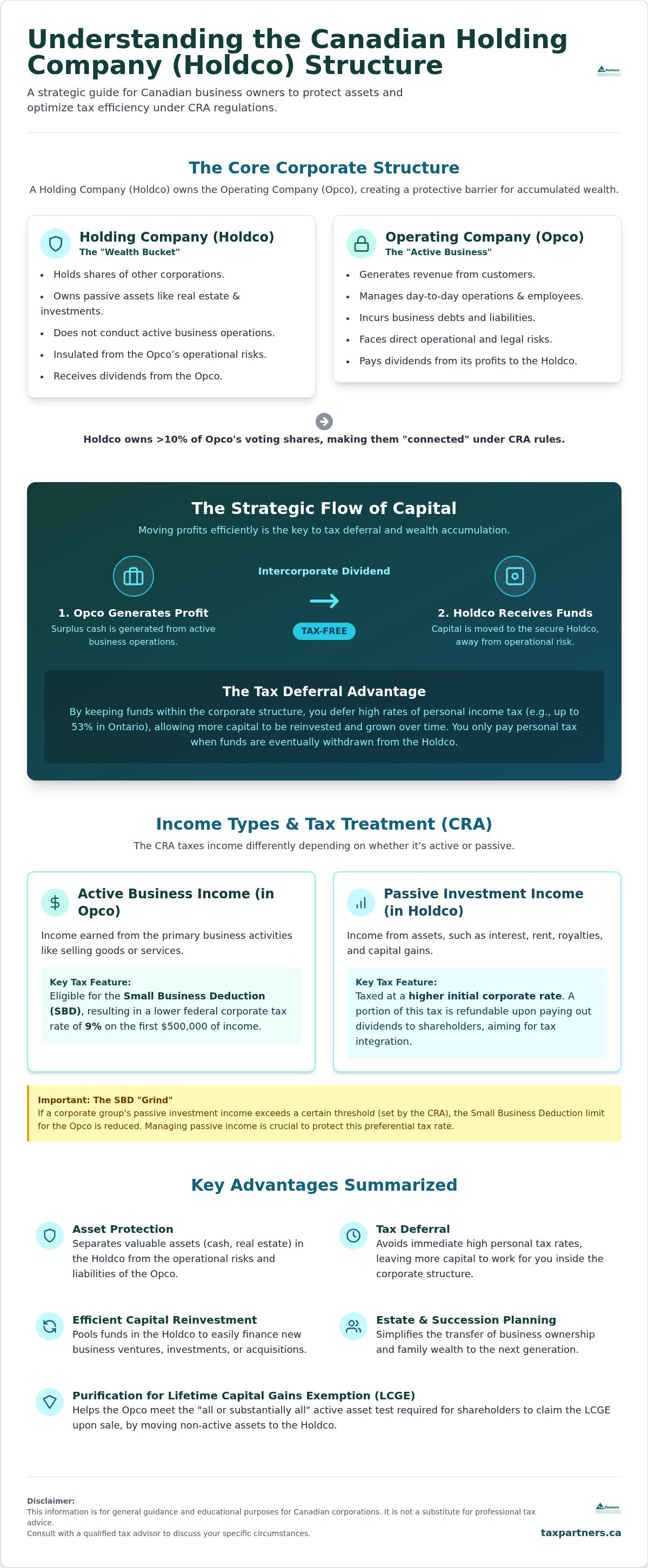
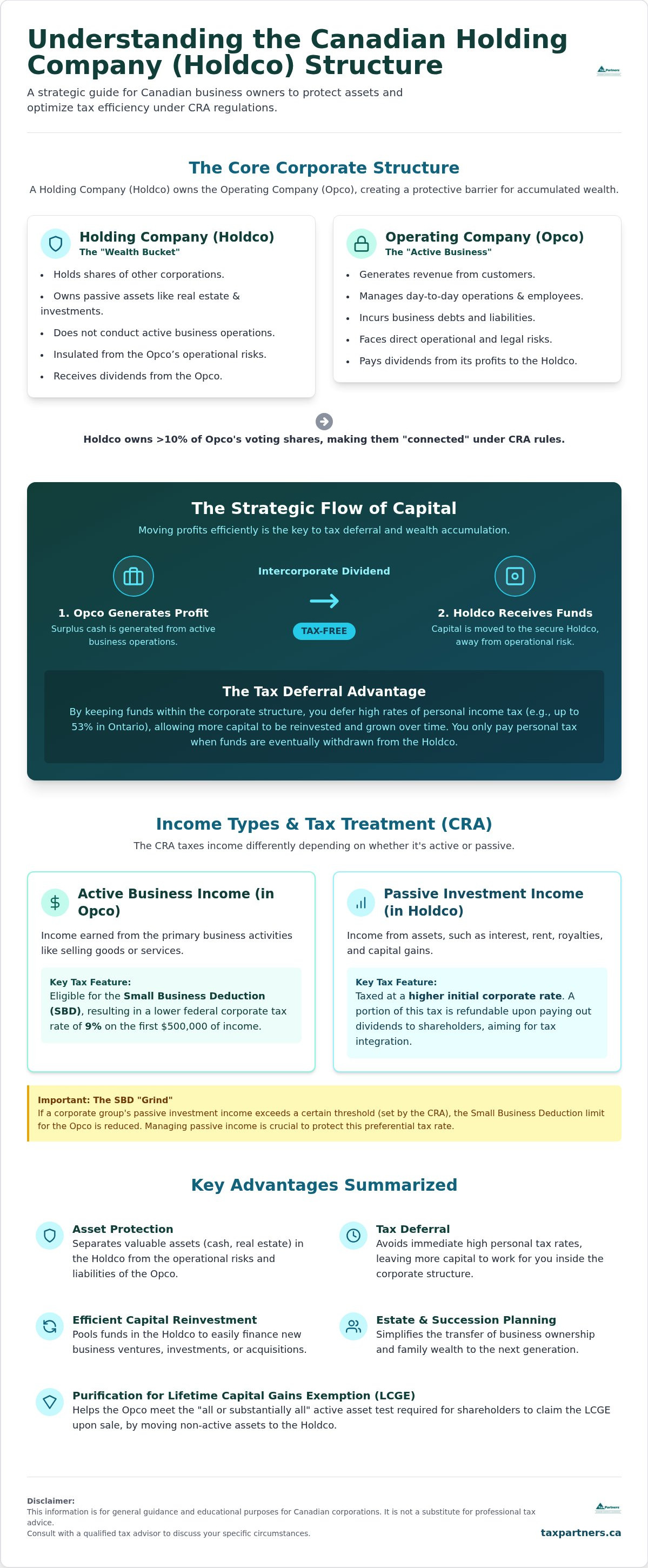
A holding company, often called a "Holdco" by Canadian tax professionals, is a legal entity created specifically to hold assets rather than conduct active business. It doesn't sell products, provide services, or manage daily operations itself. Instead, its primary function is to own shares in other corporations or hold investments like real estate, bonds, and stocks. Understanding What is a Holding Company? is the first step toward securing your business wealth.
Under CRA rules, the relationship between a Holdco and an Operating Company (Opco) is foundational to your corporate structure. The Opco handles the day-to-day grind, pays employees, and generates revenue from customers. The Holdco sits above the Opco as a parent entity, owning some or all of the Opco's shares to create a protective barrier for your profits.
This separation is critical for risk management and long-term stability. Because the Holdco typically has no staff and doesn't engage in high-risk contracts, it stays insulated from the operational liabilities the Opco faces. CRA considers these entities "connected" if the Holdco owns more than 10% of the Opco's voting shares, which unlocks specific tax benefits for moving money between them.
The Core Purpose of a Holdco Structure
Think of your Holdco as a strategic "wealth bucket" for your corporate group. When your Opco generates excess profit that isn't needed for immediate business growth, you can move those funds up to the Holdco. This allows you to accumulate capital for future ventures without triggering the high personal tax rates you'd face by taking a salary.
Flexibility is a major advantage for Canadian business owners using this model. You can use the Holdco to own various assets, such as commercial real estate or a diversified portfolio of securities. It acts as a centralized, secure vault for your family's financial legacy and long-term investment goals.
Key Differences Between Opco and Holdco
The way the CRA taxes these entities depends entirely on the type of income they earn. An Opco primarily earns active business income, which may qualify for the Small Business Deduction (SBD) at a lower tax rate of 9% federally. In contrast, a Holdco usually earns passive investment income, such as interest, rent, or capital gains from its asset portfolio.
Success in accounting for Canadian holding companies requires a clear distinction between these two income streams. Passive income is generally taxed at a higher initial corporate rate than active income, though a portion of this tax is refundable when you pay dividends to shareholders. This system ensures that you don't gain an unfair tax advantage by simply hoarding investment income inside a corporation.
Each entity must remain compliant as a standalone legal person under the Income Tax Act. You'll need to file separate T2 corporate income tax returns for both the Opco and the Holdco every fiscal year. Maintaining this administrative boundary is essential to preserve the legal and tax benefits that a holding company provides.
Strategic Tax Deferral and Intercorporate Dividend Flow
One of the most compelling reasons to implement a holding company structure is the ability to move profits without an immediate personal tax bill. When your operating company generates surplus cash, you can pay a dividend to your holding company. Under CRA rules, these intercorporate dividends are generally received tax-free by the holding company, provided the corporations are "connected" for tax purposes.
This strategy is a cornerstone of effective accounting for Canadian holding companies. It allows you to shift capital away from operational risks while keeping it within your corporate family. By keeping funds inside the Holdco, you avoid the immediate hit of personal income tax. Personal tax rates for high earners in Ontario can exceed 53%, whereas corporate tax on active income is significantly lower. This gap creates a powerful deferral advantage, leaving you with more capital to grow your wealth.
The deferral mechanism essentially provides you with an interest-free loan from the government. Instead of losing half your profit to personal taxes today, you keep those funds working for you. You only pay the personal tax much later, when you finally decide to withdraw the money as personal income. This foresight can lead to a significantly larger investment pool over decades of business operation.
Optimizing Your Corporate Dividend Strategy
Timing your dividend payments is a delicate art that requires foresight. Instead of pulling money out as a personal salary and losing nearly half to the CRA, you can use the Holdco to fund new business ventures or acquisitions using "pre-tax" dollars. These are funds that have only been taxed at the low corporate rate, giving you more leverage for every dollar earned. If you're unsure how to structure these flows, reviewing your corporate income tax strategy can reveal untapped opportunities for growth.
Understanding Part IV Tax for CRA Filers
While intercorporate dividends are often tax-free, the CRA uses Part IV tax to ensure that corporations aren't used as indefinite tax shelters for portfolio investments. This tax typically applies when a corporation receives dividends from a company it doesn't control or isn't "connected" to for tax purposes. It's a refundable tax designed to keep the system fair between corporate and individual investors.
The 2025 Federal Budget introduced specific restrictions regarding the recovery of Refundable Dividend Tax on Hand (RDTOH). These rules may restrict a corporation's ability to recover tax until dividends are paid to individual shareholders. Keeping your structure efficient requires a proactive guardian who understands these shifting regulations. If you want to ensure your dividend flow remains optimized, it's wise to speak with a specialist about your specific corporate setup.
Managing Passive Income and the Small Business Deduction Grind
While a holding company provides excellent asset protection, it introduces a specific challenge known as the "SBD grind." Under CRA rules, Canadian-Controlled Private Corporations (CCPCs) benefit from a reduced federal tax rate of 9% on the first $500,000 of active business income. This benefit isn't absolute. If your holding company and its associated corporations earn too much passive investment income, the CRA begins to claw back this deduction.
The threshold for this reduction begins when your Adjusted Aggregate Investment Income (AAII) exceeds $50,000. For every $1 of passive income earned above this limit, your $500,000 small business limit is reduced by $5. If your group's passive income reaches $150,000, the Small Business Deduction is eliminated entirely. This makes accounting for Canadian holding companies a delicate balancing act between long-term wealth accumulation and immediate tax efficiency.
Exceeding these limits can significantly increase your tax bill. Without proper planning, your operating company could suddenly face the general federal corporate tax rate of 15% on income that previously qualified for the 9% rate. This jump represents a 66% increase in your federal tax burden before provincial taxes are even considered. Staying ahead of these thresholds is the only way to protect your bottom line.
Monitoring Investment Income Thresholds
AAII includes items like interest, taxable capital gains, and rental income, but it excludes certain dividends from connected corporations. It's vital to track these figures across all associated companies. The CRA treats the entire corporate group as a single unit when calculating these limits. Relying on professional bookkeeping services ensures you have real-time visibility into these thresholds. Accurate records prevent you from accidentally triggering a higher tax bracket at year-end.
Strategies to Mitigate the SBD Grind
You can manage the impact of the grind by strategically paying out taxable dividends to shareholders. This action can trigger a refund of the Refundable Dividend Tax on Hand (RDTOH), which helps offset the higher corporate tax rates applied to passive income. Balancing your portfolio between growth-oriented assets and income-producing ones also helps keep your annual AAII below the critical $50,000 mark. Regular tax planning sessions allow you to adjust your corporate structure as your wealth grows. This proactive approach ensures you don't lose the 9% rate unnecessarily while your investments continue to thrive.
Asset Protection and Estate Planning Advantages
Beyond the immediate tax benefits, a holding company functions as a financial fortress for your family's future. It provides a structural layer that separates your personal wealth from the daily risks inherent in running a business. This is where the strategic nature of accounting for Canadian holding companies truly shines, as it allows you to build a legacy that is insulated from unexpected legal or financial storms.
A Holdco acts as a proactive guardian for your capital. By moving surplus funds out of your active business, you ensure that your accumulated wealth isn't tied to the fate of a single entity. This separation is the foundation of a stable, long-term financial plan that prioritizes the security of your family's interests over several decades.
Shielding Wealth from Business Liabilities
Storing large cash reserves or valuable real estate directly within your operating company is a significant risk. If your Opco faces a lawsuit or a claim from a creditor, every asset held by that corporation could be on the table. By "sweeping" excess profits from the Opco to your Holdco through tax-free intercorporate dividends, you effectively move that capital out of the line of fire.
This structure is particularly vital for business owners in high-risk industries like construction or healthcare. It offers a sense of stability, knowing that even if the operating business hits a rough patch, the wealth you've already secured remains protected in a separate legal entity. This proactive guarding of your capital ensures that one bad year or an unforeseen liability doesn't wipe out decades of hard work.
Succession and the Lifetime Capital Gains Exemption
For many Canadian entrepreneurs, the ultimate goal is a tax-efficient exit. The Lifetime Capital Gains Exemption (LCGE) is a powerful tool, with the 2026 limit set at approximately $1,275,000 for qualifying small business shares. To qualify for this exemption under CRA rules, your Opco must be "pure," meaning at least 90% of its assets must be used in active business at the time of sale.
A holding company is essential for this "purification" process. By holding non-active assets like redundant cash or investment portfolios in the Holdco, you keep the Opco's balance sheet lean and compliant with CRA requirements. You can also implement an "Estate Freeze," which locks in the current value of the business for yourself while allowing future growth to accrue to your children or successors. This centralized approach to wealth management and financial planning ensures a smooth transition of power and wealth. If you're ready to secure your business legacy and maximize your tax exemptions, you should consult with our corporate tax experts to begin your purification strategy today.
Navigating Compliance with Expert Tax Advisory
Managing a multi-entity structure isn't a "set and forget" task for business owners. It requires meticulous attention to detail to satisfy CRA filers and maintain the legal integrity of your corporate veil. Ongoing compliance involves more than just filing an annual T2 corporate income tax return for each company. You must also issue T5 slips for dividends paid to individuals and maintain up-to-date corporate minutes to document significant financial decisions.
While many entrepreneurs attempt to use off-the-shelf DIY accounting software, these tools often fall short when dealing with the complexities of accounting for Canadian holding companies. Generic software can't account for the subtle nuances of intercorporate dividend flows or the "SBD grind" thresholds we explored earlier. It lacks the foresight to spot potential red flags that could trigger a costly CRA inquiry or a full-scale audit.
Tax Partners has served as a steady hand for Canadian business owners since 1981. With over 495,000 returns filed and more than $87M saved for our clients, we bring decades of institutional wisdom to every corporate structure. We don't just react to tax deadlines; we act as a proactive mentor, guiding you through the regulatory maze to ensure your wealth remains secure and your entities stay compliant.
The Importance of Accurate Corporate Records
Proper documentation is the lifeblood of a healthy Holdco structure. You must clearly record every intercorporate loan and dividend transfer to avoid the CRA reclassifying these movements as taxable income. Organized records don't just provide peace of mind; they drastically simplify the process during a CRA compliance review. If you're concerned about your current risk level, reviewing our CRA audit guide can help you identify areas that need immediate attention.
Bespoke Tax Planning for Long-Term Success
Our "proactive guardian" approach focuses on identifying tax savings long before the year-end deadline arrives. We understand that a medical professional has different structural needs than a real estate developer, so we tailor our strategies to fit your specific industry. This customization ensures that your holding company isn't just a generic shell, but a precision-engineered tool for wealth preservation. We invite you to contact us today for a comprehensive review of your corporate structure to ensure you're positioned for maximum growth and security.
Secure Your Wealth for Generations to Come
Establishing a robust corporate structure is about more than just immediate savings. It's about creating a legacy that remains insulated from operational risks while maximizing every available tax deferral opportunity. By mastering the nuances of accounting for Canadian holding companies, you can effectively manage the passive income grind and protect your eligibility for the Lifetime Capital Gains Exemption.
We understand that the complexity of CRA regulations can feel overwhelming; however, you don't have to navigate this path alone. With over 40 years of Canadian tax expertise and more than 1,390 five-star Google reviews, Tax Partners serves as a steady hand for business owners nationally across Canada. We're here to ensure your financial foundation is both transparent and resilient.
Secure your corporate future with Tax Partners; contact our experts today. We look forward to helping you realize your long-term vision with confidence and clarity.
Frequently Asked Questions
Is a holding company tax-exempt in Canada?
No, a Canadian holding company is not tax-exempt and must file its own T2 corporate return annually with the CRA. While it can receive certain intercorporate dividends tax-free, it remains liable for tax on other income streams like interest, rent, or capital gains. Effective accounting for Canadian holding companies ensures these entities remain compliant while utilizing available deferral mechanisms to grow your wealth over time.
Can I pay myself a salary from my Canadian holding company?
Yes, you can pay yourself a salary from a holding company, though it requires setting up a payroll account and remitting CPP to the CRA. Most owners prefer dividends for passive entities to avoid the administrative burden of payroll and the requirement to pay into the Canada Pension Plan. We recommend consulting a specialist to determine if salary or dividends better align with your personal tax bracket and retirement goals.
How much does it cost to maintain a holding company under CRA rules?
Maintenance costs vary depending on the complexity of your assets and the volume of transactions you process each year. You should expect to pay for annual corporate tax filings, legal fees for maintaining corporate minutes, and professional bookkeeping services. These costs are a necessary investment to preserve the legal and tax advantages that a multi-entity structure provides under current Canadian law.
Does a holding company protect me personally from business lawsuits?
A holding company protects your accumulated wealth by separating assets from the liabilities of your operating business. While it creates a corporate veil that shields capital from the Opco's creditors, it doesn't automatically protect you from personal liability for your own actions as a director. It's a strategic layer of defence that works best when combined with comprehensive insurance and sound legal advice from a qualified professional.
What is the small business deduction grind for associated corporations?
The "SBD grind" is a CRA mechanism that reduces the $500,000 small business limit when a corporate group's passive income exceeds $50,000. For every $1 of aggregate investment income over this threshold, the business limit drops by $5. If your associated corporations earn $150,000 in passive income, the Small Business Deduction is eliminated entirely, and you'll pay the higher general corporate tax rate on all business income.
Can my holding company own my personal residence in Canada?
While a corporation can legally own property, having a holding company own your personal residence often triggers "shareholder benefit" rules under the Income Tax Act. You would likely lose the Principal Residence Exemption, making the entire future gain on the home taxable upon sale. Most Canadian tax advisors recommend keeping your home personally owned to protect its tax-free status and avoid complex tax assessments from the CRA.
How do I move money from my Opco to my Holdco without paying tax?
You can move funds tax-free by issuing intercorporate dividends from your operating company to your holding company. This is possible when the corporations are "connected" under CRA rules, typically meaning the Holdco owns more than 10% of the Opco's voting shares. This strategy is a vital part of accounting for Canadian holding companies, as it allows you to protect profits without triggering immediate personal income tax.

Article by
Mahad Mohamed
Mahad Mohamed is an accountant and the CEO of Tax Partners, with over 26+ years of Canadian and international tax and accounting experience. His expertise includes corporate reorganization, cross-border tax structuring (Canada & US), tax disputes, CRA audits, and tax planning for small owner-managed private corporations. Most recently, Mahad is a pioneer in Canadian crypto taxation and founded Block3 Finance.
Previously, Mahad worked for the Canada Revenue Agency (CRA), Big4 accounting firms, and served as a Rulings Officer for the Federal Tax Authority of the UAE before acquiring Tax Partners in 2014.
Tax Partners has 44 full-time accountants and over 18,400+ clients.
Disclaimer
This article provides general information only and is current as of its publication date. It has not been updated and may be out of date. It does not constitute legal advice and should not be relied upon as such. Every tax situation is unique and may differ from the examples discussed in this article. If you have specific questions, you should seek the advice of our accountants for your unique circumstances. Book a FREE Initial Consultation Today!
Frequently Asked Questions
Is a holding company tax-exempt in Canada?
No, a Canadian holding company is not tax-exempt and must file its own T2 corporate return annually with the CRA. While it can receive certain intercorporate dividends tax-free, it remains liable for tax on other income streams like interest, rent, or capital gains. Effective accounting for Canadian holding companies ensures these entities remain compliant while utilizing available deferral mechanisms to grow your wealth over time.
Can I pay myself a salary from my Canadian holding company?
Yes, you can pay yourself a salary from a holding company, though it requires setting up a payroll account and remitting CPP to the CRA. Most owners prefer dividends for passive entities to avoid the administrative burden of payroll and the requirement to pay into the Canada Pension Plan. We recommend consulting a specialist to determine if salary or dividends better align with your personal tax bracket and retirement goals.
How much does it cost to maintain a holding company under CRA rules?
Maintenance costs vary depending on the complexity of your assets and the volume of transactions you process each year. You should expect to pay for annual corporate tax filings, legal fees for maintaining corporate minutes, and professional bookkeeping services. These costs are a necessary investment to preserve the legal and tax advantages that a multi-entity structure provides under current Canadian law.
Does a holding company protect me personally from business lawsuits?
A holding company protects your accumulated wealth by separating assets from the liabilities of your operating business. While it creates a corporate veil that shields capital from the Opco's creditors, it doesn't automatically protect you from personal liability for your own actions as a director. It's a strategic layer of defence that works best when combined with comprehensive insurance and sound legal advice from a qualified professional.
What is the small business deduction grind for associated corporations?
The "SBD grind" is a CRA mechanism that reduces the $500,000 small business limit when a corporate group's passive income exceeds $50,000. For every $1 of aggregate investment income over this threshold, the business limit drops by $5. If your associated corporations earn $150,000 in passive income, the Small Business Deduction is eliminated entirely, and you'll pay the higher general corporate tax rate on all business income.
Can my holding company own my personal residence in Canada?
While a corporation can legally own property, having a holding company own your personal residence often triggers "shareholder benefit" rules under the Income Tax Act. You would likely lose the Principal Residence Exemption, making the entire future gain on the home taxable upon sale. Most Canadian tax advisors recommend keeping your home personally owned to protect its tax-free status and avoid complex tax assessments from the CRA.
How do I move money from my Opco to my Holdco without paying tax?
You can move funds tax-free by issuing intercorporate dividends from your operating company to your holding company. This is possible when the corporations are "connected" under CRA rules, typically meaning the Holdco owns more than 10% of the Opco's voting shares. This strategy is a vital part of accounting for Canadian holding companies, as it allows you to protect profits without triggering immediate personal income tax.