Canadian filing requirements for US citizens: What to file and when

For Canadian tax purposes, citizenship alone doesn’t determine your filing obligations. The Canadian filing requirements for US citizens depend largely on whether you’re considered a Canadian resident and on the income you earn.
It’s understandable to focus on how long you’ve been in Canada. Time spent here matters, but your residential ties and overall circumstances also help determine your Canadian tax residency.
This guide explains how Canadian residency affects the income you report, which Canadian filing deadlines may apply, and how to understand your obligations as your circumstances change.
Key Takeaways
- The Canada-US tax treaty can help address double taxation and residency, but it doesn’t automatically remove filing obligations in either country.
- For Canadian tax residency, consider your time in Canada alongside your residential ties and any relevant treaty rules; the CRA’s deemed-resident test includes a 183-day threshold in certain circumstances.
- Track Canadian return filing dates separately from tax payment deadlines, especially if you’re self-employed or owe a balance.
- US citizens living in Canada generally file Form 1040 under US rules, and certain Canadian accounts or investments may bring additional US reporting into play.
- Understanding which rules apply to your residency and income can help you identify the returns and records to consider before deadlines arrive.
Does Canada have a tax treaty with the US?
Yes. For Canadian tax purposes, the Canada-US tax treaty can guide residency questions and provide relief when income is taxed in both countries. It doesn’t replace Canadian filing rules or make every type of income exempt from Canadian income tax.
Canadian tax treatment depends on residency and the source of your income. For example, a Canadian resident generally reports worldwide income in Canada, while a non-resident’s Canadian tax obligations relate to Canadian income and the rules that apply.
Foreign Tax Credits and Earned Income Exclusion
A foreign tax credit reduces tax to account for eligible income tax paid to another country. Under Canadian tax rules, treaty relief and foreign tax credits can help address income taxed in Canada and abroad, but they don’t remove foreign income from Canadian reporting.
The foreign earned income exclusion is a U.S. tax provision, not a Canadian exclusion. It doesn’t determine whether income is reportable in Canada, so you must assess a Canadian return independently under Canadian rules.
Employment Income and Non-Resident Employers
For Canadian tax purposes, employment income is pay earned through work, and the worker’s Canadian residency status affects how Canada taxes it. A Canadian tax non-resident earning under C$10,000 in employment income from a non-resident employer does not have to pay Canadian income tax on that income.
A person who lives in Canada for 182 or fewer days and works for a non-resident employer may qualify for Canadian tax relief on that employment income. Employment income earned in Canada for a U.S. company may be exempt from Canadian tax if the worker does not reside in Canada.
Canadian Part XIII withholding tax on income paid to non-residents is generally 25%, unless a tax treaty reduces the rate. When the correct amount is withheld, it is generally the final Canadian tax obligation on that income.
For Canadian rental income, a non-resident who elects to report income from real property or timber royalties uses the section 216 election process and Canada’s Guide T4144. Certain Canadian pension income may be reported through a section 217 election under the Income Tax Act.
If you’re a U.S. citizen asking whether Canadian pensions, investments, or business income must be reported to the IRS, that’s a question about U.S. filing obligations, not Canadian tax rules. For Canadian purposes, residents generally report worldwide income, while non-residents assess Canadian-source income under the rules that apply to their circumstances.
Canadian tax rules determine whether a U.S. citizen who owns property or earns income in Canada has reporting obligations. Rental, pension, and employment income can each receive different treatment, so identify the income type and your residency status before preparing a Canadian return.
Canadian and U.S. filing deadlines and extensions
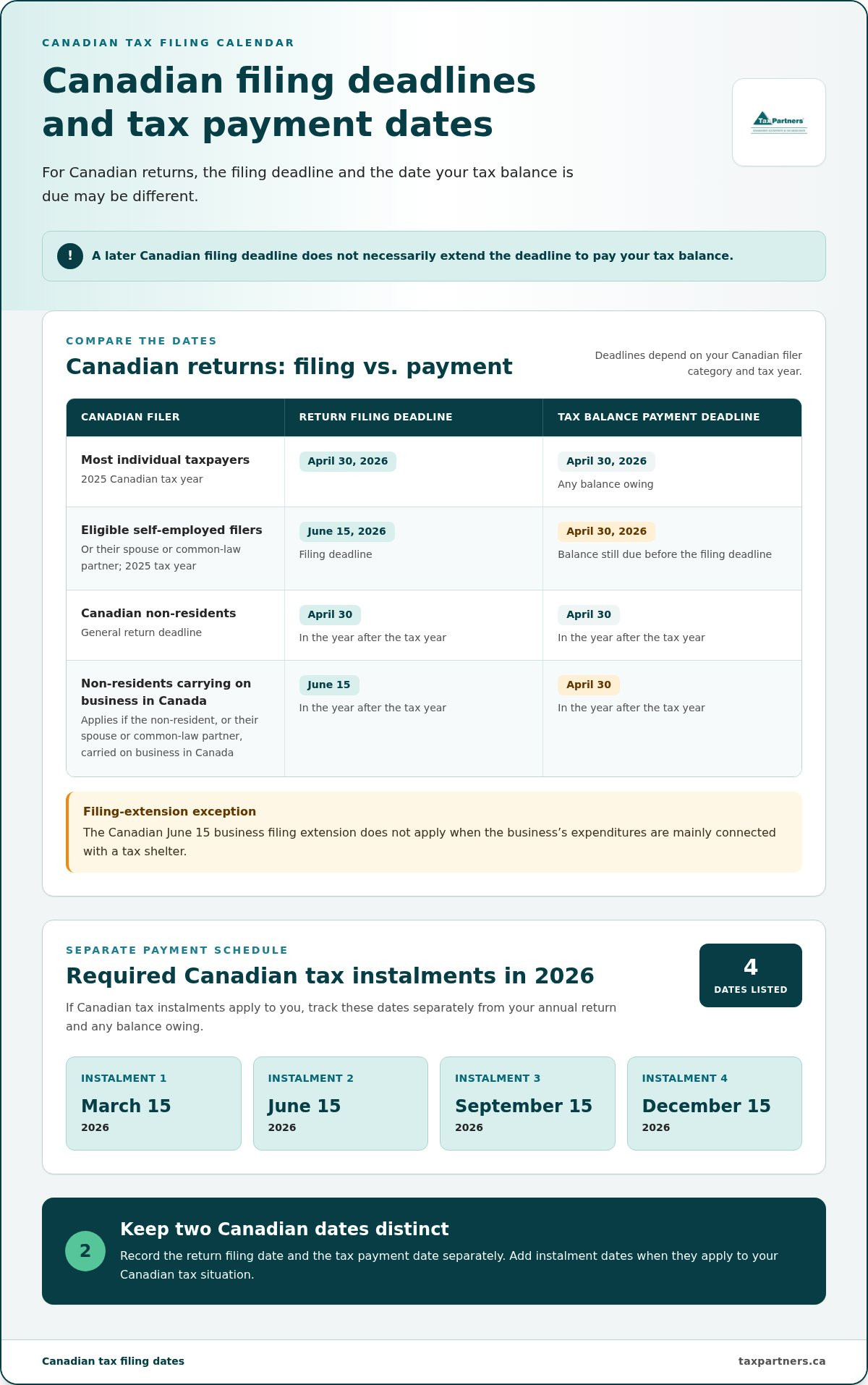
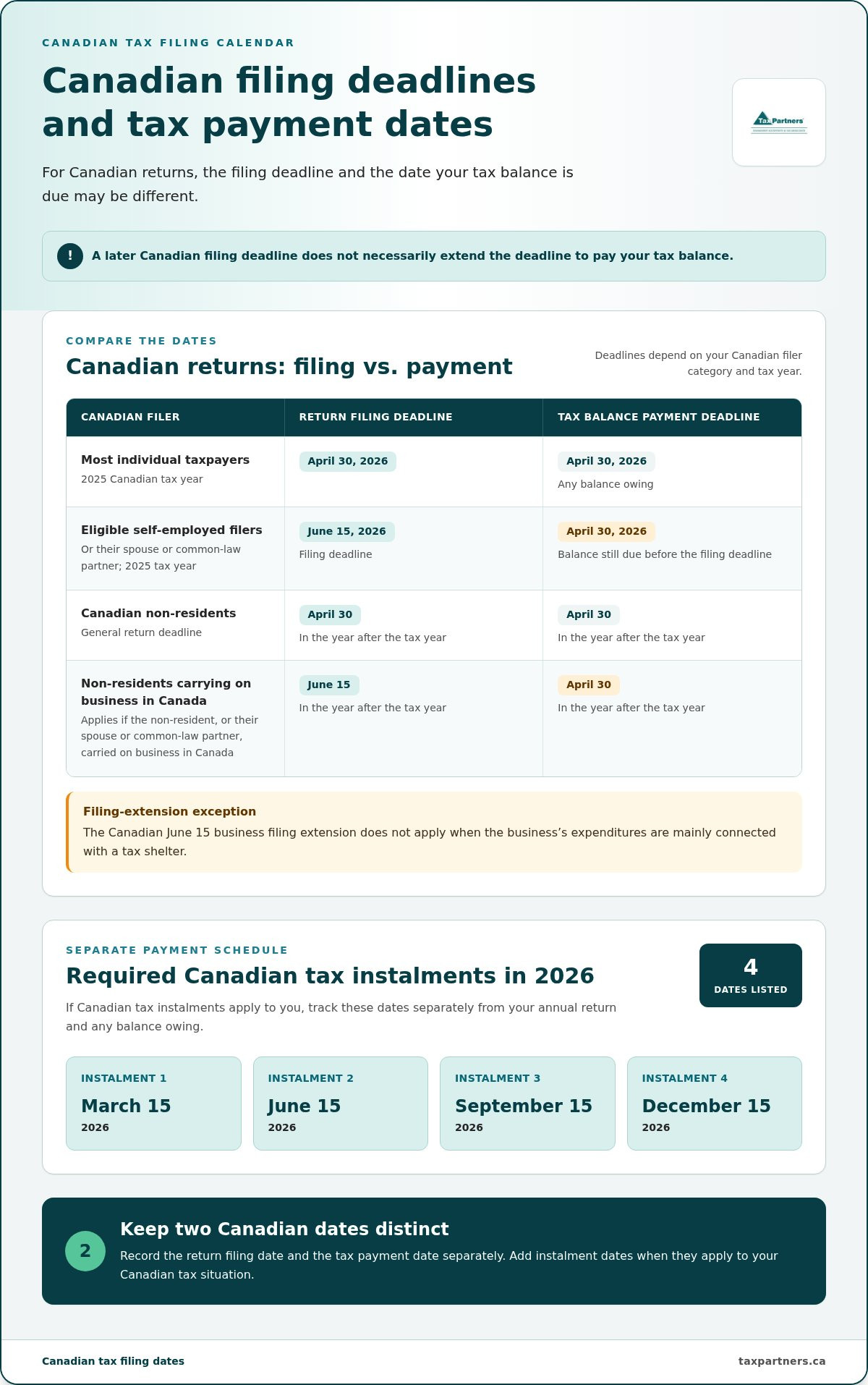
For Canadian tax purposes, the deadline depends on the return type and your circumstances. Keep filing dates separate from payment dates: a later filing deadline doesn’t necessarily postpone when Canadian tax is due.
Canada’s individual tax year runs from January 1 through December 31. For the 2025 tax year, most Canadian taxpayers must file their T1 income tax return by April 30, 2026, and pay any balance owing by that date.
Eligible self-employed taxpayers in Canada, or their spouse or common-law partner, have until June 15, 2026, to file their 2025 return. The Canadian tax balance is still due April 30, 2026, so plan for payment before the filing extension ends.
For Canadian non-residents, the general income tax return deadline is April 30 of the year after the tax year. A non-resident who, or whose spouse or common-law partner, carried on business in Canada generally has until June 15 of the following year to file.
There is an exception to that Canadian business filing extension: it does not apply when the business’s expenditures are mainly connected with a tax shelter. Even where the June 15 filing date applies, a non-resident’s Canadian tax balance remains due April 30 of the year after the tax year.
Canadian taxpayers who must pay instalments should track those payment dates separately from the annual return. Required 2026 Canadian instalments are due March 15, June 15, September 15, and December 15.
Use a Canadian filing calendar that identifies the tax year, return type, filing date, payment date, and any instalments. For example, a self-employed filer could record the April 30 balance-payment deadline and June 15 filing deadline as separate reminders, then add each required instalment date.
- Identify whether your Canadian return is for an individual, a self-employed filer, or a non-resident.
- Record the filing date and tax payment date separately.
- Add Canadian instalment dates when they apply to your situation.
If you’re a Canadian non-resident with business income, note whether the June filing extension applies and whether the tax-shelter exception affects it. Keep supporting income records and proof of payments with your return for the relevant tax year.
If you need help organizing Canadian filing dates and payment obligations, discuss your Canadian filing calendar.
How do I know if I am a Canadian Tax Resident?
Canadian tax residency depends on your residential ties and time spent in Canada, not citizenship alone. The CRA’s residency assessment affects which income you report for Canadian income tax purposes.
Canadian Residency and Residential Ties
Residential ties are connections with Canada that help establish whether you’re considered a Canadian tax resident. They matter because the same amount of time spent in Canada can have different implications depending on your ties and treaty residency.
According to the Canada Revenue Agency, an individual who sojourns in Canada for 183 days or more in a tax year may be a deemed resident if they have no significant Canadian residential ties and are not considered a resident of another country under a tax treaty. The test includes the treaty condition, not just the day count.
Less than 183 days in Canada doesn’t automatically settle your status. A person may qualify as a Canadian non-resident if they spend less than 183 days in the tax year and aren’t otherwise considered a Canadian resident. Review your time in Canada alongside your residential ties rather than treating either factor as conclusive by itself.
Residency and Canadian Filing Scope
Canadian tax residency determines the scope of income generally reported on a Canadian tax return. Canadian residents generally report worldwide income, while a non-resident’s Canadian filing concerns income connected to Canada.
This distinction matters if you earn employment income abroad, hold investments, or receive income from Canadian property. Organize income records by source and tax year, then assess how your Canadian residency status affects what belongs on your return.
Start with a calendar of your time in Canada and a record of your residential ties. Then consider whether a tax treaty treats you as a resident of another country, since the CRA’s deemed-residency test includes that condition.
Non-resident rental income has its own Canadian filing route. A non-resident who elects to report Canadian rental income from real property or timber royalties uses the section 216 election process and Guide T4144. This election relates specifically to rental income; it doesn’t determine your overall residency status.
Canadian residency and U.S. filing status are separate questions. If you’re a Canadian resident but not a U.S. citizen, assess any U.S. filing position under U.S. tax rules rather than assuming the CRA’s residency conclusion answers it. U.S. citizens, by contrast, generally file a U.S. return every year regardless of where they live. For individuals navigating cross-border relocation, visas, or legal status between both countries, mj-law.com offers professional support with U.S. immigration matters.
If your time in Canada, residential ties, or treaty position point in different directions, consider those facts together before deciding which Canadian filing requirements apply. The CRA can help determine your Canadian tax residency status.
US-Canada tax treaty provisions and limitations
The Canada-US tax treaty can coordinate tax treatment when both countries have a claim on income. It offers relief and residency guidance, but it doesn’t make every account or income source tax-free.
For a Canadian resident who pays Canadian income tax on foreign income, the treaty allows each country to provide a foreign tax credit for tax paid to the other. Under U.S. rules, Form 1116 calculates the foreign tax credit, which is limited to the lesser of foreign tax paid on that income and U.S. tax on the same income.
A foreign tax credit isn’t necessarily equal to all Canadian tax paid. When preparing the U.S. calculation, match the foreign income and tax paid to the same income category. This helps distinguish the treaty’s double-tax relief from an exemption that removes income from a return.
Withholding tax is another treaty mechanism. U.S. dividends paid to foreign investors are generally subject to 30% withholding, while the Canada-US treaty may reduce the rate to 15%. The applicable rate affects the amount withheld, not whether a U.S. citizen must consider the income for U.S. tax purposes.
Account labels don’t resolve cross-border treatment. For Roth IRAs and 529 plans, assess the account under both countries’ tax rules rather than assuming the U.S. designation determines Canadian treatment. The treaty’s relief provisions address taxation between countries; they don’t automatically make every registered or education account exempt in both jurisdictions.
The same distinction is important for Canadian accounts held by U.S. citizens. A Canadian TFSA may be tax-free in Canada but still affect U.S. taxes. A U.S. citizen with an interest in a Canadian TFSA or RESP may need Forms 3520 and 3520A if the accounts are treated as foreign trusts for U.S. tax purposes.
Canadian mutual funds can also create U.S. reporting requirements. A U.S. citizen holding Canadian mutual funds in a TFSA, RESP, RRSP, or RRIF may need to complete Form 8621. The account wrapper and the investment inside it are separate considerations for U.S. reporting.
Canadian residents may also have a Canadian foreign-property disclosure obligation. Form T1135 is required when the total cost of specified foreign property exceeds C$100,000. This Canadian form is distinct from U.S. treaty disclosures and U.S. income tax returns.
When a U.S. tax return takes a treaty-based position, Form 8833 may be relevant. The stated penalty for failing to file it on time is US$1,000. Keep the treaty position, income category, account records, and related filings aligned; treaty relief doesn’t erase separate disclosure duties.
US Form 1040 filing for citizens living in Canada
Living in Canada doesn’t end a U.S. citizen’s US tax filing obligations. Under U.S. rules, citizens generally file Form 1040 every tax year, regardless of their country of residence or workplace.
Form 1040 reports income for the U.S. tax year, including Canadian employment, pension, investment, and business income. Canadian tax paid may affect the U.S. calculation through a foreign tax credit, while the foreign earned income exclusion may apply to qualifying earned income. Neither option means all foreign income is automatically exempt.
Prepare the U.S. return using records from both countries. Gather Canadian T4 slips, pension statements, investment records, business income details, and proof of Canadian income tax paid. Sort documents by tax year so reported income and any credit relate to the correct period.
Form 1040 isn’t the only possible U.S. filing. U.S. citizens in Canada may need Form 8938 as well as an FBAR when both reporting requirements apply. Canadian mutual funds held through accounts such as an RRSP or TFSA may also bring Form 8621 into consideration.
Business interests can add another layer. Form 5471 is relevant to certain foreign corporations, and the Tax Cuts and Jobs Act of 2017 brought significant changes, including the Global Intangible Low-Tax Income regime. Keep ownership and corporate financial records with the individual return materials.
If you’ve missed returns, take an organized approach rather than guessing. Start by listing each unfiled U.S. tax year, locating income and account records, and identifying the returns and information forms that apply to each year.
The IRS introduced the current Streamlined Foreign Offshore Procedures in July 2014 for taxpayers residing outside the United States. These procedures provide a route for eligible taxpayers to address past foreign filing issues; the relevant facts include residence, missing returns, and foreign account reporting.
For each overdue year, compare the records against the required U.S. filings, including Form 1040 and any applicable foreign-account or investment forms. Keep copies of filed returns and supporting records together, and account for any tax due under U.S. rules. When facing accumulated penalties or complex balances from unfiled years, professional IRS tax resolution services can help navigate compliance options and settlement agreements.
Tax Partners assists U.S. citizens and expatriates with Form 1040 filings, ITINs, and FBAR/FATCA compliance. If you’re living in Canada and need to organize current or missed U.S. filings, discuss your U.S. tax filing needs.
Tax Partners: Canadian Accounting & Tax Services
Tax Partners helps individuals address Canadian and cross-border tax obligations through Canadian Accounting & Tax Services and US & Cross-Border Accounting & Tax Services. This support can be useful when Canadian residency, U.S. Form 1040 filings, foreign-account reporting, or income from both countries needs to be considered together.
For example, a dual citizen managing Canadian employment income and U.S. investment reporting may need to coordinate records across both tax systems. Tax Partners’ Bookkeeping and Payroll Services can help keep financial records organized, while Wealth Management & Financial Planning can support broader financial decisions.
If you’re ready to discuss your cross-border tax situation, contact Tax Partners.
Make your next filing decision with clarity
Treat the Canadian filing requirements for US citizens as an ongoing part of your financial planning, not a once-a-year paperwork exercise. Changes in where you live, how you earn income, or which accounts and assets you hold can affect the information you need to assemble for future returns.
Use the coming months to build a clear record of income, tax paid, account activity, and important residency details. Keeping those documents organized as events happen can make it easier to explain how your financial picture changed and prepare consistent filings across jurisdictions.
If you’re ready to turn your questions into a practical plan, connect with Tax Partners about your tax situation. A considered next step can help you move forward with greater confidence and a clearer view of what to prepare.
Frequently Asked Questions
Managing US and Canadian tax forms at once?
Use a separate checklist for each country, then reconcile shared income records before preparing returns. For example, match Canadian employment slips and investment statements to the income reported for the same tax year under U.S. rules. Keep proof of Canadian tax paid with those records, as it may support a foreign tax credit calculation on your U.S. return. Track information forms separately from income tax returns.
What’s the difference between US and Canadian tax rules?
U.S. filing obligations for citizens generally follow citizenship, while Canadian income tax obligations depend substantially on residency and Canadian-source income. A U.S. citizen living in Canada may therefore need to consider both systems, even if tax has already been paid in one country. The countries also treat certain accounts and investments differently, so a Canadian tax-free account isn’t automatically tax-free for U.S. purposes.
Do U.S. citizens living in Canada have to file U.S. federal tax returns?
Generally, yes. U.S. citizens living in Canada file a U.S. federal income tax return every year, regardless of where they live or work. They generally use Form 1040 to report income, including Canadian income that falls within U.S. reporting rules. A foreign tax credit or exclusion may affect the U.S. tax calculation, but it doesn’t itself replace the return or settle separate reporting requirements.
What Canadian tax returns and forms must U.S. citizens living in Canada file?
The Canadian forms depend on residency, income, and assets. A Canadian tax resident generally reports worldwide income on a T1 return; a non-resident may have Canadian filing obligations for Canadian-source income. The Canadian T1135 applies when the total cost of specified foreign property exceeds C$100,000. Canadian filing requirements for US citizens can also include rental or pension elections where the relevant income and circumstances qualify.
How does the U.S.-Canada tax treaty prevent double taxation for U.S. citizens in Canada?
The treaty provides relief mechanisms, including the ability for each country to allow a foreign tax credit for income tax paid to the other. A credit helps reduce tax on the same income, subject to each country’s rules and limits. For example, the U.S. Form 1116 credit is limited to the lesser of foreign tax paid on that income and U.S. tax on that income. Treaty relief doesn’t erase filing duties.
What are the U.S. foreign earned income exclusion and foreign tax credit rules for Canadian residents?
Under U.S. rules, the foreign earned income exclusion can exclude qualifying earned income, while a foreign tax credit accounts for eligible income tax paid abroad. For the 2025 U.S. tax year, the exclusion can cover up to US$130,000 of qualifying earned income. The U.S. Form 1116 credit is limited to the lesser of foreign tax paid on that income and U.S. tax on the same income.
What is the deadline for filing U.S. and Canadian tax returns, and what extensions apply?
For the 2025 tax year, most Canadian individual returns and any balance owing are due April 30, 2026. Eligible self-employed Canadian taxpayers have until June 15, 2026, to file, but payment remains due April 30. The automatic U.S. expat filing extension for the 2025 return also reaches June 15, 2026. Keep the two countries’ filing dates and payment dates on separate calendar entries.
Do U.S. citizens in Canada have to report foreign bank accounts on FBAR and Form 8938?
Some U.S. citizens in Canada may have to file both an FBAR and Form 8938 when each reporting requirement applies. These are separate from the U.S. income tax return, and filing one doesn’t automatically satisfy the other. Gather account statements and ownership details for the relevant reporting period, then assess each form independently under U.S. rules. Canadian accounts may also involve separate Canadian reporting obligations.

Article by
Mahad Mohamed
Mahad Mohamed is an accountant and the CEO of Tax Partners, with over 26+ years of Canadian and international tax and accounting experience. His expertise includes corporate reorganization, cross-border tax structuring (Canada & US), tax disputes, CRA audits, and tax planning for small owner-managed private corporations. Most recently, Mahad is a pioneer in Canadian crypto taxation and founded Block3 Finance.
Previously, Mahad worked for the Canada Revenue Agency (CRA), Big4 accounting firms, and served as a Rulings Officer for the Federal Tax Authority of the UAE before acquiring Tax Partners in 2014.
Tax Partners has 44 full-time accountants and over 18,400+ clients.
Disclaimer
This article provides general information only and is current as of its publication date. It has not been updated and may be out of date. It does not constitute legal advice and should not be relied upon as such. Every tax situation is unique and may differ from the examples discussed in this article. If you have specific questions, you should seek the advice of our accountants for your unique circumstances. Book a FREE Initial Consultation Today!
Frequently Asked Questions
Managing US and Canadian tax forms at once?
Use a separate checklist for each country, then reconcile shared income records before preparing returns. For example, match Canadian employment slips and investment statements to the income reported for the same tax year under U.S. rules. Keep proof of Canadian tax paid with those records, as it may support a foreign tax credit calculation on your U.S. return. Track information forms separately from income tax returns.
What’s the difference between US and Canadian tax rules?
U.S. filing obligations for citizens generally follow citizenship, while Canadian income tax obligations depend substantially on residency and Canadian-source income. A U.S. citizen living in Canada may therefore need to consider both systems, even if tax has already been paid in one country. The countries also treat certain accounts and investments differently, so a Canadian tax-free account isn’t automatically tax-free for U.S. purposes.
Do U.S. citizens living in Canada have to file U.S. federal tax returns?
Generally, yes. U.S. citizens living in Canada file a U.S. federal income tax return every year, regardless of where they live or work. They generally use Form 1040 to report income, including Canadian income that falls within U.S. reporting rules. A foreign tax credit or exclusion may affect the U.S. tax calculation, but it doesn’t itself replace the return or settle separate reporting requirements.
What Canadian tax returns and forms must U.S. citizens living in Canada file?
The Canadian forms depend on residency, income, and assets. A Canadian tax resident generally reports worldwide income on a T1 return; a non-resident may have Canadian filing obligations for Canadian-source income. The Canadian T1135 applies when the total cost of specified foreign property exceeds C$100,000. Canadian filing requirements for US citizens can also include rental or pension elections where the relevant income and circumstances qualify.
How does the U.S.-Canada tax treaty prevent double taxation for U.S. citizens in Canada?
The treaty provides relief mechanisms, including the ability for each country to allow a foreign tax credit for income tax paid to the other. A credit helps reduce tax on the same income, subject to each country’s rules and limits. For example, the U.S. Form 1116 credit is limited to the lesser of foreign tax paid on that income and U.S. tax on that income. Treaty relief doesn’t erase filing duties.
What are the U.S. foreign earned income exclusion and foreign tax credit rules for Canadian residents?
Under U.S. rules, the foreign earned income exclusion can exclude qualifying earned income, while a foreign tax credit accounts for eligible income tax paid abroad. For the 2025 U.S. tax year, the exclusion can cover up to US$130,000 of qualifying earned income. The U.S. Form 1116 credit is limited to the lesser of foreign tax paid on that income and U.S. tax on the same income.
What is the deadline for filing U.S. and Canadian tax returns, and what extensions apply?
For the 2025 tax year, most Canadian individual returns and any balance owing are due April 30, 2026. Eligible self-employed Canadian taxpayers have until June 15, 2026, to file, but payment remains due April 30. The automatic U.S. expat filing extension for the 2025 return also reaches June 15, 2026. Keep the two countries’ filing dates and payment dates on separate calendar entries.
Do U.S. citizens in Canada have to report foreign bank accounts on FBAR and Form 8938?
Some U.S. citizens in Canada may have to file both an FBAR and Form 8938 when each reporting requirement applies. These are separate from the U.S. income tax return, and filing one doesn’t automatically satisfy the other. Gather account statements and ownership details for the relevant reporting period, then assess each form independently under U.S. rules. Canadian accounts may also involve separate Canadian reporting obligations.