Canadian departure tax planning for your company and assets

Leaving Canada can trigger a deemed sale: certain property is treated as sold at fair market value under the departure-tax rules. You’re generally taxed in Canada on worldwide income earned up to the date your Canadian tax residency ends. Canadian departure tax planning should also consider what you own or control through a private corporation or trust, since those structures raise questions beyond your personal assets.
It’s understandable to focus on the move itself, but the timing of your residency change, the assets you hold and your role in a business or trust can all affect the tax consequences. A departure doesn’t automatically mean your corporation or trust is treated the same way as property you own personally.
This article explains how Canadian tax residency and departure tax work, what may happen to personal assets, and which departure-year filings may apply. It also outlines issues to consider when you own or control a corporation or trust, so you can identify what needs attention before and after leaving Canada.
Key Takeaways
- Assess your residential ties and time in Canada to understand when your Canadian tax residency may end.
- Identify which personal assets may be treated as sold at fair market value when you leave, and consider how that could affect your tax bill.
- Separate income earned before your residency ends from Canadian-source income that may remain taxable afterward.
- Review the departure-year return and related CRA forms early so reporting duties and deadlines are part of your moving plan.
- Examine how your ownership or control of a Canadian corporation or trust could affect decisions about the structure after you emigrate.
Canadian tax residency and severing residential ties
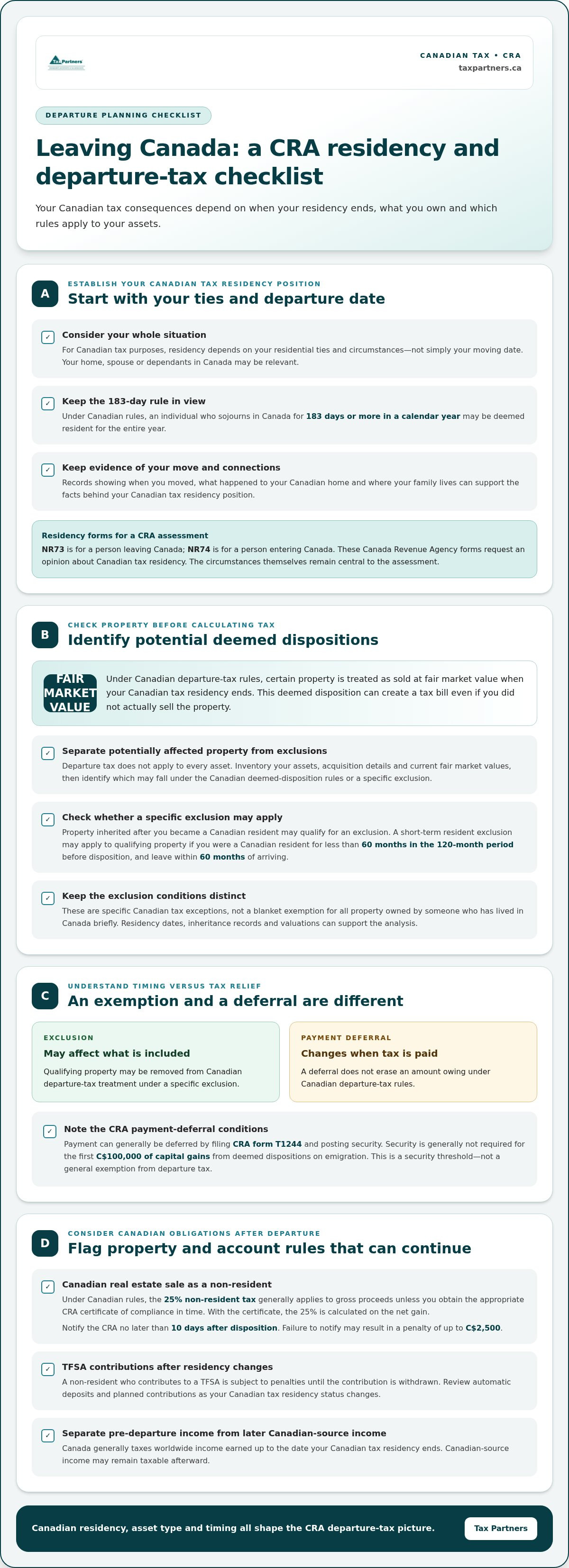
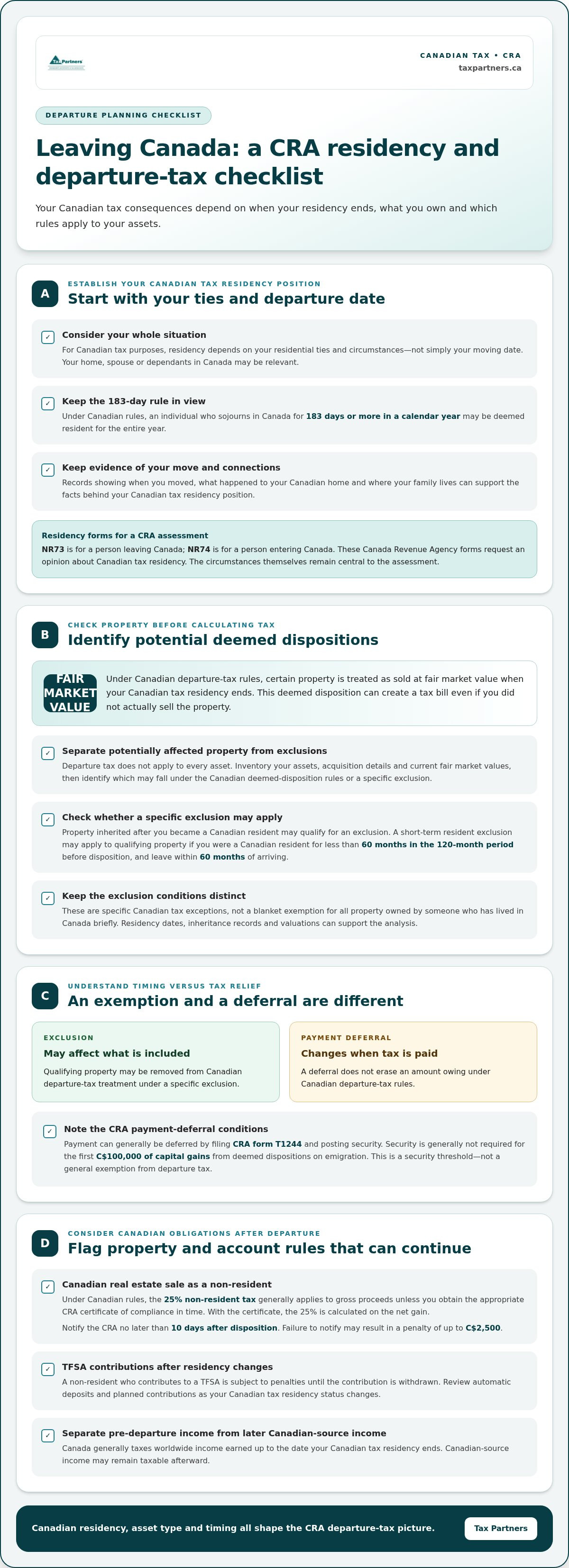
For Canadian tax purposes, your residency status depends on your residential ties and circumstances, not simply your moving date. The date you cease to be a Canadian resident affects how the Canada Revenue Agency treats your income and property.
Residential Ties and Residency Tie-Breakers
Residential ties are connections to Canada that help determine whether you remain a Canadian tax resident after moving. Your home, spouse or dependants in Canada may be relevant, along with your overall circumstances. Significant ties can affect when your Canadian tax residency ends and what you need to report.
For example, leaving Canada while keeping a home available and your immediate family here may indicate continuing residential ties. An individual who sojourns in Canada for 183 days or more in a calendar year may be deemed resident for the entire year. Review the facts together, including your home, family connections and steps taken to establish your life elsewhere.
Under Canadian rules, departure tax applies to certain property when your residency ends. The date your Canadian residency ceases and the type of property you own help determine its Canadian tax treatment. This section focuses on the Canadian tax consequences.
Residency Assessments and CRA Forms
NR73 and NR74 are Canada Revenue Agency forms used to request an opinion about Canadian tax residency. NR73 is for a person leaving Canada, while NR74 is for a person entering Canada. The forms help present your circumstances for a residency assessment, which can be useful when your departure date or remaining ties are unclear.
Describe your move and Canadian connections consistently, and keep supporting records. Documents showing when you moved, what happened to your Canadian home and where your family lives can help explain the facts behind your position. Forms don’t replace the circumstances themselves; your position is assessed based on the information provided.
A sale of Canadian real estate as a non-resident can bring separate Canadian reporting and payment duties. The 25% non-resident tax generally applies to gross proceeds unless you obtain the appropriate CRA certificate of compliance in time. With the certificate, the 25% is calculated on the net gain. Notify the CRA no later than 10 days after disposition; failure to notify may result in a penalty of up to C$2,500.
A non-resident who contributes to a TFSA is subject to penalties until the contribution is withdrawn. Review automatic deposits and planned contributions when your Canadian residency status changes. Withholding tax is deducted from a payment before you receive the balance. For a Canadian property sale, understanding the deduction helps you plan for the cash available at closing.
For a broader review of how your assets fit your financial plans, consider long-term financial planning.
Departure tax and deemed disposition of assets
When you leave Canada, certain property is treated as sold at fair market value under departure-tax rules, according to the Canada Revenue Agency. This deemed disposition can create a tax bill even when you haven’t actually sold the property.
Factual and Deemed Residency
Factual residency reflects your residential ties and circumstances, while deemed residency may apply under specific Canadian rules. The distinction matters because your residency status and departure date help determine whether departure-tax rules apply.
Before calculating possible tax, identify when you became a Canadian tax resident and when that status ends. The short-term resident exclusion may apply to property if you were a Canadian resident for less than 60 months in the 120-month period before disposition. An individual must leave within 60 months of arriving to qualify.
Departure tax applies to certain property, not every asset you own. The key question is whether an asset falls under the deemed-disposition rules or a specific exclusion. Inventory your assets, acquisition details and current fair market values, then flag items for closer review. This helps distinguish a deemed sale from an actual transaction and identify where a valuation could affect the reported gain.
Some property may be excluded. Property inherited after you became a Canadian resident may qualify for an exclusion. The short-term resident exclusion may also apply to qualifying property under the residency conditions described above. These are specific exceptions, not a blanket exemption for everything owned by someone who has lived in Canada briefly.
Exempt Assets and Payment Arrangements
An exemption removes qualifying property from departure-tax treatment, while a payment deferral changes when tax is paid. Keep these outcomes distinct: an exclusion may affect the calculation, but a deferral does not erase an amount owing.
You can generally defer payment by filing CRA form T1244 and posting security. Security is generally not required for the first C$100,000 of capital gains from deemed dispositions on emigration. This threshold concerns security, not a general exemption from departure tax.
For example, someone who became a Canadian tax resident on January 1, 2020, may qualify for the short-term resident exclusion by leaving before December 31, 2024, if the other conditions are met. Keep residency dates, inheritance records and valuation documents together. These details support the exclusion analysis and any deferral request.
If your departure involves several assets or a potential deferral, discussing your departure-tax position can help you organize the valuation, exclusion and payment questions before filing.
Departure-year income tax and filing deadlines
Your Canadian departure-year return covers worldwide income earned up to the date your Canadian tax residency ends. After that date, Canadian tax generally focuses on income connected to Canada rather than your worldwide income.
Separate the departure year into two periods: before and after your residency end date. For the first period, gather income records from Canadian and foreign sources. For the second, identify Canadian-source income, such as rent from Canadian real estate, and keep those records separate.
Leaving Canada doesn’t automatically end every Canadian filing obligation. A non-resident may still have Canadian-source income to report, and the type of income affects the applicable process. Canada Revenue Agency says its Section 216 return may apply to non-residents with Canadian-source income.
Canada’s Section 217 return may also apply to some non-residents with Canadian-source income. These return options relate to particular income and circumstances, so identify the income category before deciding which reporting route applies. Treating all Canadian income as one category can obscure relevant filing requirements.
Rental income needs a separate review. Gross rental income from Canadian real estate is subject to 25% Canadian non-resident withholding tax. “Gross” means the withholding calculation starts with rent received, before rental expenses are deducted.
If you convert a Canadian property to a rental, consider filing Form NR6 before rental income begins. This can allow withholding to be based on net rental income instead of gross income. The timing matters: the NR6 should be filed before the rental period starts, not after rent has already accumulated.
An elective Canadian return reporting net rental income must be filed by June 30 for the rental income reporting period. Keep rental statements, expense records and withholding details organized for that return. This separates the net-income calculation from the withholding applied to gross rent during the year.
For example, if you earn rent from Canadian property after leaving, track each payment and related expense. Gross withholding and an elective net-rental return are separate parts of the process. Filing the return may allow the rental income to be assessed on a net basis instead of leaving gross withholding as the final amount.
Create a departure-year file with your residency end date, income records for both periods and details of any Canadian property. Then classify post-departure income by source and type. This gives your return preparer a clearer basis for assessing Canadian reporting obligations and applicable withholding.
Departure-year tax returns and CRA forms
Your Canadian departure-year return reports income for the year your tax residency ends. For CRA filers, the return is due April 30 of the year after departure.
Organize your return around your residency end date. Separate income earned while resident from amounts connected to Canada afterward. This helps distinguish worldwide income for the resident period from Canadian reporting that may continue while you’re a non-resident.
Bring key dates and supporting records together in a departure-year file. Include your departure date, income documents, property information and details of outstanding repayment obligations. Clear records help connect each reported amount to the right period and filing requirement.
Form T1161 may also be required when the fair market value of your properties at emigration, subject to specified exceptions, exceeds C$25,000. Fair market value means the value of property at the time you leave, rather than its original purchase price. Review the property list and identify applicable exceptions before preparing the form.
For each asset in your inventory, gather records that help establish its value at emigration. Purchase documents, account statements and valuation records can support the reported figures. Keep them with your departure-year documents, even if an exception may apply.
Unrepaid Home Buyers’ Plan or Lifelong Learning Plan withdrawals require attention when you leave Canada. You must repay them within 60 days of departure or include the unpaid amount as income on your departure-year return. Identify any balance before moving, then record the repayment or income inclusion in your tax file.
These items serve different purposes. The departure-year return reports income for the relevant year, while T1161 reports property information when its threshold and conditions apply. A repayment under the Home Buyers’ Plan or Lifelong Learning Plan addresses a separate balance, not the property disclosure.
- Mark April 30 of the year after departure as the Canadian departure-return deadline.
- Compare the fair market value of emigration property with the C$25,000 T1161 threshold, while accounting for specified exceptions.
- Track Home Buyers’ Plan and Lifelong Learning Plan withdrawals, repayments and any amount included as income.
For example, someone leaving Canada with property valued above C$25,000 should review T1161 alongside the departure-year return. If that person also has an unrepaid plan withdrawal, the 60-day repayment window creates a separate task. Keeping both matters visible reduces the risk of overlooking a form or income entry.
Complete the return using records that match the departure year and residency end date. Keep copies of the filed return, T1161 if applicable, valuation documents and repayment records together. These documents help explain how the Canadian departure-year figures were assembled.
Canadian corporations and trusts owned or controlled by emigrants
Leaving Canada changes your personal tax position, but a corporation or trust you own or control needs separate analysis. Map each entity, your role, its assets and its income before deciding what to do after departure.
Start with a structure chart showing the Canadian corporation, its shareholders and directors, and any trusts connected to ownership. Record who makes decisions, receives income and holds voting or beneficial interests. This gives your departure review a practical picture of control, rather than treating the business as another personal asset.
A private corporation’s retained earnings, investments and operating assets are distinct from shares you own personally. List these categories separately, then note planned transactions, distributions or management changes around your move. Don’t assume your personal departure automatically determines how the corporation will be taxed or reported.
For a Canadian-resident corporation paying dividends to a non-resident shareholder, Canadian withholding tax ranges from 5% to 25%, depending on the applicable tax treaty. That makes the shareholder’s new residence and the type of payment relevant to distribution planning. Model a proposed dividend before approving it, rather than relying on the corporation’s previous payment pattern.
Canadian withholding tax on interest and royalties paid by a Canadian-resident corporation to a non-resident ranges from zero to 25%, depending on the applicable treaty. Classify each payment correctly in the corporation’s records. A payment labelled as interest, a royalty or a dividend can have a different Canadian withholding result.
Trusts need a separate inventory. Note the trust’s assets, trustees, beneficiaries and your role, then record expected distributions or changes after emigration. For example, if you leave Canada but remain involved in trust decisions, document that involvement separately from your personal asset ownership.
Review the following before departure:
- Draw the corporation and trust ownership chain, including your position in each structure.
- Separate corporate assets from shares personally held, and record expected transactions.
- Identify dividends, interest and royalties paid to you after becoming a non-resident.
- Document trust roles, beneficiaries and planned distributions in the departure file.
These steps help distinguish a corporation’s ongoing Canadian activity from your own residency change. They also bring treaty-dependent withholding questions into view before a distribution or restructuring. Keep the entity chart and supporting records with your departure-year tax documents.
For a review of your corporation or trust alongside your personal departure position, discuss your Canadian tax situation with a tax professional.
Tax Partners: Canadian Accounting & Tax Services
Tax Partners can bring your Canadian departure-year filings, asset reporting and corporate or trust considerations together in one tax-planning picture. Its Canadian Accounting & Tax Services support individuals and businesses assessing their Canadian reporting obligations before and after emigration.
If your move involves income or financial connections across borders, Tax Partners offers US & Cross-Border Accounting & Tax Services. Bookkeeping and Payroll Services can support your business records, while Wealth Management & Financial Planning can help align asset decisions with your broader financial plans.
Consider turning to Tax Partners when you need to coordinate personal departure reporting with a corporation or trust you own or control. You can contact Tax Partners to discuss your Canadian tax situation.
Make your next move with a clear plan
Thoughtful Canadian departure tax planning starts before your move is final. Use the time beforehand to align personal decisions with your company’s operations, ownership arrangements and financial records. This preparation can help you make deliberate choices and coordinate related tasks.
Tax Partners offers Canadian Accounting & Tax Services to help individuals and businesses address Canadian tax obligations as they prepare to emigrate. Its Bookkeeping and Payroll Services can also support the business records that inform decisions about ongoing operations and ownership.
When you’re ready to discuss how your move and business interests fit together, contact Tax Partners about departure tax. A considered plan can help you move forward with greater clarity.
Frequently Asked Questions
What happens to the private corporation you control when you leave Canada?
Review the corporation separately from your personal tax file before you leave. Prepare a current ownership chart, identify who will make business decisions, and note planned changes to management, payments or operations. Keep corporate bank, accounting and shareholder records separate from your personal records. This gives you a clearer basis for assessing the corporation’s ongoing Canadian obligations and documenting decisions made around your move.
What happens to my registered plans upon emigration?
The tax effects depend on your plans and the activity you undertake after becoming a Canadian non-resident. Before moving, list each plan and record its balance, planned contributions, withdrawals and beneficiary details. This helps distinguish account administration from tax consequences. For example, a planned withdrawal may need separate review from simply keeping an account invested, while a beneficiary’s residency can matter for certain education or disability savings plans.
What is Canadian departure tax and when does it apply?
Canadian departure tax can arise when you stop being a Canadian tax resident and specified property is treated as disposed of for tax purposes. The practical trigger is your change in Canadian residency, not necessarily a cash sale. Start by establishing the relevant residency end date, then review your assets individually. This helps identify which property needs a valuation and which reporting questions need attention.
Which assets are subject to deemed disposition when leaving Canada?
There isn’t one universal list that can be applied without reviewing the property and its history. Create an inventory separating personally held investments, business interests and other property, then gather acquisition records and departure-date valuations. For example, two assets with similar market values may need different analysis because their ownership or acquisition history differs. A clear inventory also helps explain how each item was treated in your Canadian reporting.
How is departure tax calculated, including capital gains and the lifetime capital gains exemption?
The calculation generally compares an asset’s value on the relevant deemed-disposition date with its tax cost to determine whether a gain arises. The lifetime capital gains exemption is not a blanket reduction for every asset; its relevance depends on the property and eligibility requirements. Keep records supporting both the valuation and tax cost, and distinguish gains from assets that may qualify for different treatment.
How do I report a departure from Canada on my final tax return and Form T1243?
Report the emigration information and applicable deemed-disposition amounts with your Canadian departure-year filing. Form T1243 is associated with reporting deemed dispositions, but the figures should agree with the asset records and valuations supporting your return. Keep a copy of the submitted form and related calculations with your tax documents. This creates a clear record if you later need to explain how you reported a particular asset.
What departure tax planning steps should I take before emigrating from Canada?
Before leaving, create a working file for your residency timeline, asset inventory, valuations, registered plans and business or trust interests. Record decisions as they happen, including changes to ownership, management or planned transactions. Use the file to coordinate your departure-year return and any continuing Canadian reporting. This helps you identify missing records early and keeps personal and business matters separate.

Article by
Mahad Mohamed
Mahad Mohamed is an accountant and the CEO of Tax Partners, with over 26+ years of Canadian and international tax and accounting experience. His expertise includes corporate reorganization, cross-border tax structuring (Canada & US), tax disputes, CRA audits, and tax planning for small owner-managed private corporations. Most recently, Mahad is a pioneer in Canadian crypto taxation and founded Block3 Finance.
Previously, Mahad worked for the Canada Revenue Agency (CRA), Big4 accounting firms, and served as a Rulings Officer for the Federal Tax Authority of the UAE before acquiring Tax Partners in 2014.
Tax Partners has 44 full-time accountants and over 18,400+ clients.
Disclaimer
This article provides general information only and is current as of its publication date. It has not been updated and may be out of date. It does not constitute legal advice and should not be relied upon as such. Every tax situation is unique and may differ from the examples discussed in this article. If you have specific questions, you should seek the advice of our accountants for your unique circumstances. Book a FREE Initial Consultation Today!
Frequently Asked Questions
What happens to the private corporation you control when you leave Canada?
Review the corporation separately from your personal tax file before you leave. Prepare a current ownership chart, identify who will make business decisions, and note planned changes to management, payments or operations. Keep corporate bank, accounting and shareholder records separate from your personal records. This gives you a clearer basis for assessing the corporation’s ongoing Canadian obligations and documenting decisions made around your move.
What happens to my registered plans upon emigration?
The tax effects depend on your plans and the activity you undertake after becoming a Canadian non-resident. Before moving, list each plan and record its balance, planned contributions, withdrawals and beneficiary details. This helps distinguish account administration from tax consequences. For example, a planned withdrawal may need separate review from simply keeping an account invested, while a beneficiary’s residency can matter for certain education or disability savings plans.
What is Canadian departure tax and when does it apply?
Canadian departure tax can arise when you stop being a Canadian tax resident and specified property is treated as disposed of for tax purposes. The practical trigger is your change in Canadian residency, not necessarily a cash sale. Start by establishing the relevant residency end date, then review your assets individually. This helps identify which property needs a valuation and which reporting questions need attention.
Which assets are subject to deemed disposition when leaving Canada?
There isn’t one universal list that can be applied without reviewing the property and its history. Create an inventory separating personally held investments, business interests and other property, then gather acquisition records and departure-date valuations. For example, two assets with similar market values may need different analysis because their ownership or acquisition history differs. A clear inventory also helps explain how each item was treated in your Canadian reporting.
How is departure tax calculated, including capital gains and the lifetime capital gains exemption?
The calculation generally compares an asset’s value on the relevant deemed-disposition date with its tax cost to determine whether a gain arises. The lifetime capital gains exemption is not a blanket reduction for every asset; its relevance depends on the property and eligibility requirements. Keep records supporting both the valuation and tax cost, and distinguish gains from assets that may qualify for different treatment.
How do I report a departure from Canada on my final tax return and Form T1243?
Report the emigration information and applicable deemed-disposition amounts with your Canadian departure-year filing. Form T1243 is associated with reporting deemed dispositions, but the figures should agree with the asset records and valuations supporting your return. Keep a copy of the submitted form and related calculations with your tax documents. This creates a clear record if you later need to explain how you reported a particular asset.
What departure tax planning steps should I take before emigrating from Canada?
Before leaving, create a working file for your residency timeline, asset inventory, valuations, registered plans and business or trust interests. Record decisions as they happen, including changes to ownership, management or planned transactions. Use the file to coordinate your departure-year return and any continuing Canadian reporting. This helps you identify missing records early and keeps personal and business matters separate.