Documents to Give Your Accountant: Your Canadian Tax Prep Checklist

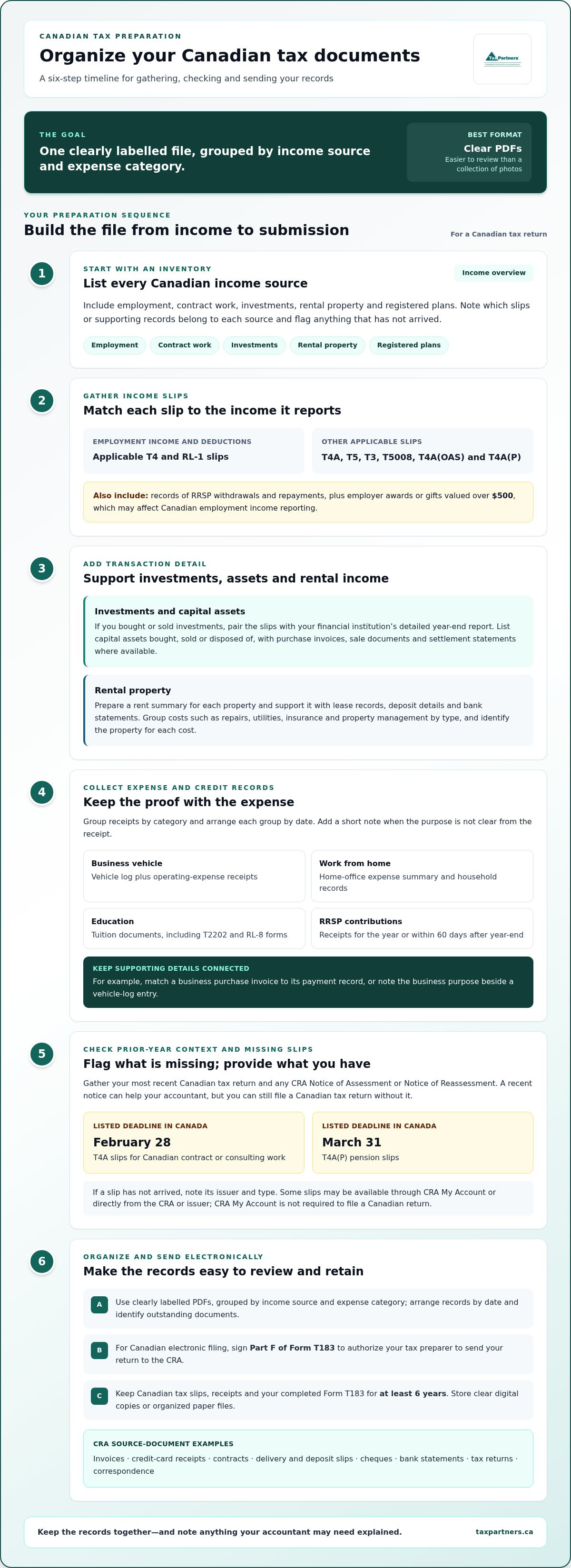
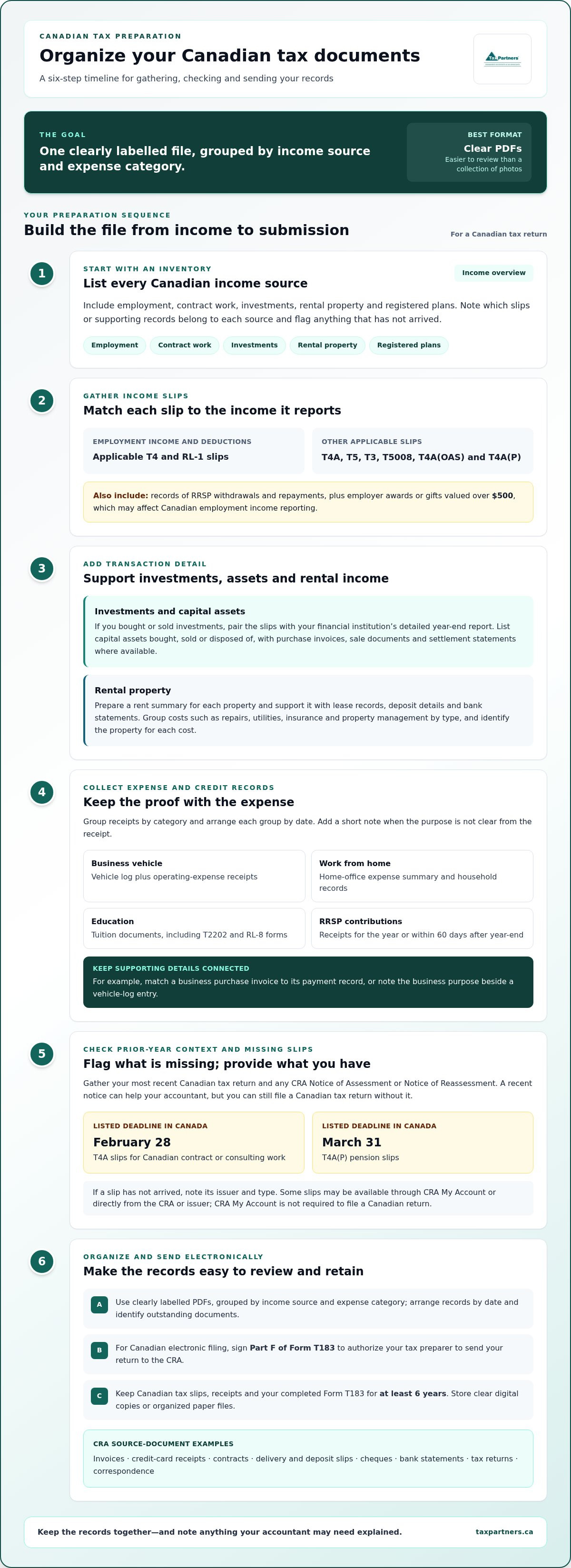
Paper isn’t the only way to prepare for tax time. In Canada, you can send the documents to give your accountant electronically. Clearly labelled PDFs are generally easier to review than a collection of photos. Gather your income slips, receipts, identification details, business records and prior-year tax information in one organized set.
A clear checklist can make it easier to get started, especially when personal and business records overlap or a tax slip hasn’t arrived yet. The right documents help your accountant understand your situation and prepare your return using the information you provide.
This guide explains what to collect for income and expenses, which records matter for business owners, what to include for identification and prior-year context, and how to organize and send everything electronically. Use it as a practical starting point for a more orderly tax-preparation process.
Key Takeaways
- For Canadian employment income, gather the slips that report your earnings and deductions.
- Pair investment tax slips with a detailed year-end report if you bought or sold investments during the year.
- For a Canadian business return, assemble financial statements alongside asset, liability, payroll and expense records.
- A recent CRA Notice of Assessment can help with your return, but you can still file without it.
- For electronic filing in Canada, sign Part F of Form T183 to authorize your tax preparer to send your return to the CRA.
Deductible expenses and tax credit receipts
For a Canadian tax return, collect receipts that support deductions and credits, not just slips showing income. A receipt helps identify what you paid, when you paid it and what the expense covered. Group documents by category, then arrange each group by date so your accountant can match records to the relevant tax year.
Use this checklist to gather supporting records:
- Keep receipts for expenses you want reviewed as possible deductions or credits, and add a short note when the purpose isn’t clear from the receipt.
- Include a vehicle log if you used a personal vehicle for business, because it helps show business use alongside operating-expense receipts.
- Prepare a home-office expense summary if you worked from home, with the related household expense records for review.
- Gather tuition documents, including T2202 and RL-8 forms, which may be relevant to education amounts on a Canadian tax return.
- Include RRSP contribution receipts for contributions made during the year or within 60 days after year-end.
Keep supporting details with each receipt. For example, match a business purchase invoice to its payment record, or note the business purpose beside a vehicle-log entry. The Canada Revenue Agency lists invoices, credit-card receipts, contracts, delivery and deposit slips, cheques, bank statements, tax returns and correspondence as source documents. These records help explain the transactions behind reported income and expenses.
If a Canadian tax slip or receipt is missing when you meet your accountant, some slips may be available through CRA My Account or directly from the CRA or issuer. A CRA My Account isn’t required to file a Canadian return, so note what’s missing and provide the records you do have.
Timing can vary by slip type. For Canadian contract or consulting work, the listed deadline for receiving T4A slips is February 28; the listed deadline for T4A(P) pension slips is March 31. If a slip hasn’t arrived, include its issuer and type on your missing-records list.
Keep Canadian tax slips, receipts and your completed Form T183 for at least 6 years. Store clear digital copies or organized paper files, and retain the details that connect each receipt to its expense or credit. A tax preparation checklist can help you sort the records into labelled categories before you send them.
Gathering income and expense information
Start with a complete inventory of income for the Canadian tax year. Include employment, contract work, investments, rental property and registered plans.
Separate slips from supporting records, then compare each income source with your bank statements. The documents to give your accountant should make each source easy to identify and show which records are still outstanding.
For employment and other personal income, gather the slips that apply:
- Collect applicable T4 and RL-1 slips for Canadian employment income and deductions.
- Include T4A, T5, T3, T5008, T4A(OAS) and T4A(P) slips when they apply to your income.
- Keep records of employer awards or gifts valued over $500, since these may affect how Canadian employment income is reported.
- Gather records of RRSP withdrawals and repayments, along with contribution receipts for the relevant tax year.
Investment income needs supporting detail, not only annual slips. Investment slips can help document income, alongside other supporting records.
If you bought or sold investments, include your financial institution’s detailed year-end report. It can help explain transaction dates, proceeds and purchase information behind a T5008 slip.
For capital assets, list anything bought, sold or disposed of during the year. Add purchase invoices, sale documents and settlement statements where available.
These records let your accountant review transaction history alongside investment slips. If your broker can provide investment information directly, authorize that transfer and note which accounts it covers.
Rental property records should connect rent collected with costs paid. Prepare a rent summary for each property, supported by lease records, deposit details and bank statements.
Sort expense records by type, such as repairs, utilities, insurance or property management, and identify the property each cost relates to. Keep property purchase or sale documents with that year’s records.
Label each income category and match it with supporting records. The Canada Revenue Agency identifies invoices, contracts, bank statements, cheques and correspondence as examples of source documents.
Keep the documents to give your accountant together by income source, and note any unusual transaction that needs explanation. For several income streams or investment transactions, you can discuss your Canadian tax preparation needs as you organize your records.
Before handing over the file, check that the income records cover the slips relevant to the return: T4s, T4As, T5s, T3s, T5008s, T4A(OAS), and T4A(P). Include records of RRSP withdrawals and repayments as well, so those transactions are part of the material your accountant reviews.
For investment activity, pair tax slips with the financial institution’s detailed year-end report if there were purchases or sales. Also provide details of capital assets bought, sold or disposed of. Grouping these items with related income records gives your accountant a clearer picture for preparing the return and reviewing transactions.
Prior-year returns and CRA Notices of Assessment
Gather your most recent Canadian tax return and any CRA Notice of Assessment or Notice of Reassessment. These records help your accountant compare what you filed with the CRA’s latest review and understand changes from one tax year to the next. A recent notice is helpful, but you can still file a Canadian tax return without it.
Keep each notice with its matching return, rather than mixing it with current-year slips. If the CRA reassessed a prior return, include that notice too. Its figures may differ from the original assessment, so label each document by tax year and mark which notice is the latest.
Use the previous return as a reference, not a substitute for current-year records. It can help you spot changes in income sources, family details or other information before your accountant prepares the new return. Note anything that changed, such as a new employer or a move, and provide the relevant current-year documents separately.
- Provide the latest filed Canadian tax return, including schedules and supporting statements you retained.
- Include each CRA Notice of Assessment or Reassessment for the years being reviewed.
- Flag any difference between a return and its notice, such as a changed amount or reassessed item.
- For a first Canadian return, gather immigration documents showing your date of arrival.
- Prepare details of foreign income earned before and after arriving in Canada, organized by period and source.
A first Canadian tax return needs context that may not appear on Canadian slips. Immigration records establish your arrival date, while a foreign-income summary helps show when income was earned in relation to that date. Keep available statements or other records with the summary so the amounts and dates can be reviewed together.
Before approving an electronically filed Canadian return, review the completed Form T183 carefully. The information on Form T183 must match the electronic tax return. Check names, addresses and reported figures against the return before signing; a mismatch can create an avoidable correction step.
For an electronic submission by a Canadian tax preparer, sign Part F of Form T183 to authorize the preparer to send the return to the CRA. Keep a copy of the signed form with the matching return and tax-year records. If you’ve filed in Canada before, provide the prior return and notice as a pair; if it’s your first filing, organize arrival and foreign-income records together.
Identification and business registration details
For Canadian filing, give your accountant your Social Insurance Number (SIN) and business registration details. Keep the information with the correct tax year, and identify whether the return covers you personally, your business or both. This context helps distinguish personal records from business activity.
Self-employed Canadians should provide their SIN, business registration details and records identifying business income and expenses. Add vehicle-use records if a personal vehicle served the business, plus payroll or GST/HST records if they apply to your operations.
For Canadian small-business year-end taxes, gather business registration details, payroll information and organized records of business expenses, vehicles, assets, loans and grants. Include GST/HST filings or account records that help explain the business’s activity for the tax year.
Use separate labelled folders for personal and business records. A practical checklist can include:
- Identity: provide your SIN and confirm the name and address used for Canadian tax filing.
- Registration: include business registration documents and note the business name used on invoices or contracts.
- Payroll: group payroll summaries and related records by tax year, so employee payments can be reviewed together.
- GST/HST: set aside relevant returns, account statements, and records that explain collected or paid amounts.
- Vehicle use: include the business-use log and related expense records when a personal vehicle was used for work.
- Medical and personal records: keep personal medical receipts separate from business expenses, so they aren’t mixed during filing.
For loans, provide the agreement and statements that show principal and interest separately. Canadian businesses can’t deduct loan principal from taxable income, but interest paid on business loans is deductible. Clear separation helps your accountant identify the relevant expense without treating the full payment as deductible.
Report business grants with the award letter and payment record. In Canada, a grant may be taxable or non-taxable, so your accountant needs the details to determine its treatment. Keep the grant’s purpose, date received and any conditions in the same folder.
Before sending your records, label files with the business name, tax year and record type. For example, name a payroll summary “Payroll, [business name], [tax year]” and keep GST/HST records in their own folder. This structure makes identification, filing and follow-up easier.
Business financial statements and expense records
For a Canadian business return, provide financial statements that show the year’s overall position and activity. For business owners working with services like McConnell Bookkeeping to maintain monthly reconciliations, these records can be compiled directly from your year-end reporting package. Include a balance sheet, income statement and cash flow statement, plus a summary of business assets and liabilities. Together, these records help explain how income, expenses and balances fit your business situation.
Use a checklist to connect each total to its supporting records:
- Provide the income statement and sales records. Sales invoices, contracts and deposit records help explain reported revenue.
- Include categorized business-expense records. Match invoices and receipts to bank or credit-card statements so each expense can be traced.
- Prepare a balance sheet with asset and liability details. List business property, equipment and outstanding amounts alongside the statement.
- Add a cash flow statement. It shows cash moving into and out of the business during the reporting period.
- Document capital asset purchases and disposals. Include invoices and sale records for equipment, vehicles or real estate held by the business.
Keep source records together by category and date. The Canada Revenue Agency identifies sales and purchase invoices, cash-register and credit-card receipts, contracts, delivery and deposit slips, cheques, bank statements, tax returns and correspondence as examples of source documents. A clear record trail lets your accountant compare statement totals with the underlying transactions.
For a home office, prepare an expense summary and show the business-use area compared with the home’s total area. Keep records for the household costs included in that summary. This helps your accountant see how the workspace calculation relates to the expenses under review.
Separate vehicle expenses from other operating costs. Match the vehicle log with fuel, repair and insurance records, and identify which vehicle each document concerns. For a business vehicle purchase or disposal, include the transaction documents with the asset records.
Capital Cost Allowance (CCA) is the tax method Canadian businesses use to claim depreciation on eligible capital assets. Provide purchase dates, invoices and disposal details, so the asset history can be reviewed for the return. The Canada Revenue Agency recommends keeping business and tax records for six years.
Use consistent file names, such as “Equipment purchase” or “Real estate expenses,” followed by the business name and tax year. If you want to connect business records with longer-term financial goals, discuss your financial planning needs.
Tax Partners: Canadian Accounting & Tax Services
Tax Partners provides Canadian Accounting & Tax Services to individuals and businesses whose tax preparation involves personal income, business activity or both. If your records include payroll and recurring transactions, Bookkeeping and Payroll Services can help keep financial information organized for filing.
Consider professional support when business and personal records overlap, income comes from several sources, or year-end statements need a clearer review. Organizing your records before filing gives your accountant useful context and helps focus attention on details that need discussion.
If you’re ready to discuss your Canadian tax preparation needs, contact Tax Partners.
Make your records work for what comes next
Tax preparation can also be a useful moment to look beyond filing. Clear records can help you and your accountant identify questions, organize ongoing bookkeeping and plan for upcoming business or personal financial decisions. The documents to give your accountant can support a more informed conversation, not just this year’s return.
Tax Partners provides Canadian Accounting & Tax Services and US & Cross-Border Accounting & Tax Services for people with Canadian or cross-border tax matters. Its Bookkeeping and Payroll Services can support businesses looking to maintain consistent records throughout the year. Choose the support that fits your situation and the questions you want to resolve.
When you’re ready to discuss your next step, contact Tax Partners about your accounting and tax needs. A clear conversation can help you move forward with greater confidence and a more organized approach.
Frequently Asked Questions
Can I send my documents electronically instead of bringing paper copies?
Yes, you can send Canadian tax records electronically, and PDFs are easier to reference than photographs. Scan each document clearly, include every page and use a file name that identifies its contents, such as “investment statement” or “tuition receipt.” Keep paper originals filed by tax year while sharing digital copies. A short note can identify any missing item or explain an unusual transaction.
What documents should Canadians give their accountant for a personal tax return?
For a Canadian personal return, provide records covering your identity, income, expenses, investments and prior filing history. Include the slips relevant to your situation, such as employment or investment income documents, and supporting records for amounts you want reviewed. If you moved to Canada during the tax year, include your arrival-date information and a summary of foreign income earned around that period. A note describing changes since your previous return can add useful context.
What tax slips and receipts do I need to provide my accountant in Canada?
Provide the Canadian tax slips that match your income sources, such as employment, pension, contract, investment or education slips. Add receipts and statements that explain transactions not fully described by a slip. For example, if an investment statement lists sales, include the related purchase details where available. If a document is missing, note its issuer and type so your accountant can distinguish an outstanding slip from income that had no slip.
What deductions and credits require supporting documents in Canada?
For a Canadian return, provide records for each expense or amount you want your accountant to assess for a deduction or credit. Where available, the documents should show the date, amount, payee and purpose. For instance, match a business expense receipt to the transaction on your bank statement, or keep tuition paperwork with the related education records. That context helps your accountant review whether the amount belongs on your return.
Should I give my accountant original documents or copies, and how should I organize them?
Readable copies are suitable for electronic review; keep paper originals with your own tax-year records. Organize files into labelled categories, then place documents in date order within each category. Use clear names to distinguish similar records, such as separate files for each investment account or rental property. Before sending, check that scans include all pages and aren’t blurred or cut off. Add a brief contents list if your package includes many files.
What documents does an accountant need for a first-time client or a new business?
A first-time Canadian tax client should provide identity details, their most recent tax return and any CRA assessment they have. For a first Canadian return, include immigration records showing the arrival date and information about foreign income earned before or after arrival. A new business should add its registration details, financial statements, payroll information, business bank records and asset purchase or disposal documents. Label business records with the correct legal or operating name.

Article by
Mahad Mohamed
Mahad Mohamed is an accountant and the CEO of Tax Partners, with over 26+ years of Canadian and international tax and accounting experience. His expertise includes corporate reorganization, cross-border tax structuring (Canada & US), tax disputes, CRA audits, and tax planning for small owner-managed private corporations. Most recently, Mahad is a pioneer in Canadian crypto taxation and founded Block3 Finance.
Previously, Mahad worked for the Canada Revenue Agency (CRA), Big4 accounting firms, and served as a Rulings Officer for the Federal Tax Authority of the UAE before acquiring Tax Partners in 2014.
Tax Partners has 44 full-time accountants and over 18,400+ clients.
Disclaimer
This article provides general information only and is current as of its publication date. It has not been updated and may be out of date. It does not constitute legal advice and should not be relied upon as such. Every tax situation is unique and may differ from the examples discussed in this article. If you have specific questions, you should seek the advice of our accountants for your unique circumstances. Book a FREE Initial Consultation Today!
Frequently Asked Questions
Can I send my documents electronically instead of bringing paper copies?
Yes, you can send Canadian tax records electronically, and PDFs are easier to reference than photographs. Scan each document clearly, include every page and use a file name that identifies its contents, such as “investment statement” or “tuition receipt.” Keep paper originals filed by tax year while sharing digital copies. A short note can identify any missing item or explain an unusual transaction.
What documents should Canadians give their accountant for a personal tax return?
For a Canadian personal return, provide records covering your identity, income, expenses, investments and prior filing history. Include the slips relevant to your situation, such as employment or investment income documents, and supporting records for amounts you want reviewed. If you moved to Canada during the tax year, include your arrival-date information and a summary of foreign income earned around that period. A note describing changes since your previous return can add useful context.
What tax slips and receipts do I need to provide my accountant in Canada?
Provide the Canadian tax slips that match your income sources, such as employment, pension, contract, investment or education slips. Add receipts and statements that explain transactions not fully described by a slip. For example, if an investment statement lists sales, include the related purchase details where available. If a document is missing, note its issuer and type so your accountant can distinguish an outstanding slip from income that had no slip.
What deductions and credits require supporting documents in Canada?
For a Canadian return, provide records for each expense or amount you want your accountant to assess for a deduction or credit. Where available, the documents should show the date, amount, payee and purpose. For instance, match a business expense receipt to the transaction on your bank statement, or keep tuition paperwork with the related education records. That context helps your accountant review whether the amount belongs on your return.
Should I give my accountant original documents or copies, and how should I organize them?
Readable copies are suitable for electronic review; keep paper originals with your own tax-year records. Organize files into labelled categories, then place documents in date order within each category. Use clear names to distinguish similar records, such as separate files for each investment account or rental property. Before sending, check that scans include all pages and aren’t blurred or cut off. Add a brief contents list if your package includes many files.
What documents does an accountant need for a first-time client or a new business?
A first-time Canadian tax client should provide identity details, their most recent tax return and any CRA assessment they have. For a first Canadian return, include immigration records showing the arrival date and information about foreign income earned before or after arrival. A new business should add its registration details, financial statements, payroll information, business bank records and asset purchase or disposal documents. Label business records with the correct legal or operating name.